Tommy Trinder
Thomas Edward Trinder CBE (24 March 1909 – 10 July 1989), known as Tommy Trinder, was an English stage, screen and radio comedian whose catchphrase was "You lucky people!". Having found recognition with his music hall revues in the late 1930s, Trinder was one of the United Kingdom's foremost entertainers during the Second World War. He starred in several Ealing Studios films including Sailors Three (1940), Champagne Charlie (1944) and Bitter Springs (1950). Trinder became a television star during the 1950s, notably as the original host for Sunday Night at the London Palladium (1955-1958). He was chairman of Fulham Football Club between 1959 and 1976. Trinder continued to perform into the 1980s.
Tommy Trinder | |
|---|---|
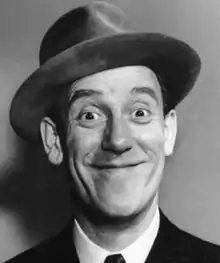 Trinder in 1956 | |
| Born | Thomas Edward Trinder 24 March 1909 Streatham, London, England |
| Died | 10 July 1989 (aged 80) Chertsey, Surrey, England |
| Occupation | Comedian |
Biography
Early years: 1904–1937
Tommy Trinder was born at 54 Wellfield Road, Streatham, South London, on 24 March 1909, the son of Thomas Henry Trinder, a London tram driver from Shilton, Oxfordshire, and his wife Jennie Georgina Harriet née Mills. After Thomas Trinder was transferred to Hammersmith, the family moved to Fulham.
Trinder left school early for a job as an errand boy. He made his first stage appearance at the age of twelve in a talent competition at Collins Music Hall. Trinder's singing act won the contest and when collecting his award, he was approached by Will Murray who recruited him for his Casey's Court juvenile comedy show. Trinder made his first appearance with the company on 5 June 1921 in Oldham.[1] The company, which also featured Jimmy Wheeler at the time, toured music halls including Sunderland Empire Theatre.[2]
After a few years with Casey's Court, Trinder then joined a dancing act called Phil Rees' Stable Lads. At the age of 14, he performed with them at Folies Bergère, Paris.[2] By 1926, the 17-year-old Trinder was the star of Archie Pitt's travelling variety comedy shows, often appearing at the Queen's Theatre, Poplar, London.[2] Trinder also performed in concert parties and working men's clubs.[3]
Stardom: 1937–1945
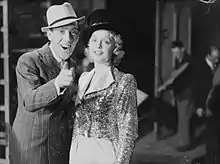
Trinder began to achieve national recognition in 1937 with the revues Tune In and In Town Tonight. He promoted himself with posters bearing the slogan "If it's laughter you're after, Trinder's the name"[4] and would often begin his act with "The name's Trinder. That's T-R-I-N-D-E-R, pronounced Chumley", a dig at the upper classes."[5] In December 1938, he was spotlighted in an end-of-year review in The Era, who said "Tommy Trinder has established himself firmly in his own special niche, as we knew he would. But it is not a niche easy of attainment. To abolish deliberately the proscenium, to get down among the audience, treat individual members of it with easy familiarity, pinch their cigarettes and chocolates and to be loved for doing it... well, I have seen other artists try something like it, and their reward has been the frozen face and the indignant murmur. Tommy Trinder is a truly great artist".[6] In July 1939, Trinder starred alongside Arthur Askey in Jack Hylton's stage version of the BBC's radio comedy series Band Waggon at the London Palladium.[7]
By the time of the Second World War, Trinder was one of Britain's foremost entertainers and his shows brought welcome relief during the darkest days of the war. He had been signed up to Michael Balcon's Ealing Studios in 1938 when it became clear that George Formby was about to be wooed away.[8] Trinder's most successful film was the comedy Sailors Three (1940) in which he, Claude Hulbert and Michael Wilding capture a German pocket battleship. He also took straight acting parts in The Foreman Went to France, The Bells Go Down (a tribute to the work done by firemen in London during the Blitz); and Bitter Springs about a family fighting to make a new life in the Australian Outback. During the war, Trinder worked for ENSA (Entertainments National Service Association) and would joke it stood for Every Night Something Atrocious.[1]
Television: 1950-1970
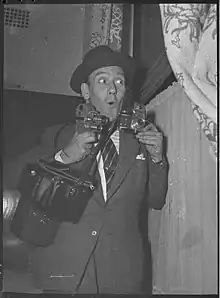
After the war, Trinder was recruited to television. From 1955 to 1958, he was the original compere for ITV television programme Sunday Night at the London Palladium.[4] He hosted his own television series, Trinder Box on the BBC in 1959. Despite his television success he never fully warmed to the medium, believing that the amount of daily rehearsal sapped performances of their spontaneity.[3] He was the subject of This Is Your Life in May 1959 when he was surprised by Eamonn Andrews. In 1979 he appeared in an edition of The Old Boy Network, doing his stand-up routine and presenting a condensed history of his life and career.
Trinder was a lifelong devoted supporter of Fulham Football Club and was chairman of the club between 1959 and 1976. Always a favourite with the Royal family (he made six appearances in Royal Variety Performances between 1945 and 1980), he was appointed a CBE in 1975. He was a proud and active member of the exclusive entertainment fraternity, the Grand Order of Water Rats, serving two non-consecutive terms as its "King Rat" in 1963 and 1965, respectively. He was also President of the Lord's Taverners cricketing charity in 1956.
He lived in an Art Deco-style apartment block – Du Cane Court, in Balham, south-west London – the largest such under one roof in Europe in the 1930s. He moved in with Violet Trinder (née Bailey; they had married in 1932) in 1939, and was still there in 1955. A neighbour described an impromptu encounter she had with him in which her silk scarf had covered her features. He said: "One should never hide a pretty face."[5] His second marriage was to Gwyn (Toni) Lancelyn Green. He moved to a large private estate, Burwood Park in Hersham, Surrey, calling the house "Tiverly". He is buried in Burvale Cemetery, which is close by to where he lived.
Final years and death
In January 1986, Trinder collapsed on stage in Burton-on-Trent.[9] Having suffered a stroke, he used a wheelchair for the remainder of his life. He continued to work, appearing on television in the game show The Parlour Game.[10] He made his final television appearance in February 1989, recalling his contemporary Max Miller in the BBC 40 Minutes documentary I Like The Girls Who Do.[3] An exhibition of photographs and ephemera was held at Streatham Library in March 1989 to mark Trinder's 80th birthday.[11] He made a final appearance at the London Palladium in 1989.[12] He died at St Peter's Hospital, Chertsey on 10 July 1989. Among the tributes, Ernie Wise described Trinder as "one of the best ad lib comedians we have ever produced - he was in the same class as Max Miller".[13]
Legacy
A biography by Patrick Newley, You Lucky People! – The Tommy Trinder Story, was published by Third Age Press in 2008.[14]
Trinder was placed 83rd in Channel 4's The 100 Greatest Stand-Ups in 2007.[15] In 2010, comedian Ross Noble campaigned for people to vote for Trinder in an online poll for an updated version of the list. The campaign received support from fellow comics Tim Minchin, Alan Davies, Jason Manford and Viz co-founder Simon Donald.[16] Trinder ultimately placed 44th in the 2010 list.[17]
He is believed to have originated "Trinder's Impossibility" – a "bar bet" where the mark is presented with a ten shilling note, partly torn through in two places at right angles to the long side and challenged to hold the two corners of the torn edge and tear it into three pieces. It cannot be done.
Filmography
- 1938 – Save a Little Sunshine
- 1938 – Almost a Honeymoon
- 1939 – She Couldn't Say No
- 1940 – Sailors Three (US: Three Cockeyed Sailors)
- 1940 – Laugh It Off
- 1942 – The Foreman Went to France
- 1943 – The Bells Go Down
- 1944 – Fiddlers Three
- 1944 – Champagne Charlie
- 1950 – Bitter Springs
- 1955 – You Lucky People
- 1959 – Make Mine a Million
- 1963 – The Damned (US: These are the Damned)
- 1964 – The Beauty Jungle (US: Contest Girl)
- 1969 – Under the Table You Must Go (documentary)
- 1974 – Barry McKenzie Holds His Own
References
- "A Chance to Meet... Tommy Trinder". Youtube. ITV. Retrieved 2 October 2021.
- Mellor, Geoff (19 August 2021). "Trinder's the Name". The Stage: 6. Retrieved 1 October 2021.
- Oliver, John. "Tommy Trinder (1909-1989)". BFI Screenonline. Retrieved 2 October 2021.
- "Tommy Trinder". The Stage: 25. 27 July 1989. Retrieved 1 October 2021.
- Vincent, Gregory K. (2008). A history of Du Cane Court: land, architecture, people and politics. Woodbine. ISBN 0-9541675-1-1.
- Beswick Goodgame, L. (30 December 1938). "Thanks for the memory". The Era: 13. Retrieved 3 October 2021.
- "Who's Where in Variety". The Era: 9. 13 July 1939. Retrieved 3 October 2021.
- Sweet, Matthew. "You lucky people: remembering Tommy Trinder". The Guardian. Retrieved 1 October 2021.
- Kirkland, Olive (6 January 1986). "Time for a break". The Mirror: 18. Retrieved 1 October 2021.
- "The Parlour Game". Aberdeen Press and Journal (4). 13 July 1988. Retrieved 1 October 2021.
- "Trip along with Trinder". The Stage: 3. 16 March 1989. Retrieved 1 October 2021.
- Lee, Patrick. "Patrick Newley". The Guardian. Retrieved 1 October 2021.
- "Death of Comic Veteran". Sandwell Evening Mail: 19. 11 July 1988. Retrieved 1 October 2021.
- "You Lucky People! The Tommy Trinder Story". Third Age Press. Retrieved 1 October 2021.
- "The 100 Greatest Stand-Ups". Comedy. Retrieved 1 October 2021.
- Taylor, Jerome. "Web campaign plans to put Forties comedian back on top". Independent. Retrieved 1 October 2021.
- "The 100 Greatest Stand-Ups". Comedy. Retrieved 1 October 2021.
2. Lew Grade Biography (1906–1998) – Jump Up. Film Reference. Retrieved 12 August 2017.
External links
 |
Wikimedia Commons has media related to Tommy Trinder. |
- Tommy Trinder at IMDb
- Biography at biography.com
- Britmovie biography
- The Tommy Trinder Story autobiographical pamphlet
Authority control  | |
|---|---|
| General | |
| National libraries | |
| Other | |