Tongoni Ruins
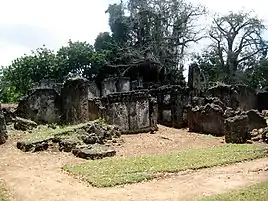
The Tongoni Ruins are 15th century Swahili ruins of a mosque and forty tombs located in Tongoni ward in Tanga District inside Tanga Region of Tanzania. The area was a different place four to five centuries ago. Contrary to its almost unnoticed presence today, it was a prosperous and a respected Swahili trading centre during the 15th century.
History
Tongoni was established around the 11th century by Swahili residents as part of the Swahili city states dotted along the East African coast.[1][2]
Vasco da Gama, the Portuguese sailor, first visited Tongoni in April 1498. He had the opportunity to eat the local oranges, which he said were better than those available in Portugal. He made a second visit the following year, and spent fifteen days in Tongoni.[3]
The ruins at Tongoni are under the Tanzanian Antiquities department. The ruins are open to the public but there have been no Phase III excavations. Decades ago, a small test excavation was conducted at the site and a site plan was drawn. In 2006, an American archaeologist conducted additional test excavations and mapped the site using modern methods of site survey. A resident guide, Mr. Job Tengamaso is available to show visitors around. A more recent ruin of a mosque (of about one hundred years) at the other end of the village, on the beach, can also be visited.
References
- Urithi Newsletter, Vol 1 No 1, Sep. 2000
- Lane, Paul J. “Maritime and Shipwreck Archaeology in the Western Indian Ocean and Southern Red Sea: An Overview of Past and Current Research.” Journal of Maritime Archaeology, vol. 7, no. 1, Springer, 2012, pp. 9–41, http://www.jstor.org/stable/43551368.
- Askew, Kelly M. “Female Circles and Male Lines: Gender Dynamics along the Swahili Coast.” Africa Today, vol. 46, no. 3/4, Indiana University Press, 1999, pp. 67–102, http://www.jstor.org/stable/4187285.
- Lane, Paul J. “Maritime and Shipwreck Archaeology in the Western Indian Ocean and Southern Red Sea: An Overview of Past and Current Research.” Journal of Maritime Archaeology, vol. 7, no. 1, Springer, 2012, pp. 9–41, http://www.jstor.org/stable/43551368.