TPPTS
3,3′,3′′-Phosphanetriyltris(benzenesulfonic acid) trisodium salt (abbreviated TPPTS when isolated and tppts as a ligand), is an organic compound that is also known as sodium triphenylphosphine trisulfonate. The compound has the formula P(C6H4SO3Na)3. This white solid is an unusual example of a water-soluble phosphine. Its complexes are also water-soluble.[2] Its complex with rhodium is used in the industrial production of butyraldehyde.[3]
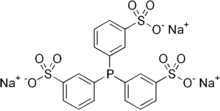 | |
| Names | |
|---|---|
| Preferred IUPAC name
Trisodium 3,3′,3′′-phosphanetriyltri(benzene-1-sulfonate) | |
Other names
| |
| Identifiers | |
| |
3D model (JSmol) |
|
| ChemSpider | |
| ECHA InfoCard | 100.058.706  |
PubChem CID |
|
CompTox Dashboard (EPA) |
|
| |
| |
| Properties | |
| C18H12Na3O9PS3 | |
| Molar mass | 568.41 g·mol−1 |
| Appearance | White microcrystalline solid |
| Soluble | |
| Hazards | |
| GHS labelling:[1] | |
 | |
| Warning | |
| H315, H319, H335 | |
| P280, P302+P352, P304+P340, P305+P351+P338, P312, P332+P313, P337+P313 | |
Except where otherwise noted, data are given for materials in their standard state (at 25 °C [77 °F], 100 kPa). | |
 verify (what is verify (what is  ?) ?) | |
| Infobox references | |
Synthesis
Tppts is synthesized by sulfonation of triphenylphosphine. The sulfonation occurs at one meta-position of each of the three phenyl rings. The sulfonation agent is oleum, a solution of sulfur trioxide in sulfuric acid. The resulting trisulfonic acid is then treated with triisooctylamine and sodium hydroxide. Immediately upon dissolving in the reaction medium, the phosphine is protonated. It is the phosphonium salt that undergoes the sulfonation:
- HP(C6H5)3+ + 3 SO3 → [HP(C6H4SO3H)3]+
- [HP(C6H4SO3H)3]+ + 4 N(C8H17)3 → [HN(C8H17)3]3[P(C6H4SO3)3] + [HN(C8H17)3]+
- [HN(C8H17)3]3[P(C6H4SO3)3] + 3 NaOH → P(C6H4SO3Na)3 + 3 N(C8H17)3 + 3 H2O
As a Lewis base, tppts is stronger than triphenylphosphine.
Uses in hydroformylation
Complexes of tppts are very soluble in water, which is the basis of its industrial application. Tppts-based rhodium catalysts were introduced in 1984 for a two-phase hydroformylation of propene by Ruhrchemie. Hydroformylation, also known as oxo synthesis, is the reaction of an alkene with carbon monoxide and hydrogen. Traditionally, hydroformylation is catalyzed by rhodium and cobalt complexes in nonaqueous solution.[4]
References
- GHS: Alfa Aesar 039538 (18 Feb 2021)
- Papadogianakis, G.; Maat, L.; Sheldon, R. A. (1998). "Tris[tris(Sodium m-Sulfonatophenyl)Phosphino]Palladium(0) Enneahydrate". Inorganic Syntheses. 32: 25–29. doi:10.1002/9780470132630.ch3.
- Herrmann, W.A.; Kohlpaintner, C.W. (1998). "Synthesis of Water-Soluble Phosphines and Their Transition Metal Complexes". Inorganic Syntheses. 32: 8–25. doi:10.1002/9780470132630.ch2. ISBN 0-471-24921-1.
- Boy Cornils, Richard W. Fischer, Christian Kohlpaintner "Butanals" in Ullmann's Encyclopedia of Industrial Chemistry, 2000, Wiley-VCH, Weinheim. doi:10.1002/14356007.a04_447