Trading post
A trading post, trading station, or trading house, also known as a factory, was an establishment or settlement where goods and services could be traded.
_1900.jpg.webp)
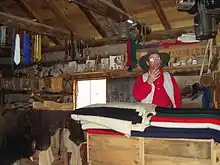
Typically the location of the trading post would allow people from one geographic area to trade in goods produced in another area. In some examples, local inhabitants could use a trading post to exchange local products for goods they wished to acquire.[1]
Examples
Major towns in the Hanseatic League were known as kontors, a form of trading posts.[2]
Charax Spasinu was a trading post between the Roman and Parthian Empires.[3]
Manhattan and Singapore were both established as trading posts, by Dutchman Peter Minuit and Englishman Stamford Raffles respectively, and later developed into major settlements.[4][5]
Other uses
- In the context of scouting, trading post usually refers to a camp store in which snacks, craft materials, and general merchandise are sold.
- A "trading post" also once referred to a trading booth within the New York Stock Exchange.[6]
See also
References
- Trading post; Factory - Webster's Encyclopedic Unabridged Dictionary of the English Language, 1989
- BBC News https://www.bbc.co.uk/news/extra/A2MFANtn3Z/hanseatic_league
- Metropolitan Museum of Art, https://www.metmuseum.org/toah/hd/silk/hd_silk.htm
- Matt Soniak (October 2, 2012). "Was Manhattan Really Bought for $24?". Mental Floss. Archived from the original on February 12, 2020. Retrieved May 11, 2020.
- Mun Cheong Yong; V. V. Bhanoji Rao (1995). Singapore-India Relations: A Primer. NUS Press. p. 3. ISBN 978-9971-69-195-0.
- New York Institute of Finance https://www.nyif.com/dictionary/t/term/tradingpost
External links
 Media related to Trading posts at Wikimedia Commons
Authority control: National libraries  |
|---|