Traffic light coalition
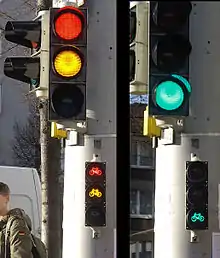
In German politics, a traffic light coalition (German: Ampelkoalition) is a coalition government of the Social Democratic Party of Germany (SPD), the Free Democratic Party (FDP) and the Greens. It is named after the parties' traditional colours, respectively red, yellow, and green, matching the colour sequence of a traffic light (Ampel). The term is also used for similar coalitions between social democrats, liberals and greens in other countries.
History
At a state level, early traffic light coalitions occurred in Brandenburg between 1990 and 1994 and in Bremen between 1991 and 1995.[1][2] Negotiations to form such a coalition following the 2001 Berlin state election were not successful;[3] likewise, preliminary talks after the 2010 North Rhine-Westphalia state election led to no result.[4] A traffic light coalition was formed in Rhineland-Palatinate following the 2016 Rhineland-Palatinate state election.[5] The 2021 Rhineland-Palatinate state election marked the first time in German history that an outgoing traffic light coalition was replaced by a renewed traffic light coalition in a state election.[6]
 SPD |
.svg.png.webp) FDP |
 Alliance '90/The Greens |
The inconclusive 2005 federal election produced media speculation about a federal traffic light coalition, but no such coalition was formed.[7] Historically, there have been red-green coalitions between the SPD and the Greens (from 1998 to 2005) and social-liberal coalitions between the SPD and the FDP (from 1969 to 1982) in the Bundestag.[8][9] Despite the common ground on cultural liberalism between the three parties, the FDP's economic liberalism and long association at the federal level with the conservative Christian Democratic Union (CDU) traditionally made such a coalition problematic,[10] with former FDP chairman Guido Westerwelle explicitly ruling out this option for the 2009 federal election.[11]
Following the 2021 federal election, the SPD emerged as the largest party in the Bundestag, but did not have enough seats to govern outright. With the SPD and the CDU ruling out a grand coalition with each other, a traffic light coalition was viewed as the most likely outcome by many in the media.[12][13] On 24 November 2021, the three parties announced that they had reached a deal to implement the coalition, with SPD candidate Olaf Scholz set to become chancellor.[10] The Scholz cabinet supported by a traffic light coalition finally took office on 8 December 2021.
Traffic light coalitions in other countries
Austria
In Austria, the term Ampelkoalition has been borrowed from Germany to describe a theoretical coalition of the Social Democratic Party of Austria (SPÖ), The Greens, and a liberal party. In the 1990s, this referred to the Liberal Forum (LiF). In the 2010s, the term reemerged to describe a theoretical coalition of the SPÖ, Greens, and NEOS – The New Austria, the latter of which is the successor to the Liberal Forum. NEOS's colour is pink, rather than yellow.[14]
Belgium
The Verhofstadt I Government of Belgium, headed by Prime Minister Guy Verhofstadt from 1999 to 2003, comprised liberals (the Flemish Liberals and Democrats and French-speaking Liberal Reformist Party), socialists (the Flemish Socialist Party and the French-speaking Socialist Party), and greens (the Flemish Agalev and the French-speaking Ecolo). However, as the political colours of the liberal parties were blue instead of yellow, it was known as the "purple-green" coalition.
Luxembourg
Following the 2013 general election in Luxembourg, negotiations started with the aim of forming a three-party coalition government comprising the Luxembourg Socialist Workers' Party (LSAP), the Democratic Party (DP) and The Greens in order to oust the Christian Social People's Party (CSV) of the incumbent Prime Minister Jean-Claude Juncker. This variant on the traffic light coalition is known as a "Gambia coalition" (German: Gambia-Koalition; Luxembourgish: Gambia(-)Koalitioun, Gambiakoalitioun), as the party colours match the flag of the Gambia,[15][16] and Luxembourg's liberal party (DP) uses blue as its party colour rather than yellow.
United Kingdom
In the United Kingdom the term has been used to describe a coalition between the Labour Party, the Liberal Democrats and the Green Party of England and Wales, notably that which has run the City of Lancaster district council from time to time, including from the 2019 election.[17][18]
In Scotland, a similar coalition in the Scottish Parliament involving the Scottish Labour and Scottish Liberal Democrat parties with the Scottish Greens was mooted following the 2003 Scottish Parliament election.[19] That year Labour and the Liberal Democrats continued their coalition with a slender majority, and it was again the stated position of the Greens to aim for such a coalition in 2007, despite possible tension between the unionist Labour and the Liberal Democrats and the pro-independence Greens.[20] Green support collapsed in the 2007 election, however, rendering them non-viable as a coalition partner, although they supported Alex Salmond's election as First Minister.[21]
See also
References
- Downs, William M. (1998). "Coalition Government, Subnational Style" (PDF). Ohio State University Press Columbus. Retrieved 24 November 2021.
- The Week in Germany. German Information Center. 19 May 1995. Retrieved 24 November 2021.
- "PDS takes power in Berlin". The Irish Times. 18 January 2002. Retrieved 25 November 2021.
- Beucker, Pascal (15 May 2010). "Neue Chance für Rot-Rot-Grün". Die Tageszeitung (in German). Retrieved 25 November 2021.
- Brady, Kate (13 March 2016). "Rhineland-Palatinate plays it safe, re-electing SPD for sixth consecutive term". DW. Retrieved 24 November 2021.
- Niewel, Gianna (28 September 2021). "Wo die Ampel leuchtet". Süddeutsche Zeitung (in German).
- Peifer, Douglas (November 2007). "Peifer on Langenbacher, 'Launching the Grand Coalition: The 2005 Bundestag Elections and the Future of German Politics'". H-Net. H-German. Retrieved 4 December 2021.
- Larres, Klaus; Panayi, Panikos (2014-08-27). The Federal Republic of Germany since 1949: Politics, Society and Economy before and after Unification. Routledge. p. 100. ISBN 978-1-317-89174-1.
- Hancock, M. Donald; Krisch, Henry (2008-07-10). Politics in Germany. CQ Press. p. 109. ISBN 978-1-4833-0117-4.
- Rinke, Andreas; Marsh, Sarah (24 November 2021). "Three German parties reach coalition deal to end Merkel era". Reuters. Retrieved 24 November 2021.
- "SPIEGEL Interview With FDP Leader Westerwelle - SPIEGEL ONLINE". Spiegel.de. Retrieved 2012-10-29.
- "Factbox: German "traffic light" coalition seen as most likely". Reuters. 27 September 2021. Retrieved 27 September 2021.
- Kirby, Jen (27 September 2021). "Germany's (sort of) change elections". Vox. Retrieved 10 December 2021.
- "The traffic light also flashes in Austria". Kurier (in German). 20 October 2021.
- "Three-way "Gambia Coalition": a first for Luxembourg". luxtimes.lu. 11 December 2017.
- "Juncker sidelined as Luxembourg's royal palace steps in - DW - 25.10.2013". DW.COM.
- Glover, Julian (10 September 2005). "Delegates try to shake off image as single-issue party". The Guardian. London. Retrieved 25 May 2010.
- Lakin, Nick (7 January 2021). "New make-up for Lancaster City Council Cabinet after Labour members leave to form new group". Lancaster Guardian.
- "Palgrave Macmillan - Contemporary British Politics 4th Edition". Palgrave.com. 3 May 2003. Retrieved 29 October 2012.
- Scott, Kirsty (5 May 2003). "'Traffic light' alliance may govern Scotland". The Guardian.
- "SNP and Greens sign working deal". 11 May 2007 – via news.bbc.co.uk.