List of fracture patterns in bone
Fracture patterns are ways in which a bone can break.
| Photo | Type | Description | Causes | Effects |
|---|---|---|---|---|
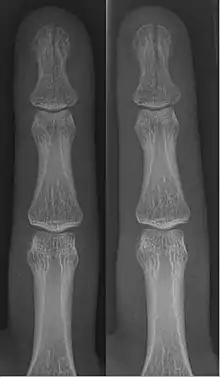 In the fingertip. More images |
Linear fracture | parallel to the bone's long axis | ||
| Transverse fracture | at a right angle to the bone's long axis | may occur when the bone is bent,[1] and snaps in the middle. | ||
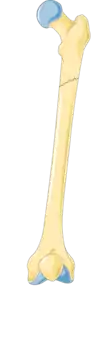 |
Oblique fracture | diagonal to a bone's long axis (more than 30°) | ||
| Spiral fracture or torsion fracture | at least one part of the bone has been twisted (image shows an arm-wrestler) | torsion on the bone[1] | may rotate, and must be reduced to heal properly | |
| Compression fracture/wedge fracture | usually occurs in the vertebrae, for example when the front portion of a vertebra in the spine collapses due to osteoporosis (a medical condition which causes bones to become brittle and susceptible to fracture, with or without trauma) | |||
| Impacted fracture | bone fragments are driven into each other | |||
| Avulsion fracture | a fragment of bone is separated from the main mass | |||
| Comminuted fracture | the bone is shattered | often from crushing injuries[1] |
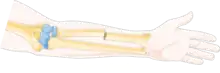
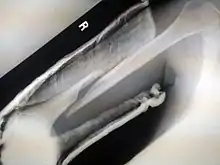
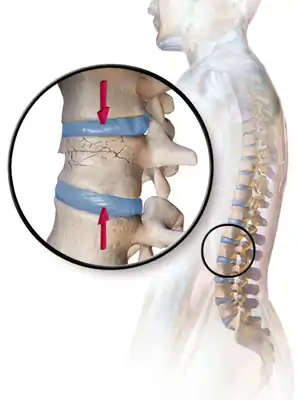
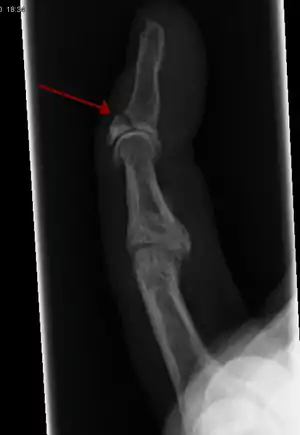
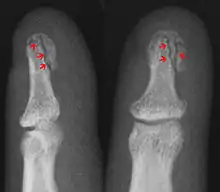
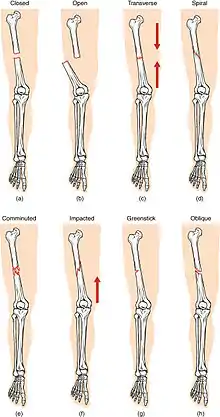
Some types of fractures
See also
References
- McDaniel, Dalton J.; Rehman, Uzma H. (November 2, 2021). "Phalanx Fractures of the Hand". StatPearls. StatPearls Publishing. PMID 32491557 – via PubMed.
Further reading
- Meinberg, Eg; Agel, J; Roberts, Cs; Karam, Md; Kellam, Jf (January 2018). "Fracture and Dislocation Classification Compendium—2018" (PDF). Journal of Orthopaedic Trauma. 32 (1): S1–S10. doi:10.1097/BOT.0000000000001063. PMID 29256945. S2CID 39138324. contains a systematic classification of fracture patterns, beyond that found this article
This article is issued from Wikipedia. The text is licensed under Creative Commons - Attribution - Sharealike. Additional terms may apply for the media files.