Trolleybuses in Pyongyang
The Pyongyang trolleybus system forms part of the public transport network of Pyongyang, the capital city of North Korea, and extends to some of its suburbs.
| Pyongyang trolleybus system | |
|---|---|
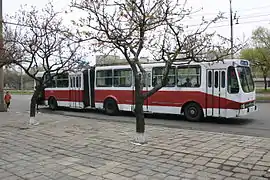 Pyongyang Trolleybus Factory Chollima 90 trolleybus. | |
| Operation | |
| Locale | Pyongyang, North Korea |
| Open | 1962 |
| Status | Active |
| Lines | 10 |
| Operator(s) | Capital City Passenger Transport Company |
| Infrastructure | |
| Electrification | 600V DC |
| Depot(s) | 9 |
| Stock | At least 370 trolleybuses[1] |
| Statistics | |
| Track length (total) | 56.6 km (35.2 mi) |
History
The network begun operation on 30 April 1962, with an opening ceremony at Pyongyang Railway station to commemorate the opening of the line from Ryonmot-dong to the railway station. Simultaneously, the Hwanggumbol station to Arch of Triumph and the Munsu to 2nd Department Store line opened, although this source states the other line was from Pyongyang Railway station to west Pyongyang. During that time, there were also alleged plans for the construction of an intercity line to Pyongsong.[2] Since then, a number of routes have been abolished, replaced by the tram system, though with the closure of tram line 1 from Songsin to Songyo, this section was rebuilt as a trolleybus line.[3] The system is continuously developed, with a new depot serving line 1 and 10 vehicles built in 2016.[4]
Between 1996 and 2005, part of the trolleybus line in Pyongsong was cut off from the rest of the line, with the area where the line belonged to being transferred to Unjong-guyok of Pyongyang.[5]
In 2020, the total route length was about 62.6 km (38.9 mi) and comprised 10 routes.[3]
Services
There are a total of 10 lines in operation. Some former lines were replaced by the tram system that opened in 1989. The numbers indicated on the dashboard are not route numbers – they are the stopping pattern of that service.[6]
| Route Number | Origin | Destination | Notes |
|---|---|---|---|
| 1 | Ryonmot-dong
(련못동) |
Pyongyang Railway station
(평양역) |
|
| 2 | West Pyongyang station
(서평양) |
Pyongyang Railway station
(평양역) |
Trolleybuses do not actually reach the railway station; instead it turns around at Sanghung depot. |
| 3 | Pyongyang thermal power plant
(화력) |
West Pyongyang
(서평양) |
Trolleybuses do not actually reach the railway station; instead it turns around at Sanghung depot. |
| 4 | Songsin
(솜신) |
Songyo
(선교) |
Replaced tram line 1 in its route on the right bank when its section from Songsin to Pyongyang railway station closed. |
| 4 (old) | Hwanggumbol station (황금벌) | Songsin station
(솜신역) |
Former line 4 ran from Songsin railway station to Hwanggumbol metro station, replaced by tram line 1 until section over Taedong River closed. |
| 5 | Munsu (문수) | Department Store No.2 (2백) | Currently runs on Sanwon street |
| 5 (old) | East Pyongyang Grand Theatre (동평양 대극장) | Department Store No. 1
(1백) |
Formerly ran from Department Store No.1 to East Pyongyang Theatre |
| 6 | Sadong
(사동) |
Department Store No.1
(1백) |
|
| 7 | Rakrang (락랑) | Munsu (문수) | Closed, replaced by tram line 2 |
| 8 | Hwanggumbol metro station
(황금벌) |
Arch of Triumph
(개선문) |
Connects Hwanggumbol metro station to Kaesong station. |
| 8 (old) | Kwangbok station
(광복역) |
Moranbong
(모란봉) |
Closed section replaced by tram line 1 |
| 9 | Ryonmot-dong
(련못동) |
Ryongsong
(룡성) |
Line to outskirts of Pyongyang |
| 10 | Loops around Pyongyang Railway station
(평양역) |
Sci-Tech Complex
(과학기술전당) |
Newest route. |
| 10 (old) | Palgol (팔골) | Rakrang (락랑) | Closed, replaced by tram line 1 and 3 |
| 11 | West Pyongyang
(서평양) |
Sopho
(서포) |
|
| Kwangmyong-dong (광명동) | Paesan-dong
(광명동) |
Completely separate line, formerly part of Pyongsong.[5] |
Fleet
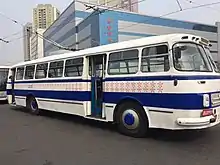
Most of the vehicles used on the system are North Korean made; some of them based on the Czech Karosa buses. The fleet also includes Hungarian Ikarus trolleybuses, imported as diesel buses and later reconstructed into trolleybuses.
For the full list including vehicles in use in other cities, see Trolleybuses in North Korea
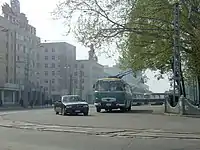 Chollima-70 #801 outside the Pyongyang Station.
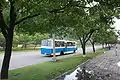 A Chollima 973 trolleybus converted from a Karosa C734 diesel bus
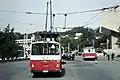 A Chollima 973 trolleybus, #590 also converted from Karosa C734
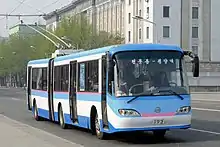 A domestically produced Chollima-091, 2014.
New rolling stock
New trolleybuses are also produced in other provinces and cities, such as in Chongjin.[8][9]
Despite the new technology incorporated with the new trolleybuses such as a dual power supply using a battery as a backup and LED displays,[10] they do not have air conditioning.
The new trolleybuses were subject to news coverage in the Rodong Sinmun, receiving multiple front page headlines subjecting the tests.[11] Kim Jong-un also made visits to the Pyongyang Trolley Bus Factory, with the intention to turn the factory 'into a world-class trolley bus producer'.[12] The first visit in February featured the Chollima-316 trolleybus, while the August visit featured the Chollima-321 trolleybus.[13]
In total, about 200 Chollima-091 were manufactured, about twenty Chollima-316 and at least 40 Chollima-321 were produced.[14][15]
See also
References
- "Vehicle Statistics Pyongyang, Trolleybus". Retrieved 26 October 2021.
- "Beitrag – trolley:motion" (in German). Retrieved 2021-03-17.
- "平壌市無軌道電車(トロリーバス)". 2427junction.com. Retrieved 2020-12-10.
- "Beitrag – trolley:motion" (in German). Retrieved 2021-03-17.
- "Beitrag – trolley:motion" (in German). Retrieved 2021-07-30.
- "Beitrag – trolley:motion" (in German). Retrieved 2021-03-17.
- "Pyongyang". transphoto.org. Retrieved 2020-12-10.
- "New Model of Trolley Buses Manufactured". 4 February 2018.
- "Rodong Sinmun". rodong.rep.kp. Retrieved 2020-10-19.
- "平壌市無軌道電車(トロリーバス)車両紹介-万里馬-312型". 2427junction.com. Retrieved 2020-10-19.
- "平壌市無軌道電車(トロリーバス)車両紹介-千里馬-316型". 2427junction.com. Retrieved 2020-10-19.
- Political News Team. "Kim Jong Un Inspects Pyongyang Trolley Bus Factory". rodong.rep.kp. Retrieved 2020-10-19.
- Political News Team. "Supreme Leader Kim Jong Un Watches New-type Trolley Bus and Tram". rodong.rep.kp. Retrieved 2020-10-19.
- "Beitrag – trolley:motion" (in German). Retrieved 2021-03-17.
- "Chollima 321". transphoto.org. Retrieved 2021-03-17.
External links
 Media related to Trolleybuses in Pyongyang at Wikimedia Commons
- "Trolleybus city: Pyongyang". Trolleymotion.
- Map of Pyongyang Trolleybus. Transphoto.