Tsaritsyno Palace
 | |
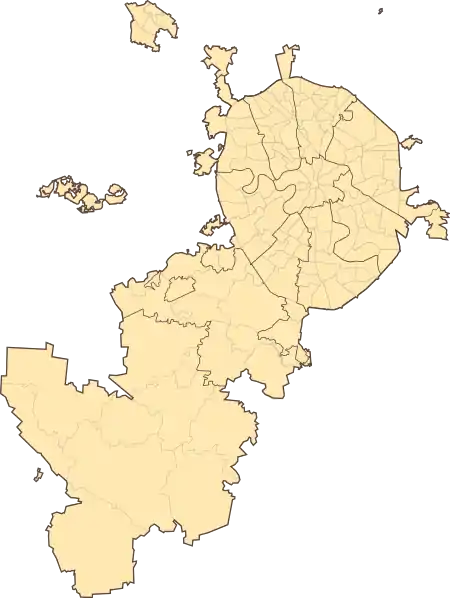  Location within Moscow | |
| Established | 1775 |
|---|---|
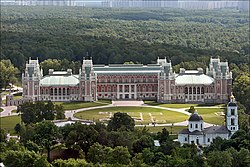
Tsaritsyno (Russian: Царицыно, IPA: [tsɐˈrʲitsɨnə]) is a palace museum and park reserve in the south of Moscow. It was founded in 1776 by the order of Catherine the Great.
The palace has lent its name to the surrounding district and the nearby metro station.
History
The estate is known from the late 16th century, when it belonged to Tsaritsa Irina, sister of Tsar Boris Godunov. At that time it was called Bogorodskoye. In the 17th century it belonged to the Streshnevs and then to the Galitzines.
In 1775, the estate was bought from Sergei Dmitrievich Kantemir by empress Catherine the Great, who happened to be passing through the area and fell in love with the picturesque beauty of the land. It received its present name, which means “Tsaritsa’s”.
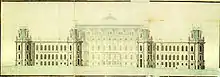
In 1776-85 architect Vasili Bazhenov built a palace for the Empress there. When the palace was almost complete, the Empress visited Tsaritsyno to inspect it. She declared the rooms to be too cramped and dark, and the palace unlivable. As a result, Catherine ordered the palace to be torn down. The remnants of the foundation of Bazhenov's original palace are still visible in the park.
In 1786, Matvey Kazakov presented new architectural plans, which were approved by Catherine. Kazakov supervised the construction project until 1796 when the construction was interrupted by Catherine's death. Her successor, Emperor Paul I of Russia showed no interest in the palace and the massive structure remained unfinished and abandoned for more than 200 years, until it was completed and extensively reworked in 2005-07.
Currently, in Tsaritsyno there are a history and architecture museum, a landscape park with an adjacent forest, an art museum, the Biryulyovo dendropark, and a cascade of the Tsaritsyno ponds. It is managed by the Tsaritsyno Museum Reserve, founded in 1984.
Architectural features of the Grand Palais
The basis of Bazhenov's architectural plan is formed by two equal wings, square in plan, intended for the apartments of Catherine II (right-wing) and Crown-prince Paul (left-wing). Both wings are connected by a middle section, which from the outside looks like the main element of the building - monumental and majestic.
The palace, despite its vivid neo-Gothic features (towers, lancet arches) in its solution is close to the canons of Classicism: strict symmetry, the tripartite division of the facades, the overall calm and balanced proportions, the monumental details (semi-columns in the corners of towers, fascias, loggias of side-wings). The hipped ends of the towers bear features tracing back to the towers of the Moscow Kremlin. In many respects, the Great Palace shows a different approach to the task of building a country residence "in the Gothic style".[1]
The palace was not completed due to the sudden death of Catherine II. By 1796 it already had a temporary roof painted black. This gave the building a gloomy appearance which affected the perception of contemporaries of the construction. It was only by the middle of the 19th century that critics started to give credit for the palace's architectural features.[1]
The ruined palace, which had not been used in any way during its history, was converted into a modern museum complex in 2005-2007. The concept of restoration, especially the creation of the interiors, which never existed in their original state, was widely criticised in the media. The palace is now used for exhibitions and exhibitions of the Tsaritsyno museum-reserve, as well as concerts held under the auspices of the museum.
Park
The 18th-century architecture ensemble was built (though not finished) following the order of Catherine II in Neo-Gothic style, after projects of the Bazhenov and Kazakov, and it is the only 18th-century architectural ensemble of such dimensions in Russia.
Around the palace, in the park there are a number of pavilions, pergolas, arbours, artificial grottos, decorative bridges (early 19th century, architect I. Yegotov), and a Russian Orthodox temple “Source of Life”, as well as a modern recreation center with an upscale restaurant. For a long time most buildings were ruined (and used for rock climbing). In 2005-2007 most buildings were extensively restored and completed: roofs, interiors and decorations have been added and their historical appearance has been altered. A number of buildings house the Russian museum of folk and applied art. The atrium of the “Bread House” is used for concerts of Moscow musicians.
The park grounds contain a group of burial mounds (Kurgans) that belong to the Early Slavs tribe Vyatichs dated to the 11th-13th century.
Ponds
The Tsaritsynskiye ponds cascade was formed during the XVI-XVIII centuries. The oldest is the Borisovsky pond, which was founded during the reign of Boris Godunov. The upper and lower Tsaritsynskiy ponds appeared when the estate of Chernaya Gryaz belonged to the boyars Streshnevs: the lower pond appeared in the XVII century. All the subsequent owners of the Chyornaya Gryazina paid a lot of attention to maintaining the ponds, building and reconstructing dams, water mills, creating artificial islands. The Middle Tsaritsynsky Pond appeared in the 1980s after the construction of a high dam, along which the route of Novotsaritsynsky Highway divided the Lower Pond into two parts. Directly adjacent to the Grand Palais and park ensemble are the Upper and Middle ponds. They form a natural boundary of the ensemble from the west and an important part of it. Some of the palace buildings and pavilions of the landscape park are oriented towards the ponds.[2]
Gallery
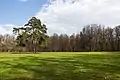 Palace lawn
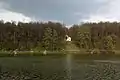 Ponds
Ponds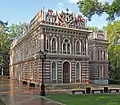 Bazhenov's "Opera House", 1776–1778
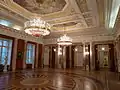 Smaller hall inside the grand palace
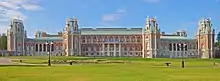 Palace front
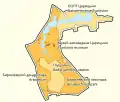 Map of park locations in Tsaritsino
External links and references
 |
Wikimedia Commons has media related to Tsaritsyno Park. |
- Official website (in English and Russian)
- Photo of Palace Complex and Park
- Reviews on TripAdvisor (in English and Russian)
- Tsaritsyno Park - One of the Best Museums in Moscow (in English)
Specific
- T︠S︡arit︠s︡yno : attrakt︠s︡ion s istorieĭ. Natalʹi︠a︡ Samutina, B. E. Stepanov, Наталья Самутина, Б. Е. Степанов. Moskva. 2014. ISBN 978-5-4448-0171-0. OCLC 889406090.CS1 maint: others (link)
- "Департамент градостроительства города Москвы". 2008-12-11. Archived from the original on 2008-12-11. Retrieved 2021-09-27.
Authority control  | |
|---|---|
| General | |
| National libraries | |