Turku City Library
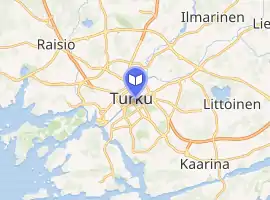
Turku City Library (Finnish: Turun kaupunginkirjasto, Swedish: Åbo stadsbibliotek) is a municipal public library in Turku. The Main Library is located in the VI District at the city centre. The Turku City Library also operates several branch libraries and two mobile libraries. It is part of the Vaski library network, which is a consolidation of 18 public libraries in the Finland Proper region.[4][5]
| Turun kaupunginkirjasto Åbo stadsbibliotek | |
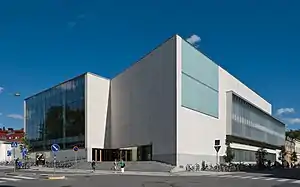 | |
| Country | Finland |
|---|---|
| Type | Public library |
| Location | Turku |
| Coordinates | 60°27′0.576″N 22°16′18.48″E (Turku Main Library) |
| Branches | 11 + 2 mobile libraries |
| Collection | |
| Size | 830 000 (2020)[1] |
| Access and use | |
| Access requirements | Open to all |
| Circulation | 2,8 million (2020)[2] |
| Population served | 1,3 million (2020)[3] |
| Other information | |
| Director | Rebekka Pilppula |
| Parent organisation | City of Turku |
| Affiliation | Vaski |
| Website | https://www.turku.fi/en/turku-city-library |
| Map | |
| |
The library traces its roots to the 1860s, when a privately funded people's library and an academic oriented city library were established in Turku. The municipality of Turku soon took over operating both libraries, and in 1912 they were merged together to form the Turku City Library.[6]
The Turku City Library has a regional development responsibility in the regions of Finland Proper and Satakunta. The libraries with regional development responsibility are tasked with developing the working environment of the area's public libraries and updating the staff's skills and knowledge.[7]
History
Origins: The People's Library and the City Library (1862–1912)
The Turku City Library traces it's roots to the 1860s, when two privately funded libraries were established in Turku: a people's library for the working class and an academic oriented city library for the educated classes. These two libraries were later merged together to form the Turku City Library.[6]
The People's Library (Finnish: Turun kansankirjasto) was established in 1862, and it operated first in the house of a factory owner's wife. The library was open only a couple of hours a week, and each customer was allowed to loan just one book at a time, because there were only around one thousand books in the collection. Loaning was free, but there was a voluntary annual fee of one mark. However, the People's Library was soon in financial troubles, and it was even temporarily closed for a short period at the beginning of the 1870s. The financial situation improved when the municipality of Turku took over the management of the library in 1878.[6]
After the Great Fire of Turku in 1827 the Royal Academy of Turku was moved to Helsinki. Also the library of the Royal Academy was moved, after which there was no more an academic library in Turku. For this reason an acedemic oriented City Library (Finnish: Turun kaupunginkirjasto) for the city's educated classes was established in 1869. Also the City Library was soon in financial difficulties, and the municipality took over it's operations in 1891.[6]
Around 1900 the premises of both libraries were getting too small. The situation eased when the local businessman and patron Fredric von Rettig donated a new library building for the city. In addition to the building, von Rettig also donated 10 000 books, an art collection and a sum of money for the maintenace of the libraries. The architect of the new library building was Fredric von Rettig's own son-in-law Karl August Wrede. The building was designed in the style of Dutch late Renaissance, and the immediate model for it was the House of Nobility in Stockholm. The People's Library moved to the new building's ground floor, and the City Library moved to the first floor. The entrance to the City Library was from the main door, but the entrance to the People's Library was from a side door by Linnankatu.[6][8][9]
The People's Library and the City Library, both already located in the same building, were formally merged together in 1912. The name of the new library was Turku City Library (Finnish: Turun kaupunginkirjasto, Swedish: Åbo stadsbibliotek). The ground floor of the former people's library was changed into the library's general department, whereas the first floor was transformed into the library's educational department.[6]
Growth and modernization (1913–1970)
During the 1910s American ideas about the development of public libraries started to take root also in Turku. Einar Holmberg, who worked as a librarian in the Turku City Library, brought new and radical ideas with him from his travels in England and the United States. Very soon these new ideas and notions were put into practice in Turku. Most of the modifications and reforms were ready by 1914. The Turku City Library implemented open collections, free loans for everyone, long opening hours, a children’s department and a modern classification system. The separate men’s and women’s reading rooms on the ground floor were combined, and newspapers were attached to racks from which the patrons could read them while standing. The side door by Linnankatu was also closed permanently, after which every one entered the library from the main door. The rules of use were revised so that loaning was entirely free and every resident had the right to loan books. This meant that the library was developing even more clearly towards a universal public library, because the userbase of the library broadened and diversified significantly during the 1910s. Also the number of patrons and loans increased. However, The First World War and the Finnish Civil War marked an ending to the library’s progressive period: the author Volter Kilpi, who started as a librarian in the Turku City Library in 1919, found the library in a state of degradation. During Kilpi’s management the library slowly began to recover, but after a few years Kilpi left his post to start working at the recently established Turku University Library.[8][10]
The Turku City Library was a pioneer in patron counselling. Already in 1933 the library established a special help desk for the patrons, which was inspired by a similar service at the Stockholm Public Library. There had been a reading room for newspapers in the old People’s Library since the year 1878, and during the 20th century the newspaper and magazine services were further developed and expanded. Already in 1907 a separate reading room for newspapers was established by Sofiankatu, and later on even more reading rooms for newspapers were established. At best, there were a total of four different reading rooms for newspapers and magazines. Also children’s library services were developed diligently from early on. Children had had their own reading room already in the premises of the People’s Library, but it soon proved inadequate and too small. The children got their own department during the alterations of 1914. Children and young adults have since been active users of the library.[8]
The library network of Turku started to expand after the Second World War. The first branch library was formed in 1939, when the former public library of Kaarina became the Nummi loaning station after a portion of the municipality of Kaarina was merged into Turku. The library network expanded slowly when new branch libraries were established in different parts of the city. Turku also had the first mobile library in Finland, which started operating in 1961. The music library was opened on the first floor of the Main Library in 1970.[8]
Branches
In addition to Turku Main Library, the following branches are a part of Turku City Library:
- Hirvensalo Library in Hirvensalo
- Härkämäki Library in Härkämäki
- Ilpoinen Library in Ilpoinen
- Lauste Library in Lauste
- Maaria Library in Maaria
- Nummi Library in Nummen
- Pansio Library in Pansio
- Runosmäki Library in Runosmäki
- Varissuo Library in Varissuo
- Vasaramäki Library in Vasaramäki
External links
References
- "Turku". Suomen yleisten kirjastojen tilastot (in Finnish). Kirjastot.fi. Retrieved 6 December 2021.
- "Turun kaupunginkirjaston tilastoja". Turun kaupunginkirjasto (in Finnish). Turun kaupunki. Retrieved 6 December 2021.
- "Turun kaupunginkirjaston tilastoja". Turun kaupunginkirjasto (in Finnish). Turun kaupunki. Retrieved 6 December 2021.
- "Welcome to the Library". Turku City Library. City of Turku. Retrieved 6 December 2021.
- "Using the library". Vaski. Vaski Libraries. Retrieved 6 December 2021.
- "Turun kaupunginkirjaston alku". Turun kaupunginkirjasto (in Finnish). Turun kaupunki. Retrieved 6 December 2021.
- "Alueellista kehittämistehtävää hoitavat kirjastot (AKE)". Kirjastot.fi (in Finnish). Kirjastot.fi. Retrieved 6 December 2021.
- "1910-luvulta 1970-luvulle". Turun kaupunginkirjasto (in Finnish). Turun kaupunki. Retrieved 9 December 2021.
- Seppälä, Eila (1963). Turun kaupunginkirjasto 1863–1963 (in Finnish). Turku: Turun kaupunki. pp. 85–86.
- Hypén, Kaisa; Koivunen, Leila; Tunturi, Janne (2015). Kirjoista kokoelmaksi: Kansansivistystä ja kansainvälisyyttä Turun kaupunginkirjastossa 1800–1900-luvuilla (in Finnish). Helsinki: Avain. p. 40. ISBN 9789523040816.
Authority control  | |
|---|---|
| General | |
| National libraries | |