Class U special wagon
The International Union of Railways groups all special classes of railway goods wagon (less those in classes F, H, L, S or Z) into Class U in its goods wagon classification system.
These are:
- Bulk goods wagons for transporting powders, etc.
- Dual coupling wagons for joining wagons with different coupling systems
- Well wagons including Schnabel wagons
- Self-discharging hoppers with loading hatches
- Trials vehicles for RoadRailer and Kombirail systems for intermodal transport.
Between 1964 and 1979 bulk goods wagons for liquid and gaseous materials (tank wagons) were included in Class U before being reclassified in 1980 as Class Z.
Bulk goods wagons for transporting powders (powder wagons)
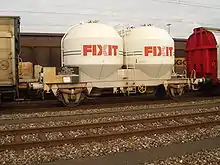
The powder wagon is a special form of bulk goods wagon designed to transport goods in powder form. These wagons are pneumatically unloaded, usually by using compressed air. For goods that might react with oxygen in the compressed air, nitrogen is used instead. These wagons are used for bulk commodities, such as cement, that are so fine-grained they cannot be poured, or at least do not pour very well, and so cannot be emptied under gravity. Under the UIC system they are given the category letter U and index letter c. They do not normally have their own compressors but must be unloaded using external equipment.
Intermodal container well wagons
- Basic 4 axle container well wagons
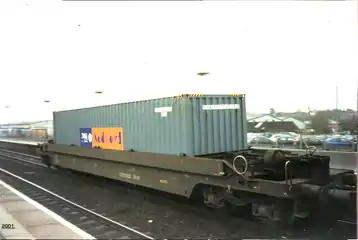
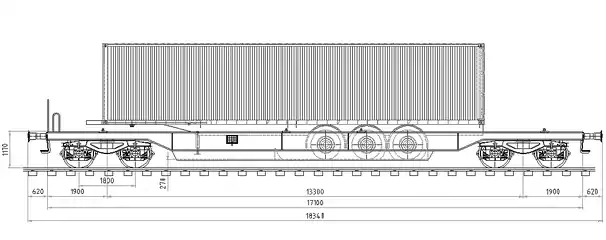
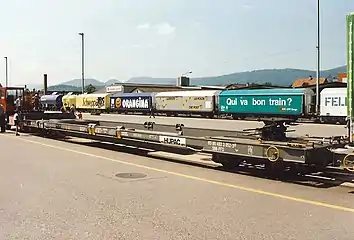 Special wagon of Hupac for Semi-trailers
%252C_op_het_terrein_van_de_Veilinghaven_te_Utrecht%252C_bedoeld_voor_een_tentoonstell.jpg.webp)
Special low deck wagons
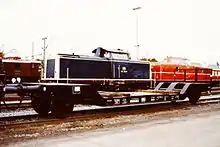
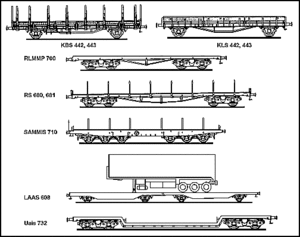
This group has a large variety of different types of wagon that range from the two-axle low deck wagon to the 36-axle Schnabel wagon.
The current designation for all well wagons is Ui, which can be supplemented as necessary by the index letters a, aa, k, kk or s. The load limits on low-loading wagons are not indicated by letters. The former German wagon classes were St and SSt.
In 1998 the Deutsche Bahn had a total of 180 well wagons of 43 different types. They are used to move very large and heavy goods that would exceed the loading gauge on flat wagons. Such loads typically include: combine harvesters, generators or narrow gauge vehicles.
Schnabel wagons
.jpg.webp)
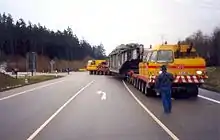
The largest low-loading wagons are designed as Schnabel wagons, made from two completely separate sections. Each section rests on multiple-axle bogies or groups of bogies. The two sections each support a beak-shaped carrying arm which, in turn, supports one side of a low-loading platform or is directly fixed to the outsize load to be transported. In the latter case the load becomes temporarily part of the vehicle itself. The wagons have hydraulic equipment with which the load can be raised or lowered in order to manoeuvre it past obstacles. There are about 30 examples of Schnabel wagon in Europe, North America and Asia.
Typical loads for these vehicles are large boilers for power stations, turbine components or power station transformers. Due to their heavy weight and outsize dimensions these goods are not usually transported in normal goods trains, but are moved in special trains and need careful preparation. Whenever transportation restrictions arise with a wagon and its load due to its weight and size, it is designated as an abnormal load and must be labelled in accordance with the RIV as a U type. When the vehicle is unladen the two carrying arms are joined directly to one another; the wagon can then travel in goods trains at normal speeds.
- Schnabel wagons
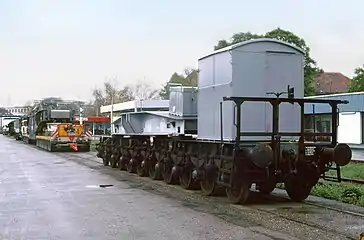 Arrival of a Schnabel wagon at its destination with a large transformer, the load will now be transported by road on a lowboy
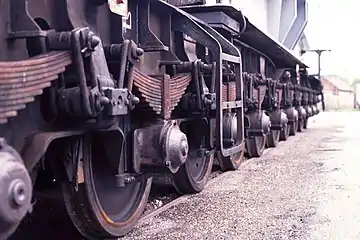 Undercarriage of a Deutsche Bahn Class Uaai 687.9 Schnabel wagon
List of selected well wagons
| Class number | Maximum carrying capacity | Tare weight | Wheelsets | Quantity (DB as at 31 Dec 1997) |
Length over buffers | Bogie pivot spacing or wheelset spacing |
Length of low loading bay |
|---|---|---|---|---|---|---|---|
| Uis 632[2] | 25 t (24.6 long tons; 27.6 short tons) |
14,500 kg 32,000 lb |
2 | 25 | 12,240 mm 40 ft 1+7⁄8 in |
9,000 mm 29 ft 6+3⁄8 in |
N/A |
| Uiks 635[3] | 19 t (18.7 long tons; 20.9 short tons) |
12,800 kg 28,200 lb |
2 | 27 | 15,590 mm 51 ft 1+3⁄4 in 15,760 mm 51 ft 8+1⁄2 in |
9,000 mm 29 ft 6+3⁄8 in |
7,450 mm 24 ft 5+1⁄4 in |
| Uais 732[4] | 50 t (49.2 long tons; 55.1 short tons) |
29,500 kg 65,000 lb |
4 | 16 | 19,940 mm 65 ft 5 in |
14,900 mm 48 ft 10+5⁄8 in |
10,000 mm 32 ft 9+3⁄4 in |
| Uaai 812[5] | 159 t (156 long tons; 175 short tons) |
41,000 kg 90,000 lb |
10 | 1 | 19,704 mm 64 ft 7+3⁄4 in |
8,970 mm 29 ft 5+1⁄8 in |
N/A |
| Uaai 820 [6] | 157 t (155 long tons; 173 short tons) |
83,100 kg 183,200 lb |
12 | 1 | 31,440 mm 103 ft 1+3⁄4 in |
19,100 mm 62 ft 8 in |
8,500 mm 27 ft 10+5⁄8 in |
| Uaai 821 [7] | 190 t (190 long tons; 210 short tons) (180 t (180 long tons; 200 short tons) with suspension bars) |
83,800 kg 184,700 lb |
12 | 1 | 30,124 mm 98 ft 10 in |
19,100 mm 62 ft 8 in |
8,000 mm 26 ft 3 in |
| Uaai 823 [8] | 230 t (230 long tons; 250 short tons) |
102.2 t 100.6 long tons; 112.7 short tons |
16 | 1 | 37,080 mm 121 ft 7+7⁄8 in |
N/A | N/A |
| Uaai 831[9] | 275 t (271 long tons; 303 short tons) (250 t (250 long tons; 280 short tons) with suspension bars) |
170,000 kg 370,000 lb |
20 | 2 | 45,120 mm 148 ft 3⁄8 in |
18,730 mm 61 ft 5+3⁄8 in 28,330 mm 92 ft 11+3⁄8 in |
N/A |
| Uaai 836 [10] | 317 t (312 long tons; 349 short tons) |
82.870 kg 182.70 lb |
20 | 1 | 31,800 mm 104 ft 4 in |
15,300 mm 50 ft 2+3⁄8 in |
N/A |
| Uaai 837 | 398 t (392 long tons; 439 short tons) |
N/A | 24 | 1 | N/A | N/A | N/A |
| Uaai 838 | 341 t (336 long tons; 376 short tons) (313 t (308 long tons; 345 short tons) with suspension bars) |
N/A | 24 | 1 | N/A | N/A | N/A |
| Uaai 839 | 454 t (447 long tons; 500 short tons) |
N/A | 32 | 1 | N/A | N/A | N/A |
The Class Uaai low-loading wagon with special equipment is marketed Europe-wide exclusively by the heavy load department, Heavy Cargo + Service, of Nuclear Cargo + Service.[11][12]
Hopper wagons with loading hatches
A range of funnel-shaped self-discharging wagons is also classed as special wagons. Their external shape resembles the open hoppers, but they have an enclosed roof with loading hatches or in some other way do not fulfil the criteria for a wagon with opening roof.
The DB has grouped several of the lime wagons with four hatches taken over from the DR into Class Uaoos-y. Some of these wagons have since been fitted with swing roofs.
In the SNCF there is a large number of grain wagons in service that are classed as special wagons.
See also
References
- Piggyback transport in the 60s, video in French
- Uis 632
- Uiks 635
- Uais 732
- Uaai 812
- Uaai 820
- Uaai 821
- Uaai 823
- Uaai 831
- Uaai 836
- "Heavy Cargo + Service, Tiefladewagen für Großraum- und Schwerlasttransporte". Archived from the original on 2008-11-21. Retrieved 2009-02-19.
- "Bauart Uaai: Schienentiefladewagen mit Sondereinrichtungen, Übersicht mit technischer Spezifikation und Wagenkizzen". Retrieved 2009-02-19. Domain for sale
Literature and media
- "Bahn TV, Schwerlasttransporte: Riesentrafo auf Reisen; Mai 2008, Video 11 Minuten". Retrieved 2009-02-19.
- Stefan Carstens: Die Güterwagen der DB AG. MIBA, Nürnberg 1998, ISBN 3-86046-030-7