UMTAS
UMTAS or Mizrak-U (Uzun Menzilli Tanksavar Sistemi) is a modern long range air-to-surface anti-tank missile developed by Turkish armor and missile manufacturer ROKETSAN.[2][3][4][5][6]
| UMTAS Long Range Anti-Tank Missile System | |
|---|---|
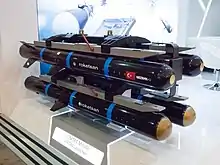 L-UMTAS (upper) and UMTAS (lower) missiles displayed on helicopter pylon | |
| Type | Air-to-surface, Anti-tank missile |
| Place of origin | Turkey |
| Production history | |
| Manufacturer | Roketsan A.Ş. |
| Specifications | |
| Mass | 37.5 kg[1] |
| Length | 175 cm |
| Diameter | 16 cm |
| Warhead | Insensitive Anti-armor Tandem Warhead |
| Engine | Solid-fuel rocket |
Operational range | 500–8,000 m |
Guidance system | Two-way RF Data-link Imaging Infrared Seeker (UMTAS) or semi active Laser guidance (L-UMTAS) |
Launch platform | Rotary wing platforms Unmanned combat air vehicle Land combat vehicle Naval platforms |
| External image | |
|---|---|
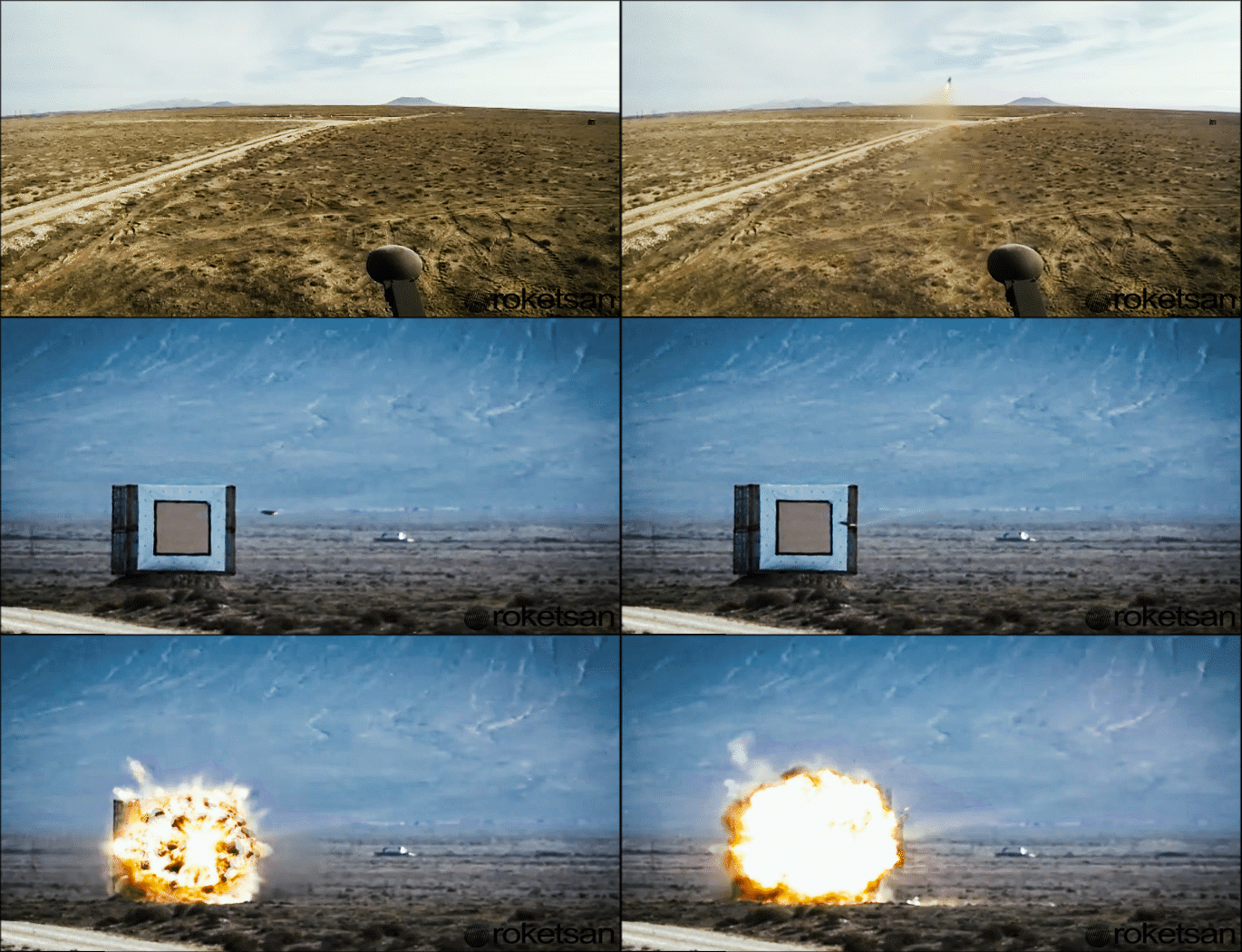
| Launch and Warhead test | |
 Dual-Stage antitank Warhead Dual-Stage antitank Warhead |
Background
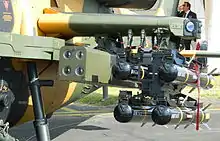
The UMTAS program was initiated in late 2003 by Turkey's Undersecretariat for Defence Industries (SSM), specifically to provide T-129 ATAK combat helicopters with an indigenous guided missile.[7] The UMTAS has been designed to engage tanks and heavily armoured vehicles.[8] It can be integrated to various platforms (Helicopters, UAVs, Land Vehicles, Stationary Platforms, Light Assault Aircraft, Naval Platforms).[3]
Description
The UMTAS missile features "fire and forget" and "fire and update" infrared guidance with a tandem anti-armor warhead.[2] The laser guided version is marketed as the L-UMTAS.[3] It is capable of engaging targets at 8 kilometers.
- Fire Behind Mask
- Can be used in day or night and in adverse weather conditions
- Tandem warhead, effective against reactive armors
- Insensitive munition characteristics against liquid fuel fire and bullet hits
- Communication of seeker image to the user and command by user using Data Link.
- Lock-on before launch or Lock-on after launch (L-UMTAS)
- Update of aim point on the target (UMTAS)
- Switching targets during flight (UMTAS)
- Direct-attack / Top-attacks (UMTAS)
- Fire-and-Forget, Fire-and-Update modes (UMTAS)
Development
Phase 1 (design) was launched in 2005 and completed in 2008.[1]
Phase 2 (development and qualification) was launched in 2008 and completed in 2015.[8]
The L-UMTAS and UMTAS version have been successfully integrated and fired from the Turkish T-129 ATAK helicopter against land targets and from SH-60 Sea Hawks against sea targets.
The missile has also been successfully tested fired from the Bayraktar TB2 UCAV. The missile was dropped from an altitude of 16,000 ft. to hit a 2×2 meter laser-designated target self designated from the drone, at a distance of 8,000 meters.[9]
Serial production has begun with the delivery dates set in 2016.[8]
References
- LONG RANGE ANTITANK MISSILE (LRAT) Archived 2011-06-16 at the Wayback Machine, Roketsan, Retrieved October 11, 2010
- "UMTAS LONG RANGE ANTI-TANK MISSILE SYSTEM « Roketsan". www.roketsan.com.tr. Archived from the original on 5 February 2021. Retrieved 13 July 2021.
- "Long Range Anti-Tank Missile UMTAS « Roketsan". www.roketsan.com.tr. Archived from the original on 4 March 2021. Retrieved 12 July 2021.
- "UMTAS Long Range Anti-Tank Missile System - Army Technology". Archived from the original on 2019-03-24.
- UMTAS (Long Range Anti Tank System) (Turkey) Archived 2010-04-28 at the Wayback Machine, Jane's Information Group, Retrieved October 10, 2010
- "Archived copy". Archived from the original on 2019-04-14. Retrieved 2019-07-22.CS1 maint: archived copy as title (link)
- "SAVUNMA SANAYİİ MÜSTEŞARLIĞI Faaliyet Raporu 2013" (pdf). Kamuda Stratejik Yönetim. 2013. p. 99. Retrieved 24 April 2021.
- "Roketsan Shows Broad Capabilities". aviationweek.com. Archived from the original on 2016-06-02. Retrieved 2016-04-28.
- Eshel, Tamir. "Turkish UMTAS Missile Dropped From a Bayraktar Tactical Drone | Defense Update". defense-update.com. Archived from the original on 2016-04-13. Retrieved 2016-04-28.