Uhiji-ne and Suhiji-ne
Uhijini no Kami and Suhichini no Kami are Gods that appear in Japanese mythology.
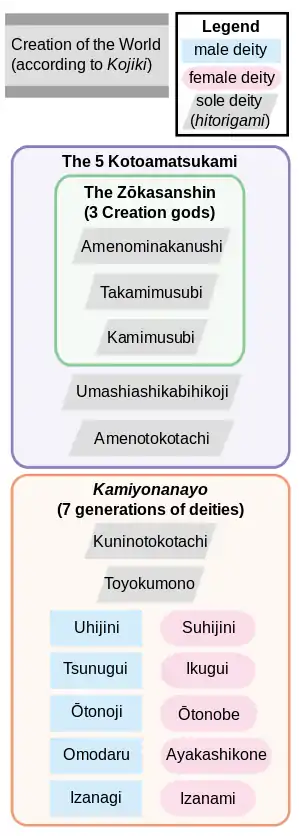
In the Kojiki, the elder brother is referred to as Uhijini-no-kami and the younger sister as Suichini-no-kami; in the Nihon Shoki, the elder brother is referred to as Uhijini-no-mikoto and the younger sister as Suichini-no-mikoto; and in the Sekaiyo-kyojihonki, the elder brother is referred to as Dorojini-no-mikoto and the younger sister as Suichini-no-mikoto.
In the Nihon Shoki, both deities use the word ji, which means earth, but in the Kojiki, ji and ji are used interchangeably, so the correct reading of Suhichini no Kami is Suhichini no Kami.
In the Kojiki (Records of Ancient Matters), he is the third deity of the Seventh Generation of the Divine Age, with his elder brother, Ubichinoi, being the male deity and his younger sister, Subichinoi, being the female deity. In the Nihon Shoki, they are the fourth gods of the seventh generation of the Kamiseiki. They were Dokugami until then, but in this generation they became a pair of male and female deities for the first time.
The "U" in the name of the deity means mud ("uki" in ancient Japanese), and the "Su" means sand.
The name of the deity Ubichinoi is thought to be "the first mud", as "Ubichinoi" is a contraction of "Uihijimi", and "Ni" is a suffix indicating affection. The name of the god Suhichinoi is thought to be "sand", "Hichi" is "mud", and "Nin" is a suffix expressing affection, and the name is thought to be "sand and mud". In the original text of the Kojiki, there are notes on accents, with the "ni" of Ubijini being pronounced with a raised sound and the "ni" of Subichinoi being pronounced with a lowered sound.[1]。
Shrines
- Monobe Shrine, precincts of Kamishiro Shichidai Shrine (Kawai-cho, Shimane Prefecture, Ota City)
- Imaibe Shrine (Higashi Imaibe Town, Matsue City, Shimane Prefecture)
- Kumano Hayatama Taisha (Wakayama Prefecture, Shingū City)
- Miyaura Shrine (Kagoshima PrefectureKirishima CityFukuyama Town)
- Twelve shrines on the grounds of Futarasan Shrine (Tochigi PrefectureUtsunomiya, Utsunomiya)
- Shada Shrine (Nagano PrefectureMatsumoto City)
References
- 新潮日本古典集成 古事記