Unaccusative verb
In modern linguistics, an unaccusative verb is an intransitive verb whose grammatical subject is not a semantic agent. In other words, it does not actively initiate, or is not actively responsible for, the action of the verb.
An unaccusative verb's subject is semantically similar to the direct object of a transitive verb or to the subject of a verb in the passive voice.
Examples in English are "the tree fell"; "the window broke". In those sentences, the action (falling, breaking) can be considered as something that happened to the subject, rather than being initiated by it. Semantically, the word "tree" in the sentence "the tree fell" plays a similar role as it does in a transitive sentence, such as "they cut down the tree", or its passive transformation "the tree was cut down".
Unaccusative verbs thus contrast with unergative verbs, such as run or resign, which describe actions voluntarily initiated by the subject. They are called unaccusative because although the subject has the semantic role of a patient, it is not assigned accusative case.
In nominative–accusative languages, the accusative case, which marks the direct object of transitive verbs, usually represents the non-volitional argument (often the patient). However, for unaccusative verbs, although the subject is non-volitional, it is not marked by the accusative.
As Perlmutter points out, the same verb such as "slide" can be either unaccusative or unergative, depending on whether the action was involuntary or voluntary.[1]
The term "unaccusative verb" was first used in a 1978 paper by David M. Perlmutter of the University of California, San Diego.[2] Perlmutter credited the linguist Geoffrey K. Pullum with inventing the terms "unaccusative" and "unergative".[3]
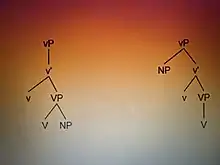
Unaccusitives and unergatives verbs, while syntactically different, are, on the surface, communicated the same. They both include a noun phrase followed by a verb phrase when being produced. Underlyingly, an unaccusitive verb has a VP Shell in which the NP is selected by the bottom most VP phrase and later moved. An unergative verb, on the other hand, the NP is selected by the top most VP in a VP shell, and therefore is not required to move to create a surface level order of the noun being followed by the verb. The trees pictured to the right demonstrates how the noun in an unaccustive is the direct object of the sentence, as it is selected by the VP as a complement, whereas the noun in an unergative is the subject of the sentence.
Auxiliary selection as a test for unaccusativity
As mentioned above, the unaccusative/unergative split in intransitive verbs can be characterized semantically. Unaccusative verbs tend to express a telic and dynamic change of state or location, while unergative verbs tend to express an agentive activity (not involving directed movement). While these properties define the "core" classes of unaccusatives and unergatives, there are intermediate classes of verbs whose status is less clear (for example, verbs of existence, appearance, or continuation, verbs denoting uncontrolled processes, or motion verbs).
A number of syntactic criteria for unaccusativity have also been identified. The most well-known test is auxiliary selection in languages that use two different temporal auxiliaries (have and be) for analytic past/perfect verb forms (e.g. German, Dutch, French, Italian; even Early Modern English). In these languages, unaccusative verbs combine with be, while unergative verbs combine with have.
- French:
- unaccusative: Je suis tombé. lit. "I am fallen." (= "I have fallen.")
- unergative: J'ai travaillé. "I have worked."
- Italian:
- unaccusative: È arrivato. lit. "[He] is arrived." (= "He has arrived.")
- unergative: Ha telefonato. "[He] has phoned."
From one language to another, however, synonymous verbs do not always select the same auxiliary, and even within one language, a single verb may combine with either auxiliary (either depending on the meaning/context, or with no observable semantic motivation, sometimes depending on regional variation of the language). The auxiliary selection criterion therefore also identifies core classes of unaccusative and unergatives (which show the least variation within and across languages) and more peripheral classes (where variation and context effects are observed). There are languages which do not have auxiliary selection, such as Russian, and therefore other tests sometimes have to be used to determine whether a verb is unaccusitive or unergative
Other tests that have been studied involve passivization (see Impersonal passive voice), ne/en cliticization in Italian and French, and impersonal, participial, and resultative constructions in a wide range of languages.
For example, in Dutch and Turkish, unergative verbs can be used in impersonal passive constructions, but unaccusative verbs cannot.[4] In the following example from Dutch, the verb is unergative, describing a voluntary action, and can be made passive:
- Er wordt hier veel geskied.
- "A lot of skiing is done here." (lit. "it is skied much here")
But a sentence with an unaccusative verb, such as "The concert lasted a long time", cannot be made passive.
In Japanese, the grammaticality of sentences that appear to violate syntactic rules may signal the presence of an unaccusative verb. According to transformational models of grammar, such sentences contain a trace located in the direct object position that helps to satisfy the mutual c-command condition between numeral quantifiers and the noun phrases they modify (Tsujimura, 2007).
Unaccusativity in English
Test for unaccusative verbs in English
Modern English only uses one perfect auxiliary (have), although archaic examples like "He is fallen/come" reflect the use of be with unaccusative verbs in earlier stages of the language.
The identification of unaccusative verbs in English is therefore based on other criteria. For example, many unaccusatives alternate with a corresponding transitive construction where the unaccusative subject appears in direct object position:
- The ice melted. ≈ The sun melted the ice.
- The window broke. ≈ The golf ball broke the window.
Unaccusative past participles can be used as nominal modifiers with active meaning, while unergative past participles cannot:
- unaccusative: the melted snow, the departed guests, the fallen soldiers
- unergative: *the shouted victim, *the slept child, *the hesitated leader
Finally, unaccusative subjects can generally be modified by a resultative adjunct. This is a property shared by direct objects and passive subjects, but not shared by the subjects of unergative and transitive verbs.
- unaccusative subject: The vase broke into pieces.
- direct object: John broke the vase into pieces.
- passive subject: The vase was broken into pieces.
- unergative subject: *John dined full/to death/two pounds heavier.
- subject of transitive verb: *John ate the brownies full/to death/two pounds heavier.
While "to die" has been classified as an unaccusative verb, like "to fall" and "to arrive",[5] Dąbrowska (2016)[6] noted that "to die" is an example of Unaccusative Mismatch, because "to die" behaves:
- unaccusatively in some tests, e.g. (!)There laughed a girl in the room (unergative) vs. There appeared a lady on the scene (unaccusative) vs. There died a myriad;
- yet unergatively in others, e.g. Philip died vs. (!)The soldier died Philip.
Examples of English unaccusative verbs
Perlmutter (1978) gives examples of various types of unaccusative verbs. He emphasises that the following categories are not definitive, but that alternative classifications are possible.[7]
(a) The verb "be" with adjectives:
- be heavy, be red, etc.
(b) Those where the grammatical subject is semantically a Patient:
- (i) burn, fall, sink, float, flow, slip, slide, shake, stumble, succumb, boil, dry, sway, wave, lie (involuntary), bend (involuntary)
- (ii) melt, freeze, evaporate, solidify, darken, rot, wither, collapse, break, increase, germinate, die, suffocate, crack, split, disappear, disperse, explode
(c) Predicates of existing and happening:
- exist, happen, occur, arise, ensue, turn up
(d) Non-voluntary verbs of appearance, sound, smell, etc.:
- shine, sparkle, clink, snap (involuntary), pop, smell (bad), stink
(e) Aspectual predicates:
- begin, start, stop, continue, end
(f) Duratives:
- last, remain, stay, survive
He points out that some verbs can be used in either unaccusative or unergative clauses. If the action is deliberate or willed, the clause is unergative:
- The figurine stood on this table. – (unaccusative)
- The children stood on this table. – (unergative)
Unaccusativity in Russian
Unlike the subtle evidence for unaccusatives in English, Russian provides strong tests to determine unaccusativity. The four tests for unaccusitivity in Russian are:
- po-phrases
- na-phrases
- Locative Inversion
- Genitive-of-Negation (GN)
When the subject of an unaccusitive verb appears in a po-phrase, the verb will lack subject-verb agreement. This construction would be ungrammatical for unergatives, causing a distinction to be able to be seen between unaccusitives and unergatives.
Transitive ([8]Pesetsky 1982:69)
Я дал мальчикам по яблоку
I gave boys-DAT ( po) apple-DAT
‘I gave the boys an apple each.’
Unaccusative ([9]Babby 1980:45)
По яблоку упало каждого дерева
(po) apple-DAT fell from each tree-GEN
‘A (different) apple fell from each tree.’
Unergative ([10]Schoorlemmer 1995:33)
*В каждой квартире смеялся по мальчику.
in each apartment laughed (po) boy-DAT
‘A (different) boy laughed in each apartment.’
Na-phrases affect the interpretation of the internal arguments of the verb. This would be the NP in the direct object position of a transitive verb or the NP in the subject position of an unaccusative verb, once again creating a clear distinction between unaccusitives and unergatives.
Transitive ([11]Borik 1995, 32-33)
Дети купили много книг
children-Nom bought a-lot books-Gen
‘The children bought a lot o f books.’
Unaccusative
Много травы наросло в парке
a-lot grass-Gen grew in park
‘A lot o f grass grew in the park.’
Unergative
*Много детей наиграло в парке
many children-Gen played in park
‘Many children played in the park.’
Locative Inversion (Babyonyshev 1996) is a construction that is only possible for the NPs in the position of the subject of unaccusitive verbs. With these three tests, while they do distinguish unaccusitives from unergatives, they are seldom used in everyday speech.
Unaccusatives
В углу валялась куртка
in comer lay jacket-Nom
‘In the comer lay a jacket.’
В саду росли три розы
in garden grew three roses-Nom
‘In the garden grew three roses.’
Unergatives
*Себе под нос напевал Петя
self under nose sang Petja-Nom
‘To himself sang Petya.’
*В квартире свистит Ваня
in apartment whistles Vanya-Nom
‘Vanya is whistling in the apartment.’
In contrast, Genitive-of-Negation, is frequently used by Russian speakers in both spoken and written language. The genitive case can be used both for the direct objects of transitive verbs and the subjects of unaccusitive verbs while the sentence is being negated. This grammatical case is not allowed to be used for the NPs in the subject position of transitive and transitive verbs, and with unergative verbs.[12]
Internal argument of Transitive
Я не пишу стихи
I neg write poems Gen.
'I don’t write poems'.
Internal argument of Unaccusative
Ответ-а не пришло
AnswerGen neg came Neut sg
The answer didn't come.
External argument o f Transitive
*Студента не *писал /*писало
Student Masc Gen/ neg wrote Masc Sg /Neut Sg
*Студент не *писал /*писало
Student Masc./Nom neg wrote Masc. Sg /Neut S
Student didn't write
External argument o f Intransitive (unergative)
Студенты/* Студентов не спят’
Students Masc./Nom/PI /students Masc./Gen/Pl neg sleep3pp
Students don’t sleep.
Oblique Direct Object
Владимиров не управляет фабрикой /*фабрики
Vladimirov Neg direct factory Fem instr/* factory Fem Gen
Vladimirov doesn’t direct the factory.
Morphosyntactic Alignment and Unaccusative Verbs
Unaccusative verbs are generally more readily identifiable in ergative-absolutive languages, such as Basque, since the subject of unaccusative verbs is inflected similarly to direct objects. [13] By contrast, nominative-accusative languages, such as Japanese mark the subject of unaccusative verbs agentively. [14]
Recent Developments
The Unaccusative Hypothesis
The derivation of the core properties of unaccusative constructions from a set of principles is one of the topmost issues of the agenda of modern syntax since the seminal work by Perlmutter 1978 (cf. Burzio 1986 and Hale-Keyser 2003 for landmark proposals). Perlmutter introduced the "Unaccusative Hypothesis" in 1978 explaining that intransitive verbs are not homogeneous, but can be categorized into either an unaccusative verb or an unergative verb. [15] The Unaccusative Hypothesis was later integrated into the Government and Binding Theory by Burzio (1986). The Unaccusative Hypothesis (UH) argues that the Object of the sentence becomes the Subject in the derivation, meanwhile unergatives start as subjects. More specifically, the first approach introduced by the Unaccusative Hypothesis arrived at an important consequence constituting an analogy between English passive voice constructions and unaccusative constructions whereas in the second approach a more radical theory was proposed based on the analysis of expletive there stemming from the sentences with the copula suggested in Moro 1997.
Brain Activation in Unaccusative Verbs
According to linguistic theory, unaccusative verbs have sentences that undergo lexical and syntactic operations that do not occur with unergative and transitives. [16]A recent study in 2010 explains and supports this linguistic theory by showing that there are two separate activation locations from unaccusative and unergative verbs in the brain. [17] This study was taken from participants who were tested in their native language, Hebrew. The differences between Unaccusative and Unergative (and transitive) verbs arose from differences in syntactic and lexical derivations.
Developments on the Unaccusative Hypothesis
Split Intransitivity
Further linguistic studies have shown that intransitive verbs will identify as either unergative or unaccusative, determined by the language. A recent study proposed by James Baker in 2019 suggests that intransitive verbs not only identify as either unaccusative or unergative, but with multiple different classes. [18] According to Baker, the Split Intransitivity analysis has various advantages over the traditional approach in terms of argument structure. The original traditional hypothesis proposed by Levin & Rappaport-Havov in 1995 mentions linking rules referring to either an external or internal argument. In Split Intrasitivity, Baker introduces additional components to the processing of unaccusative verbs he calls Initiation, State, and Change.
The Unaccusative Trap Hypothesis
The Unaccusative Trap Hypothesis, developed by Oshita in 1997 and 2001, proposes that unaccusatives are first acquired as unergatives in L2 learners. He suggests that L2 learners must go through 3 different processes before they have the knowledge to distinguish between unaccusative and unergative verbs. This study, discussed by Junhua Mo in 2020, analyzed the Unaccusative Trap Hypothesis with L2 English learners and calls for further study. [19] The linking rules associated proposed by Levin and Rappaport Hovav were only effective for L1 acquisition of English, not applicable to L2 acquisition.
See also
- Anticausative verb – type of unaccusative
- Copula
- Deponent verb
- Ergative verb – transitive equivalent of unaccusative
- Impersonal passive voice
- Reflexive verb
- Transitivity
- Ambitransitive verb – transitive equivalent of unergative
- Intransitive verb
- Transitive verb
- Unergative verb – opposite of unaccusative
References
- Perlmutter (1978), p. 163.
- Google ngrams.
- Perlmutter (1978) p.186.
- Perlmutter (1978), p. 168–9.
- Kerstens, Johan; Ruys, Eddy; Zwarts, Joost (1996–2001). "unergative verb". Lexicon of linguistics. Utrecht institute of Linguistics, OTS Utrecht University. Retrieved July 28, 2019.
- Dąbrowska, A. "Unaccusative or unergative: The case of the English verb to die" in Roczniki humanistyczne 64(11):25-39 · (January 2016). doi:10.18290/rh.2016.64.11-2
- Perlmutter (1978), pp. 162-3.
- Pesetsky (1982:69). Cite journal requires
|journal=(help); Check date values in:|date=(help); Missing or empty|title=(help) - Babby (1980:45). Cite journal requires
|journal=(help); Check date values in:|date=(help); Missing or empty|title=(help) - Schoorlemmer (1995:33). Cite journal requires
|journal=(help); Check date values in:|date=(help); Missing or empty|title=(help) - Borik (1995). : 32–33. Cite journal requires
|journal=(help); Missing or empty|title=(help) - Brown (1999). Cite journal requires
|journal=(help); Missing or empty|title=(help) - Aske, Jon. "The Accusativity/Ergativity Balance in a Non-Split Ergative Language: The Case of Euskara (Aka Basque)." Proceedings of the Annual Meeting of the Berkeley Linguistics Society, vol. 13, 09/10/1987, pp. 1, doi:10.3765/bls.v13i0.1821.
- Hirakawa, M. (2001). L2 ACQUISITION OF JAPANESE UNACCUSATIVE VERBS. Studies in Second Language Acquisition, 23(2), 221-245. doi:10.1017/S0272263101002054
- Perlmutter (1978) p.186.
- Perlmutter (1978)
- Shetreet (2010)
- Baker (2019)
- Mo (2020)
Further reading
- Lexicon of Linguistics (Utrecht institute of Linguistics)
- Burzio, Luigi (1986). Italian Syntax: A Government-Binding Approach. Dordrecht: Reidel. ISBN 978-90-277-2014-6.
- Everaert, M.; van Riemsdijk, H; Goedemans, R. (eds) 2006 The Blackwell Companion to Syntax, Volumes I–V, Blackwell, London. See "copular sentences" and "existential sentences and expletive there" in Volume II
- Hale, Kenneth; Keyser, Jay (2002). Prolegomenon to a theory of argument structure. Linguistic Inquiry Monograph. 39. Cambridge, Massachusetts: MIT Press. ISBN 978-0-262-26305-4.
- Levin, Beth; Rappaport-Hovav, Malka (1994). Unaccusativity: At the Syntax-lexical Semantics Interface. Cambridge, Massachusetts: MIT Press. ISBN 978-0-262-62094-9.
- Moro, Andrea (1997). The Raising of Predicates: Predicative Noun Phrases and the Theory of Clause Structure. Cambridge Studies in Linguistics. 80. Cambridge University Press. ISBN 978-0-521-56233-1.
- Perlmutter, David M. (1978). "Impersonal passives and the Unaccusative Hypothesis" (PDF). Proc. of the 4th Annual Meeting of the Berkeley Linguistics Society. UC Berkeley. pp. 157–189.
- Sorace, Antonella (2000). "Gradients in auxiliary selection with intransitive verbs". Language. Linguistic Society of America. 76 (4): 859–890. doi:10.2307/417202. JSTOR 417202.
- Tsujimura, Natsuko (2007). An introduction to Japanese linguistics (2nd ed.). Malden, MA: Blackwell. ISBN 978-1-4051-1066-2.
- Huang, Yujing (2018). Linking form to meaning: Reevaluating the evidence for the unaccusative hypothesis. Ann Arbor, MI: ProQuest LLC. ISBN 979-8-6781-3796-8.
- Friedmann, Naama (2008). "The Leaf Fell (the Leaf): The Online Processing of Unaccusatives". The MIT Press: 355–77. Cite journal requires
|journal=(help) - Mo, Junhua (2020). "A Critical Review of the Unaccusative Trap Hypothesis: Theoretical, Conceptual and Empirical Issues". Journal of Language Teaching and Research. Academy Publication. 11: 260–268. ISSN 1798-4769.