BAP Unión (1865)
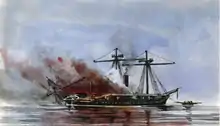
BAP Unión was a Peruvian corvette, originally ordered by the government of the Confederate States of America during the American Civil War. Built in France it was bought by the Peruvian Navy and during its service participated in the Chincha Islands War and in the War of the Pacific in which it was scuttled following the Blockade of Callao to prevent it falling into Chilean hands.[2]
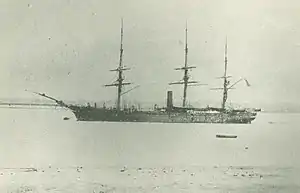 Unión at anchor, 1880 | |
| History | |
|---|---|
 Peru Peru | |
| Name | BAP Unión |
| Ordered | 6 June 1863 |
| Builder | Chantiers Dubigeon, Nantes, France |
| Laid down | December 1864 |
| Launched | 26 January 1865 |
| Completed | 10 June 1865 |
| Fate | Scuttled following the Blockade of Callao, 16 January 1881[1] |
| General characteristics | |
| Class and type | Steam corvette |
| Displacement | 2,016.66 t (1,984.81 long tons) |
| Length | 74.07 m (243.0 ft) |
| Beam | 11.12 m (36.5 ft) |
| Draft | 5.34 m (17.5 ft) |
| Installed power | 2,700 ihp (2,000 kW) |
| Propulsion |
|
| Speed | 13 knots (24 km/h; 15 mph) |
| Complement | 134 |
| Armament |
|
The current Peruvian training ship; BAP Unión, is named after this vessel.
History
Construction and purchase
During the American Civil War, the Confederate States ordered the French shipbuilder Henri Arman de Rivière to build 4 cruisers. He built 2 in his own shipyard in Bordeaux, under the names of Osaka and Yedo, which were to be called Louisiana and Mississippi. The other two were commissioned from his partner Voruz in Nantes, under the names of San Francisco and Shanghai, which were to be called Texas and Georgia. Due to pressure from American diplomacy, the cruisers were embargoed in 1864 when they were not yet completed. Those in Bordeaux were bought by Prussia, then at war with Denmark, while those in Nantes were bought by Peru in anticipation of a possible war with Spain.
Peru bought the two vessels in November 1864 at a cost of 2.3 million francs, equivalent to 92 thousand pounds sterling, which was more than the Huáscar monitor cost. The San Francisco took the name of America and the Shanghai became the Union. Lieutenant Commander Juan Pardo de Zela took command of the America and First Lieutenant Miguel Grau was assigned to the Union. Both corvettes, which were in Saint Nazaire, prepared to set sail for the Pacific in December 1864.
Breaking of the Blockade of Arica
Under the command of Manuel Villavicencio the Union was tasked with breaking the Blockade of Arica in order to deliver supplies to the beleaguered city.
The operation was a success with the vessel breaking the Arica blockade twice. It's casualties were several wounded and one dead.
The Union arrived in Callao on March 20.
Blockade of Callao and scuttling
The Chilean Navy began the Blockade of Callao in the early hours of 10 April 1880 which led to the Union being trapped.
on 16 January 1881, the Union and other ships of the Peruvian Navy were sunk in Callao to prevent them from falling into Chilean hands.
References
- Guerra del Pacífico, Carlos López Urrutia
- "Union corvette" (in Spanish). Peruvian Navy. Archived from the original on 4 June 2007. Retrieved 28 August 2021.