Union of Poor Peasants
The Union of Poor Peasants (Ukrainian: Спілка бідних хліборобів) was an underground anarchist organization, operating in the years 1905–1908 in the Huliaipole Raion in Ukraine.
| Union of Poor Peasants | |
|---|---|
| Спілка бідних хліборобів | |
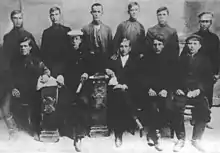 Nestor Makhno (sitting in the first row on the left) with other members of the Union of Poor Peasants on May 1, 1907. | |
| Leader | Woldemar Antoni, Oleksandr Semeniuta |
| Dates of operation | January 22, 1905–August 27, 1908 |
| Dissolved | March 1910 |
| Country |  Ukraine Ukraine |
| Headquarters | Huliaipole |
| Active regions | Huliaipole Raion, Ukraine |
| Ideology | Anarchism, expropriative anarchism |
| Political position | Far-left |
| Size | c. 50 |
| Opponents |  Russian Empire Russian Empire |
Activity
The organization initially operated under the guise of a theater group associated with the Coliseum theater in Huliaipole. The leaders were Czech - Woldemar Antoni (pseudonym Zarathustra, son of a socialist, worker, brought up from childhood in an anti-capitalist atmosphere) and a Ukrainian - Oleksandr Semeniuta (an anarchist defector from Odessa). They had about fifty permanent members and several hundred supporters. Initially, they dealt with the distribution of anarchist leaflets and appeals among the population. In 1905, Nestor Makhno became a member of the Poor Peasants (he took part in the first action in 1906).[1] Due to the lack of financial resources for its day-to-day operations (members lived in poverty or extreme poverty), the organization launched armed attacks on the local rich,[2] which was called expropriation by its members. There were many deaths then. Weapons were usually bought in Czerniowce in Bukovina, from where revolutionary literature was also brought. Spherical bombs were cast illegally at Kerner's plant in Huliaipole (they also attacked Boris Kerner himself). In July 1908, the group was weakened, some members died, including Ołeksander Semeniuta's wounded brother - Prokop, who shot himself in the head. Oleksandr was also killed later. On August 27, 1908, the group was finally exposed, 15 people were arrested, including Makhno. They waited for the sentence until March 1910. The punishments were death (including for Makhno), hard labor, imprisonment or penal colonies. Makhno avoided death only thanks to the forgery of his birth certificate, which indicated that he was a minor.[3]
See also
References
- Wierzchoś, Dariusz (13 April 2010). "Maria Nikiforowna – władczyni stepu" (in Polish). Rozbrat. Retrieved 12 May 2021.
- Maciek (9 June 2012). "Stanisław Łubieński- Pirat stepowy" (in Polish). Przez Historię. Archived from the original on 7 March 2016. Retrieved 12 May 2021.
- Łubieński, Stanisław (2012). Pirat stepowy (in Polish). Wołowiec: Wydawnictwo Czarne. pp. 14–19. ISBN 978-83-7536-367-8. OCLC 804699883.