Unrotated Projectile
The Unrotated Projectile, or UP, was a British 7-inch anti-aircraft rocket of the Second World War. It was developed for the Royal Navy by Alwyn Crow of the Projectile Development Establishment of the Ministry of Supply at Fort Halstead. It proved unreliable and ineffective in operation, and was withdrawn from use in 1941. Development of the concept led to the UP-2 and UP-3, which had smaller diameters of 2 in (51 mm) or 3 in (76 mm) respectively but were longer. The latter was used as the basis of the Z Battery anti-aircraft weapons and later developed in air-to-ground form as the RP-3, used against ground forces and shipping by aircraft like the Hawker Typhoon..

Background
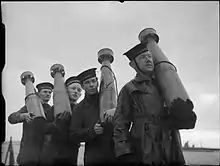
Awareness of French and German rocket research in the early 30s coincided with rearmament from 1934 and by 1935 the Research Department had set up specialist branches in the Ballistics Directorate and the Explosives Directorate to look into the use of rockets against aircraft. To a lesser extent the researchers looked into long-range rocketry as a replacement for pilotless aircraft and use as a take-off aid for heavily-laden aircraft. The Ballistics Directorate designed components and studied ballistics theory, prediction and stability. The Explosives Directorate worked on a propellant which burnt at a "steady controllable pressure; whose surface, during burning, will remain constant and which will leave, at the end of the burning, as little un-burnt residue as possible". The research threw up more problems; the charges had to be packed in non-inflammable material and a substance had to be developed that was impervious to rapid acceleration and differential gas pressure.[1]
The acceleration of a rocket was far slower than that of projectiles which meant that a new type of fuze, not reliant on acceleration to be armed, was necessary. The cordite propellant had to be formed in unusual shapes which made extrusion a much more elaborate process but by 1936, the Director of Ballistics Research, Alwyn Crow reported that the use of rockets should be considered as weapons of war. A new propellant, solvent-less cordite (Cordite SC) was invented and in July 1936 Crow took over a new Projectile Development Establishment at Fort Halstead which was overseen by the Sub-Committee on Air Defence Research of the Committee of Imperial Defence.[1] In November 1939, Winston Churchill as First Lord of the Admiralty asked Crow urgently to design a means of laying an aerial minefield and to consider other methods of protecting ships against aircraft. It is likely that Churchill was influenced in his request by his friend and scientific advisor, Frederick Lindemann, who had previously advocated a scheme for "dropping bombs hanging by wires in the path of attacking aircraft".[2]
Designs

In October 1937 the Sub-Committee on Air Defence decided that the 3-inch rocket would take precedence over the 2-inch projectile and that the policy would be to obtain a rocket which, though not ideal, would be a practical weapon. Work on the 2-inch rocket was set aside for the 3-inch version which was comparable to the ammunition fired by the QF 3-inch 20 cwt and QF 3.7-inch anti-aircraft guns for use against aircraft at medium and high altitudes. By the end of 1938 trials of components were complete (except for the fuze) and proposals for twin and quadruple projectors were solicited from Vickers-Armstrongs. An advantage of a rocket weapon was that it did not need to be produced by traditional armaments firms, except for the novel Cordite SC which would need new facilities at Royal Ordnance Factories.[3]
The term unrotated projectile was a cover name to disguise the use of a rocket system and comes from the fact that the projectile was not spin-stabilized. The naval weapon had 20 smoothbore tubes and fired ten at a time. A small cordite charge was used to ignite a rocket motor which propelled the fin-stabilized 7 in-diameter (18 cm) rocket out of the tube to a distance of about 1,000 ft (300 m), where it exploded and released an 8.4 oz (240 g)-mine attached to three parachutes by 400 ft (120 m) of wire. An aeroplane hitting the wire would draw the mine towards itself, where it would detonate. A high-altitude barrage was developed of an aerial minefield up to 19,000 ft (5,800 m), the fast aerial mine up to 2,000 ft (610 m), with the PE fuse up to 18,000 ft (5,500 m) and the UP up to 20,000 ft (6,100 m). The 7-inch UP was developed simultaneously with the 2-inch and 3-inch UP systems, the latter being deployed in anti-aircraft Z Batteries which were operated by the Home Guard and was the basis of the RP-3 air-to-surface rocket and the Mattress surface-to-surface multiple rocket launcher.[4]
The Admiralty was more interested in the rocket as a weapon but the War Office took the view that rockets would be useful as an area weapon and envisaged 285 rocket units with four quadruple launchers apiece and sixty launchers in reserve, which might also allow the QF 3-inch 20 cwt guns to be put in reserve, ready to equip new units raised if war came. The Army waited on trials of the rockets conducted in Jamaica in early 1939, which were judged to fe satisfactory and the Sub-Committee on air Defence Research recommended that the 3-inch UP be taken into service. The decision was postponed because the Director of Artillery judged the rocket lacked the accuracy for medium and high altitude fire. The rocket project languished until the emergency of Dunkirk in June 1940. It was assumed that the rocket would lack the accuracy of gunfire but this assumed that accurately aimed shells were necessary. There was a paradox in trying to predict the position of an aircraft in time and space when the direction, height and speed of an aeroplane was inherently unpredictable. It had not been possible to test conventional anti-aircraft fire under wartime conditions, to calculate a statistical norm for the number of shells needed to shoot down a Luftwaffe aircraft. It had been assumed that the 3-inch rocket would have a less stable trajectory and that this would make prediction more difficult but this did not take account of the larger explosive charge carried by the rocket, which needed a much thinner casing than that of a shell.[5]
By 1943 Coastal Command decided that RP-3 rockets could be more than a supplement for torpedoes in attacks on Merchant ships in the North Sea. The RP-3 was about 6 ft (1.8 m) long and 3 in (0.076 m) diameter with 11–12 lb (5.0–5.4 kg) of propellant and either 60 lb (27 kg) of TNT or Amatol warhead or a 25 lb (11 kg) solid armour-piercing projectile. The armour-piercing head was tested against U-boats early in the year but the explosive type was to be tried first on ships. Tests from a Beaufighter were conducted in March and April; rails were fitted to Beaufighters of two Coastal Command squadrons and a target ship was moored of North Coates for training. On 22 June 1943, the North Coates Strike Wing used the RP-3 in an attack on an Axis convoy between The Hague and Den Helder. The German ships also used a new device, a rocket which lifted a cable-on-a-parachute into the air. The FlaK suppression Beaufighter crews claimed to have damaged four FlaK ships with rockets (not upheld by research after the war) and two Beaufighters were shot down.[6]
Effectiveness
A demonstration of the naval rocket containing canisters filled with a parachute, wire and an explosive device to be fired at dive bombers, was laid on for Churchill on HMS Hood, flagship of the Home Fleet (Admiral Jack Tovey) at Scapa Flow which dramatically exposed a flaw in the concept. Practice rockets were fired and drifted onto the ship, due to an unexpected change of wind and got tangled in the rigging and superstructure. The dummy rounds caused little damage but Tovey was amused at the embarrassment caused to the weapon's advocates, Lindemann and Churchill.[7] Five projectors for twenty rockets each were installed on Hood but they misfired twice in action and in one firing managed to burn some sailors in harbour.[8] The UP ammunition aboard HMS Hood was seen to be on fire just before she exploded and sank in May 1941. The report of the Admiralty Board of Enquiry into the sinking of Hood in September 1941 concluded "That the fire that was seen on Hood's boat deck, and in which UP and/or 4-inch ammunition was certainly involved, was not the cause of her loss", but it noted that "Action has (already) been taken to land UP mountings and ammunition" in the rest of the fleet.[9] The weapon was not very effective, it was slow to load, aircraft could avoid the wires and it was replaced by the QF 2-pounder naval gun or Bofors 40 mm gun.
Specifications
- Rocket length: 32 in (810 mm)
- Rocket weight: 35 lb (16 kg)
- Horizontal range: 3,000 ft (910 m)
- Sinking speed of mine: 16–23 ft/s (4.9–7.0 m/s)
- Mounting weight: 4 t (4.0 t)
See also
- AA mine discharger - a Japanese anti-aircraft mortar
- Henschel Hs 297 / 7.3 cm Föhn-Gerät - a German anti-aircraft rocket launcher
- Holman Projector - a steam-powered anti-aircraft grenade launcher
- Z battery British 3-inch land-based anti-aircraft rocket launcher
Footnotes
- Postan, Hay & Scott 1964, p. 286.
- Furneaux-Smith 1961, p. 210.
- Postan, Hay & Scott 1964, p. 287.
- Furneaux-Smith 1961, p. 234.
- Postan, Hay & Scott 1964, pp. 287–288.
- Goulter 2004, p. 208.
- "Admiral of the Fleet Lord Tovey of Langton Matravers, G.C.B., K.B.E., D.S.O., D.C.L." (PDF). The Naval Review. July 1980. Retrieved 5 August 2010.
- Edgerton 2012, p. 108.
- ADM 116/4351: Report on the Loss of H.M.S. Hood
Bibliography
- Edgerton, David (2012). Britain's War Machine: Weapons, Resources, and Experts in the Second World War. London: Penguin Books. ISBN 978-0-14-102610-7.
- Furneaux-Smith, F. (1961). The Professor and the Prime Minister: The Official Life of Professor F. A. Lindemann Viscount Cherwell. Boston: Houghton Mifflin. OCLC 254329640.
- Goulter, Christina J. M. (2004) [1995]. Cox, Sebastian (ed.). A Forgotten Offensive: Royal Air Force Coastal Command's Anti-shipping Campaign, 1940–1945. Cass Studies in Air Power (pbk. repr. ed.). London: Frank Cass. ISBN 978-0-7146-4147-8.
- Postan, M. M.; Hay, D.; Scott, J. D. (1964). Hancock, K. (ed.). Design and Development of Weapons: Studies in Government and Industrial Organisation. History of the Second World War, United Kingdom Civil Series. London: HMSO & Longmans, Green & Co . ISBN 978-0-11630-089-8.
Further reading
- Postan, M. M. (1952). British War Production. History of the Second World War, United Kingdom Civil Series. London: HMSO. OCLC 459583161.
External links
 |
Wikimedia Commons has media related to Unrotated Projectile. |