Variyan Kunnathu Kunjahammed Haji
Variyankunnathu Kunjahammed Haji (1883 – 20 January 1922)[3][4] was an active member of Khilafat Movement.[5][6] According to RH Hitchcock who took part in the fight against the rebellion "Khilaft to him (Variamkunnath Kunjahammad Haji) was a Turkish matter not Indian".[7] He was an ordinary member of Khilafat Movement.[8]He established a parallel government in Malabar District of Madras Presidency in open defiance of the British Raj, which lasted for a short period of six months. With his long term mentor, Ali Musliyar, Kunjahammed Haji seized large areas of the then Eranad and Valluvanad taluks, now part of the Kerala state in India from British control.[9] [10] He said he was fighting for the independence of India.[11]
Variyan Kunnathu Kunjahammed Haji | |
|---|---|
| Born | 1883 |
| Died | 20 January 1922 (aged 38–39) Kottakkunnu, Malappuram, Malabar District, Madras Presidency, British Raj (present-day Kerala, India) |
| Cause of death | Execution by shooting |
| Organization | Khilafat Movement[1] |
| Known for | Malabar rebellion Khilafat Movement |
| Spouse(s) | Ruqiyya
(m. 1905, Death)Sainaba
(m. 1908, Death)
|
| Parents |
|
In 2021, under the Modi government, Indian Council of Historical Research gave recommendation to the Indian Government to remove the names of Haji and 386 others from the Dictionary of Martyrs of India’s Freedom Struggle.[12]
Message to the Friends of Freedom for India
On December 7, 1921, two American newspapers reported the message received by the Friends of Freedom for India from Variamkunnath Kunhamed Haji in a cablegram.[13] [14] In these two American newspaper reports the message was preceded by the following sentence : "Charges that the Moplahs of Malabar have put to death many Hindus and forcibly converted others to Mohammedanism were denied and characterized as part of a British plot to discredit the Moplah movement of India's independence in a cablegram from Variamkunnath Kunhamed Haji ..."[15][16] In the message he said :
"A few cases of conversion of our Hindu brethren have been reported to me." the message said. "But after proper investigation we discovered the real plot. The vandals that were guilty of this crime were members of the British reserve police and British intelligence department, and they joined our forces as patriots to do such filthy work only to discredit our soldiers. There are Christians, Hindus and Moplahs amongst these British agents and spies. They have decidedly been put to death.[17]
"We are at war with England. We are fighting for the independence of India, and we are doing exactly what the Americans did to free America from British domination. So anyone giving aid and comfort to the enemy will be se verely dealt with, irrespective of social position or religious affliation.
"Let the great people of the great land of Washington postpone judgment until they have a chance to know the full truth about the present war in Malabar."
" [18]
Involvement in the events of war
Leadership
Haji was not active in anti-British activities for some years.[19] RH Hitchcock says "for six years he lived an irreproachable life".[20] It was during the rebellion began after the firing incident took place in Thirurangadi by Collector Thomas at a large group of people gathered there that he again became active in the struggle against the British. Unlike Jallianwala Bagh Massacre of 1919, the Thirurangadi firing got suppressed. The firing occured when Ali Musliyar approached the British requesting to release the people arrested and at a time when he became ready to stop the protest. The firing was resisted effectively though casualties occured. The rebellion began bringing some area of South Malabar under the control of the leaders of the Rebellion started after suppresing the Thirurangadi firing on August 20, 1921. Next day of the Thirurangadi firing incident Haji took the leadership of the rebellion against the British.[21]
Military
His military included a group of previous members of military who fought in the First World War. They had weapons those were seized and those were manufactured after the rebellion started.[22] Most of his military were Khilafat Movement members[23] His forces against the British included uniformed members and a certain number of ex-sepoys [24]
Escape of adversaries
As the rebellion helmed by the Haji and others began to spread across the Ernad and Valluvanad taluks of erstwhile Malabar district, British officers and the local police loyal to them escaped[25] From the first day of war those fled to Kozhikode from Eranad include some pro-British Mappilas besides Jenmis.[26] In South Malabar, especially Walluvanad, many Hindus along with Muslims attacked government institutions. At this time even some Nambudiris were with Khilafat Movement members[27]
Plot by British loyalists
From the first day of war, looting also started. Looters include even CI Narayana Menon who participated in the looting wearing Mappila dress. CI Narayana Menon used criminals and prisoners to loot. One of the main looters of Thirurangadi was Kizhakan Mukari who was pretending as Variamkunnan. Fifteen looters including Mukhari was caught by on very August 21, 1921. All of them were militant employees of Khan Bahadur-Khan Sahibs. Those who tried to loot Namboori Bank were Mappilas loyal to the British[28] Thus the loot was carried out by those who are loyal to the British.[29] The main people who tried to thrawt the war against the British were the Mappilas loyal to the British. Intervention by Ali Musliyar and Variamkunnan stopped their attempt to an extent[30]
Manjeri proclamation
Around August 25, 1921 he declared an independent state in Manjeri [31] [32] with Haji it's undisputed ruler.[33] Later on its own passport, currency, and its own system of taxation were introduced[34] Even in the Manjeri proclamation which was made within few days after the rebellion started he said he knew it is propagated in the outside world that it's a war between the Muslims and Hindus. He also blamed Mappilas loyal to the British similar to Khan Bahadur Chekkutti and Jenmis for propagating this. He also said he did not intent to make it a Muslims' only country.[35]
Battle of Pookottur
He set up an armed force to attack the British force at Pookottur on their way to rescue the British military personnel stuck in the area ruled by Variamkunnath Kunjahammad Haji. And the Battle of Pookottur was fought on August 26 ,1921.[36]
Surrender of Ali Musliyar
On August 30, 1921, A firing occurred at Thirurangadi mosque in which 114 people including Ali Musliyar were present between the British force and those inside the mosque. A huge casualties occured on both sides. Seven people managed to escape. Ali Musliyar and 39 followers surrendered when he became certain that the mosque will be distroyed. Immediately after this Variamkunnath Kunjahammad Haji asked his soldiers to move to forests.[37]
British martial law
Immediately after the surrender of Ali Musliyar, Variamkunnath Kunjahammad Haji had asked his forces to move to forests. On September 1, 1921, martial law was declared specifically targeting Mappilas by the British. Those who would allow Mappillas who come from certain area to live were to be punished and in case Mappillas come to live nearby, it was to be reported to the nearest police station to avoid punishment. Because of the law Mappilas could not go outside or shop or moque. But Mappilas loyal to the British got pass so that they could move freely.
Massacres of Mappilas
Even a vast number Mappilas who did not take part in any protest were also tortured. The British conducted a series of massacres against Muslims, in several places. Women were raped. Mappilas' houses were burnt. On September 2, 1921, the British force which arrived at Manjeri attacked all Mappila houses. Then came an order from the British to shoot all Mappillas seen outside. A group of lower caste Hindus would shave their head like Mappilas. So even many lower caste Hindus as well as Mappillas were killed because of this.
Divide and rule policy
Some Jenmis betrayed Mappilas. Under the pretext of revenge, militant employees of the Mappilas loyal to the British unleashed cruelty. They looted houses. Some ordinary Mapilas joined them for vengeance thereby causing the goal of Mappillas loyal to the British, to destroy Hindu-Muslim unity, to be fulfilled. Hindu-Muslim enemity grew. This was part of divide and rule policy of the British. They propagated it was a Hindu-Muslim riot through newspapers.[38] All this happed after the British marshal law was declared. And the British brought almost all area under their control.[39][40]
Guerrilla war
On 13 September 1921, guerrilla war was started by Variamkunnath Kunjahammad Haji. They carried out guerrilla war with separate small groups of 50-500 people. They began to seize the food for the British force. The British would not succeed in the war.[41]
Martial law and passport
On 16 September 1921, he declared martial law in Nalambur. As per the martial law orders a pass was required to leave the area under his control. Moreover the British and people loyal to the British were not allowed to come outside after afternoon ; if seen violating they may be fired at.[42] [43]He issued passports[44] for that purpose.[45] With his martial law the people denied freedom to move were the people loyal to the British.[46] The most important thing he did after declaring martial law was punishing those who helped the British and carried out riot.[47]
Coming of Gurkhas
From October 12, 1921, force including Gurkhas, Chins and Kachins came to Malabar. Important reason for the failure of the First War of Independence was Gurkhas. They were more interested in conducting massacres of ordinary people than fighting war directly.[48] The Mappilas were becoming unsuccessful in the fight while the number of Gurkhas was more in number and with so many modern weapons.[49][50]
Battle of Areekode
There were six or seven people who left from the Variamkunnan's movement.They made some violence in Areekode.Variamkunnan restored peace there. Knowing this, force from the British side reached there and made a fight. In the fight seventeen people from the Variamkunnan's force and as per the witnesses all from the British side got killed. Later Gurkhas threw bomb on the Variamkunnan's force who were hiding in the shrubs and a large number of people got killed.[51][52]
Battle of Pandikkad
Variamkunnan decided to revenge Gurkhas, who killed children and raped woman.[53] Thus on November 13, 1921, the Battle of Pandikkad was fought. Variamkunnan's force made a pre-emptive attack on Gurkha regiment camp in which there were 150-300 Grurkhas, at night. 75-120 of the Gurkhas were killed.[54] Thus they revenged Gurkhas.[55]
Genocide of Mappilas
Again a great series of massacres were unleashed against innocent Mappilas. There was no a day without the massacre of 200-300 Mappilas. This led to weakening of the fight against the British forces and started to surrender.[56][57]
Attack at Hajippara
Variamkunnan had camped at Hajippara. A group including Gurkhas and Kachins attacked here and became successful in taking so much rice and cattle. In the fight 17 from Variamkunnan's side and 35 from Gurkha-Kachins side got killed.[58]
Attack at Kallaamoola
He changed his hiding place to Kallaamoola hill storing food centering it valley Kurukkan Pottikkulam. On December 8, 1921, a large group consisting of Gurkhas and Kachis attacked this place as well. In this war a huge loss occured for Variamkunnan. Large amount of rice and thousands of cattle were captured from there. In this attack 13 from Gurkhas, 8 from Kachins and 24 from the Variamkunnan's side got killed. And Cherumas and Advasis also were captured and brought to Nilambur besides the food.[59]
Retaliation by Variamkunnan
Variamkunnan attacked Bangalow and saved his captured Cheruman-Advasi soldiers of this force on December 11, 1921. Right after this he went to Goodalloor were he attacked and killed a policeman, who was at Panthalloor training camp, belonging to British force. After this Variamkunnan's group got divided to three. One attacked a police station and killed three from the police under British rule. Another group attacked survey office under the British rule and killed three from them. The third group attacked a post office and killed a policeman. In this operation Variamkunnan's force got huge victory. In this fight 7 people got killed on Variamkunnan's side and 27 on the other.[60]
Surrender of soldiers
The soldiers of Variamkunnan began to surrender when genocide against Mappillas countinued.[61][62]
Karuvarakund Meeting
To avoid the genocide of the innocent, people including the leaders began to think of surrendering. Chembrasseri Thangal, Seethi Koya Thangal and Unneen Kutty Haji suggested surrender. Though it shocked Variamkunnan, he did not express it.[63][64]
Abolishment of military
He abolished the army after he could not make military operation at Palemad. He could not move to Palemad because he was surrounded by the British force. It's said that 25000 of Variamkunnan's forces had reached Palemad on December 18, 1921.[65][66]
Surrender of leaders
Leaders Chembrasseri Thangal and Seethi Koya Thangal surrendered.[67] Chembrassery Thangal's right hand Unneen Kutty Haji and his 450 followers surrendered. Thus a huge number of surrenders took place this time.[68]
Capture of Variamkunnan
On January 5, 1922, through a planned operation, Variamkunnan was captured.Variamkunnan wrestled for half an hour and he was chained[69]
Early life
Haji was born in a Muslim merchant family in 1883 in Valluvangad. His family later moved to Nellikuth village, near Manjeri, Malappuram district. He was the second child of his parents, Chakkiparamban Moideenkutty Haji and Kunjaisha Hajjumma. Moideenkutty Haji was a merchant, farmer, and local leader. He was imprisoned in Andaman for taking part in the 1894 Mannarkkad Rebellion.[2]
He pursued his basic religious education from village Madrasa, later upgraded as 'Ezhuthukalari' where Malayalam language was also part of curriculam. He studied many Arabic texts from Mammad Kutty Musliyar. After his father was deported to Andaman, Haji was brought up in his mother's family. His grandfather was also a local leader, he appointed a teacher named Balakrishnan Ezhuthachan, from whom he learnt Malayalam and basic English along with other grandchildren of his grandfather. He was also trained in martial arts along with his primary education.[74]
Haji could also be seen as the one who was very passionate of traditional mappila art forms, he used to conduct Kolkkali, Daffumutt, and Katha Prasangam. It is also said that he was good singer too. The acceptance he acquired through performing arts soon made him popular in community. The deportation of his father and other rebels and the seizure of their lands and properties followed, triggered his anger and hostility towards British.[2]
Manjeri Peasant Revolt
In 1896 Manjeri Kovilakam landlords started to evacuate the tenants from their lands. The conflict between tenants and landlords along with British following the evacuation of tenants from their lands. The landless tenants started to revolt under the leadership of Variyan Kunnathu Kunjammad Haji. They seized land and properties of the land lords. British army came to help the landlords. The conflict caused British to risk 94 out of 100 their soldiers. Inspector Khan Bahadhur Chekkutty tried to arrest Haji but CI Kurikkal, one of his friend helped him. Haji has become under constant surveillance of British spies. His friends and family insisted him to leave for Mecca when they smelt that Chekkutty is planning to arrest him immediately. sooner he left to Bombay, then to Mecca. During the self imposed exile, he visited home several times but was compelled to go back due to the continued surveillance before he finally decided to settle permanently at his native place in 1914.[75]
Marriage and Family
Haji returned from Mecca in 1905 and married Ruqiyya; daughter of Unni Muhammed. After her death in 1908, he married Sainaba; the sister of one of his friends. In 1920 Haji married his cousin Malu Hajjumma (Paravetti Fathima); daughter of his uncle Koyammu Haji. They were brought up in same home and this was third marriage for both of them. Malu had an important role in Haji's life.[76]
Malabar rebellion
There are many events that could be seen as undercurrents that caused Malabar rebellion. The conflict between tenants and landlords along with British following the evacuation of tenants from their farming lands fired up the British. Tenants were mostly from lower caste and mappilas. The immediate reason of the Malabar War was the rumor spread that the British army destroyed Mamburam mosque and Makkham following British army's raid in the mosque in the name of arm hunt. Ali Musaliyar, followed by a crowd went to Thirurangadi Kacheri(the compound including police station, register office, magistrate court, post office) to inquire about the incident. Seeing the Ali Musaliyar and the crowd with him the Collector ordered the Police to shoot them without any provocation. The crowd was huge, they got triggered by the sudden action and stated to attack back. They killed some Policemen and seized the police station. Collector and other officials fled to Calicut.[9]
State declaration
Following Thirurangadi Mosque attack on 20 August 1920, people were up in arms. Haji mobulised them . They attacked and seized police station, treasuries, courts, registrar and other government offices. The rebellion soon spread to the nearby areas of Malappuram, Manjeri, Pandikad and Tirur under leadership of Variyan Kunnath Kunjahammad Haji, Seethi Koya Thangal, Chembrassery Thangal and Ali Musliyar. Police, army, and other British officials escaped from areas like Malappuram, Manjeri, Thiruragadi and Perinthalmanna, become independent of British by 28 August 1921.[75][77]
Since the police and other forces escaped from Eranad, Valluvanadu and Ponnani, Haji declared it as an Independent Islamic state from British. According to Hitchcock,[78] the name of this state was Doula; Arabic equivalent word for state.
Haji had already planned well about the foundation of the Islamic state. He organised the ex-military officers who fought for British in First World War and were sent without adequate pension Nayik Thaami, the commander of Variyan Kunnath wrote in his diary that "Doula" had almost 60000 soldiers in his Army.[79]
On 24 August 1921, Variyan Kunnath Kunjahammad Haji took over command of the War from Ali Musliyar. On 30 August 1921, the mob rebels under Haji killed Khan Bahadur Chekkutty, a police officer.The state declaration was conducted in Manjeri.
Letter to The Hindu
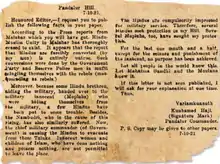
The letter written by Variyan Kunnathu Kunjahammed Haji, which appeared on the newspaper The Hindu on October 18, 1921:[80]
"Honoured Editor, I request you to publish the following facts in your paper. According to the Press Reports from Malabar which you will have got. Hindu-Muslim Unity in Malabar has thoroughly ceased to exist. It appears that the report that Hindus are forcibly converted (by any men) is entirely untrue. Such conversions were done by the Government Party and Reserve Policemen in mufti mingling themselves with the rebels (masquerading as rebels.) Moreover, because some Hindu brethren, aiding the military, handed over to the military innocent (Moplahs) who were hiding themselves from the military, a few Hindus have been put to some trouble. Besides, the Nambudiri, who is the cause of this rising, has also similarly suffered. The Hindus are compulsorily impressed for military service. Therefore, several Hindus seek protection in my Hill. Several Moplahs, too, have sought my protection. Now the chief military commander [of the government] is causing Hindus to evacuate from these Taluks. Innocent women and children of Islam, who have done nothing and possess nothing, are not permitted to leave the place. For the last one month and a half, except for the seizure and punishment of the innocent, no purpose has been achieved. Let all the people in the world know this. Let Mahatma Gandhi and Moulana know it. If this letter is not seen published, I will ask your explanation at one time."
Action against persecution of Hindus
Punishment
He was of the opinion that the reported forced conversions during the Malabar rebellion were done by the Government Party and Reserve Policemen in mufti mingling themselves with the rebels (masquerading as rebels.)[81][82][83] He said in a cablegram to have put the British agents and spies joined his forces as partriots only to discredit his soldiers to death, after the report of alleged forced conversion of Hindus to Mohammedanism and killing the rest of the Hindus.[84]
Publicising alleged plot
In two American newspapers, report about his message to the Friends of Freedom for India was preceded by the following sentence : "Charges that the Moplahs of Malabar have put to death many Hindus and forcibly converted others to Mohammedanism were denied and characterized as part of a British plot to discredit the Moplah movement of India's independence in a cablegram from Variamkunnath Kunhamed Haji ..."[85][86]
Execution
Haji was sentenced to death, executed by Commander Colonel Humphrey's firing squad for his involvement in Malabar rebellion.[3] He was shot dead on 20 January 1922 at Kottakkunnu. While reporting his death, The Guardian reported that Haji wanted to establish a Moplah Kingdom in Malabar.[88]
References
- Miller, R.E. Encyclopaedia Dictionary Islam Muslim World, etc V 6. p. 459. Retrieved 29 February 2020.
This course of events reached its final denouement in the Malabar Rebellion of 1921, frequently called the Mappila Rebellion. This was a spontaneous uprising (not one of "systematic preparation", as stated by T.W. Arnold, EI, Mappilas) that included the establishment of a temporary "Moplastan" in Ernad, South Malabar, under V.K. Kunyahamad Haji.
- Adul Kareem, KK Muhammed (1992). Variyankunnathu kunjahammed Haji. Kozhikkode. p. 24.
- Varma, Vishnu (25 June 2020). "Explained: Variyamkunnath Kunjahammed Haji, the Khilafat leader who declared an independent state". The Indian Express. Retrieved 31 October 2021.
- V, Ajmal (25 October 2018). "After 97 years, a forgotten British massacre uncovered". Deccan Herald. Retrieved 31 October 2021.
- EncyclopaediaDictionaryIslamMuslimWorld Volume 6. 1988. p. 460.
Contemporary evaluation within India tends to the view that the Malabar Rebellion was a war of liberation, and in 1971 the Kerala Government granted the remaining active participants in the revolt the accolade of Ayagi, "freedom fighter"
- C. Gopalan Nair (1923). Moplah Rebellion, 1921. p. 77. Retrieved 28 January 2020.
He styled himself Raja of the Hindus, Amir of the Mohammedans and Colonel of the Khilafat Army
- RH Hitchcock. Peasant Revolt in Malabar, A History of Malabar Rebellion 1921. p. 58.
- Ramees Muhammad. Sultan Variamkunnan. p. 143.
- K. N. Panikkar (1991). Peasant protests and revolts in Malabar. Indian Council of Historical Research.
- "The Mapilla Rebellion : 1921-1922". Retrieved 9 November 2019.
- "Clipped From Detroit Free Press". Detroit Free Press. 7 December 1921. p. 10. Retrieved 10 December 2021.
- "ICHR Panel Seeks Removal of Names of 387 'Moplah Martyrs' from Dictionary of Martyrs of India's Freedom Struggle". News18.
- "7 Dec 1921, Page 10 - Detroit Free Press at Newspapers.com". Newspapers.com. Retrieved 8 December 2021.
- "7 Dec 1921, 6 - The Baltimore Sun at Newspapers.com". Newspapers.com. Retrieved 8 December 2021.
- "The Baltimore Sun from Baltimore, Maryland on December 7, 1921 · 6". Newspapers.com. Retrieved 9 December 2021.
- "Clipped From Detroit Free Press". Detroit Free Press. 7 December 1921. p. 10. Retrieved 9 December 2021.
- "7 Dec 1921, 6 - The Baltimore Sun at Newspapers.com". Newspapers.com. Retrieved 8 December 2021.
- "Clipped From Detroit Free Press". Detroit Free Press. 7 December 1921. p. 10. Retrieved 8 December 2021.
- RH Hitchcock. Peasant Revolt in Malabar, A History of the Malabar Rebellion 1921. p. 58.
- RH Hitchcock. Peasant Revolt in Malabar, A History of Malabar Rebellion 1921. p. 58.
- Ramees Muhammad. Sultan Variamkunnan. ISBN 978-81-954397-0-6.
- Ramees Muhammad. Sultan Variamkunnan. ISBN 978-81-954397-0-6.
- Prof. MPS Menon. Malabar Samaram, MP Narayana Menonum Sahapravarthakarum. p. 78.
- "Newcastle Daily Chronicle". 26 August 1921.
- "Explained: Variyamkunnath Kunjahammed Haji, the Khilafat leader who declared an independent state". The Indian Express. 25 June 2020. Retrieved 11 December 2021.
- KK Abdul Kareem. Variamkunnath Kunjahammad Haji. p. 54.
- Prof. MPS Menon. Malabar Samaram, MP Narayanamenonum Sahapravarthakarum. pp. 108–109.
- Ramses Muhammad. Sultan Variamkunnan. pp. 146–148.
- Ramses Muhammad. Sultan Variamkunnan. p. 148.
- Ramees Muhammad. Sultan Variamkunnan. p. 151.
- Ramees Muhammad. Sultan Variamkunnan. p. 164.
- "Explained: Variyamkunnath Kunjahammed Haji, the Khilafat leader who declared an independent state". The Indian Express. 25 June 2020. Retrieved 10 December 2021.
- "Explained: Variyamkunnath Kunjahammed Haji, the Khilafat leader who declared an independent state". The Indian Express. 25 June 2020. Retrieved 11 December 2021.
- "Explained: Variyamkunnath Kunjahammed Haji, the Khilafat leader who declared an independent state". The Indian Express. 25 June 2020. Retrieved 10 December 2021.
- Ramees Muhammad. Sultan Variamkunnan. pp. 164–165.
- Ramses Muhammad. Sultan Variamkunnan. pp. 171–174.
- Ramses Muhammad. Sultan Variamkunnan. pp. 182–185.
- Ramees Muhammad. Sultan Variamkunnan. pp. 190–193.
- Ramees Muhammad. Sultan Variamkunnan. p. 195.
- Ramses Muhammad. Sultan Variamkunnan. pp. 190–193.
- Ramees Muhammad. Sultan Variamkunnan. pp. 197–198.
- Ramees Muhammad. Sultan Variamkunnan. pp. 199–200.
- The Moplah Rebellion of 1921-1922 And Its Genesis, Conrad Wood page 302; Mappilasamudayam charithram samskaaram, T Muhammad, page 359; Malabar kalabam, Madhavan Nair, page 196
- The Moppilla Rebellion 1921: Peasant Revolt in Malabar, Robert L Hardgrave Jr., Page 16; Moplah Rebellion 1921, Diwan Bahadur C Gopalan Nair, Page 78; Madras Mail, 17 September 1921
- The Moppilla Rebellion 1921: Peasant Revolt in Malabar, Robert L Hardgrave Jr., Page 16; Moplah Rebellion 1921, Diwan Bahadur C Gopalan Nair, Page 78
- Ramses Muhammad. Sultan Variamkunnan. p. 199.
- Ramees Muhammad. Sultan Variamkunnan. p. 202.
- Ramees Muhammad. Sultan Variamkunnan. p. 218.
- Ramses Muhammad. Sultan Variamkunnan. p. 220.
- Mappilasamudaayam Charithram Samskaaram, T Muhammad 414, 415
- Ramees Muhammad. Sultan Variamkunnan. p. 221.
- Anglo Mappilla Yuddam 1921, AK Kodoor, page 268
- Ramees Muhammad. Sultan Variamkunnan. p. 226.
- Ramees Muhammad. Sultan Variamkunnan. pp. 227–228.
- Ramees Muhammad. Sultan Variamkunnan. p. 228.
- Ramees Muhammad. Sultan Variamkunnan. pp. 230–231.
- Mappilasamoothayam Charithram Samskaaram, T Muhammad, page 386
- Peasant Revolt in Malabar,. A History of the Malabar Rebellion 1921, RH Hitchcock, page 165, Anglo Mappila Yuddam 1921, AK Kodoor, page 311
- Peasant Revolt in Malabar,. A History of the Malabar Rebellion 1921, RH Hitchcock, page 165, Anglo Mappila Yuddam 1921, AK Kodoor, page 311
- Anglo Mappila Yuddam 1921, AK Kodoor, page 311; Variamkunnath Kunjahammad Haji KK Abdul Kareem, page 125; Anglo Mappila Yuddam 1921, AK Kodoor 311, Mappilasamudaayam Charithram Samskaaram, T Muhammad, page 410
- Ramees Muhammad. Sultan Variamkunnan. p. 231.
- Mappilasamudaayam charithram samskaram, T Muhammad, page 386
- Ramees Muhammad. Sultan Variamkunnan. p. 244.
- Anglo-Mappila Yuddam 1921, AK Kodoor, 312, 313
- Ramses Muhammad. Sultan Variamkunnan. pp. 246–247.
- Anglo-Mappila Yuddam 1921, AK Kodoor, page 314; Variamkunnath Kunjahammad Haji, KK Abdul Kareem, page 130;
- Ramees Muhammad. Sultan Variamkunnan. p. 251.
- Peasant Revolt in Malabar 1921, A History of the Malabar Rebellion 1921, RH Hitchcock, page 98; Anglo Mappila Yuddam, AK Kodoor, page 315, 316.
- Ramees Muhammad. Sultan Variamkunnan. pp. 256–260.
- Ramees Muhammad. Sultan Variamkunnan. p. 272.
- Anglo-Mappila Yuddam 1921, AK Kodoor page 130, 197
- Ramees Muhammad. Sultan Variamkunnan. pp. 264–265.
- Anglo-Mappila Yuddam 1921, AK Kodoor, page 327; Interview with Alavi Kakkadan, 8 September 2016
- Jaleel, Dr KT (2015). Malabar Kalapam Oru Punar Vayana. Thiruvananthapuram: Chinatha Publishers. p. 79. ISBN 978-93-86112-66-8.
- Menon, MPS (1992). Malabar Samaram MP Narayanamenonum Sahapravarthakarum. Kozhikkode: Islamic Publishing House. p. 77. ISBN 81-8271-100-2.
- GEETHA, P (2015). 1921 cHILA cHARITHRA vARTHAMANGAL. THRISSUR: CURRENT BOOKS. p. 71. ISBN 978-81-226-1265-3.
- mozhikunnath Barahmadhatthan, Nambbodiripadd (1965). Khilafat Smaranakal. calicut. p. 54.
- RH Hitch cock, 1983 Peasant revolt in Malabar, History of Malabar Rebellion 1921.
- Hitchcock, RH (1983). A History Of Malabar the War. Delhi: Usha Publications. p. 57.
- K. S. Sudhi (25 June 2020). "Reports of Hindu-Muslim strife in Malabar baseless, wrote Variamkunnath Kunhamed Haji in The Hindu in 1921". The Hindu. Retrieved 4 October 2020.
- Sudhi, K. s (25 June 2020). "Reports of Hindu-Muslim strife in Malabar baseless, wrote Variamkunnath Kunhamed Haji in The Hindu in 1921". The Hindu. ISSN 0971-751X. Retrieved 7 December 2021.
- "The Baltimore Sun from Baltimore, Maryland on December 7, 1921 · 6". Newspapers.com. Retrieved 7 December 2021.
- "7 Dec 1921, Page 10 - Detroit Free Press at Newspapers.com". Detroit Free Press. Retrieved 7 December 2021.
- "Clipped From Detroit Free Press". Detroit Free Press. 7 December 1921. p. 10. Retrieved 9 December 2021.
- "The Baltimore Sun from Baltimore, Maryland on December 7, 1921 · 6". Newspapers.com. Retrieved 9 December 2021.
- "Clipped From Detroit Free Press". Detroit Free Press. 7 December 1921. p. 10. Retrieved 9 December 2021.
- Ramees Muhammad. Sultan Variamkunnan. p. 202.
- "Moplah Rebel Chief Shot". The Guardian. 24 January 1922.
Further reading
- E. M. S. Namboodiripad (1967). Kerala: yesterday, today and tomorrow. National Book Agency.
- Alok Mukhopadhyay, ed. (2002). Roots, genesis of socio-economic development of modern India. Voluntary Health Association of India.
- Vallatt George (1977). Discovery of Kerala: a Tourist Guide of Kerala. S. B. Press and Book Depot.
- The peasant Revolt in Malabar 1921, Robert L Hardgrave Jr
- Mappila Muslims of Malabar, Miller RE, Orient Longmans Madras 1976
- History of Freedom Movement in Kerala, Menon PKK, Government Press Kerala, Thiruvananthapuram 1972
- Rise of Muslims in Kerla Politics, Abdul Aziz, Thiruvananthapuram 1992
- Variyankunnathu Kunjahammed Haji, A Nisamusheen, Thiruvananthapuram January 1972
- Mappila Samudhyam Charithram Samskaram, T Muhammed
- 1921 Chila Charithra Varthamanagal, P Geetha, Current Books Thrissur
- Moulaviyude Athma Kata, E Moidu Moulavi, DC Books, Kottayam 1985
- Ente Koottukkaran, Moulavi E, 1981
- Short History of Peasant Movements in Kerala, Namboothiripadu, Peoples Publishing House, 1943