Pipistrel Velis Electro
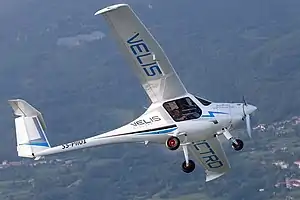
The Pipistrel Velis Electro is a Slovenian light aircraft, designed and produced by Pipistrel of Ajdovščina. The aircraft was EASA CS-LSA fully electric type certified in June 2020 and it is intended primarily for the training aircraft role, particularly multiple successive take-off and landings at the airfield.[1][2] The design is the first type certified electric aircraft and is supplied complete and ready-to-fly.[3][4][5]
| Velis Electro | |
|---|---|
 | |
| Role | Electric light aircraft |
| National origin | Slovenia |
| Manufacturer | Pipistrel |
| Introduction | 2020 |
| Status | In production (2020) |
| Developed from | Pipistrel Virus |
Design
The aircraft is based on the Pipistrel Virus airframe and features a cantilever high-wing, a two-seats-in-side-by-side configuration in an enclosed cabin accessed via doors. It has a stick shaker[2] and fixed tricycle landing gear and a single electric motor in tractor configuration.[3][4][5]
The airframe is predominantly made from composite materials. Its 10.71 m (35.1 ft) span wing, has an area of 9.5 m2 (102 sq ft), an aspect ratio of 12.03:1, an IMD 029-b airfoil and mounts three-position flaps, with settings of 0°, 8° and 19°.[5][6][1]

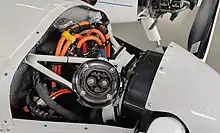
The sole approved powerplant is the liquid-cooled Pipistrel E-811 electric motor, rated at 57.6 kW (77 hp) at 2500 rpm for 90 seconds for take-off and 49.2 kW (66 hp) at 2350 rpm for continuous operation. The motor was developed in conjunction with the Slovenian engineering companies Emrax and Emsiso. It is powered by a 345 VDC, 24.8 kWh battery pack, in two 70 kg (150 lb) each, liquid-cooled lithium batteries by Pipistrel, connected in parallel for fault tolerance.[1][2] One battery is mounted in the nose and one behind the cabin for balance. They take 2 hours to recharge from 30% to 100% capacity. The motor radiator is mounted in the nose, which necessitates a different engine cowling from the Virus design. The battery radiator is mounted in the rear.[2] Due to the liquid cooling and the weight of the battery unit, the batteries are not swappable, unlike the battery replacement system in the Alpha Electro.[1] Take-off is not allowed when battery state of charge (SoC) is below 50%.[2]
The aircraft has a built-in continuous health-monitoring system displaying the estimated 'age' of the battery, and the battery must be charged using proprietary equipment.[2] The E-811 is the first certified electric aircraft motor and was certified by EASA on 18 May 2020.[3][4][5][1]
The Velis Electro has a maximum noise level of 60 dBa.[1]
The aircraft has an empty weight of 428 kg (944 lb) and a gross weight of 600 kg (1,300 lb), giving a useful load of 172 kg (379 lb).[3][4]
Development
The design received its European Union Aviation Safety Agency (EASA) type certificate for day, visual flight rules operations, on 10 June 2020, after a certification period of just under three years. The short time frame for the first certification of an electric aircraft was attributed by EASA to "close co-operation" between the manufacturer and the agency. The design was approved as a variant of the Virus on the same type certificate and is officially designated by EASA as the Virus SW 128 (Velis Electro).[3][4][5]
The aircraft is in production and the manufacturer has indicated that they intend to deliver 31 examples during 2020.[3] The first one was delivered on 16 July 2020 to a customer in Switzerland.[7][8] In January 2021, Pipistrel announced an order for 50 Velis Electro from Green Aerolease from France. The aircraft will be leased to French flight schools in cooperation with the FFA.[9]
Operational history
In August and September 2020, a group of Swiss electric mobility enthusiasts with support from the manufacturer flew a Velis Electro on a series of flights intended to be accepted as world records. Records were claimed for the lowest energy consumption (22.76 kWh/100 km), the highest average speed over a 100 km (136 km/h) and a 700 km (125 km/h) route, longest electrically flown route over 24 hours (327 km), 48 hours (608 km) and 56 hours (839 km).[10][11]
Accolades
The Pipistrel Velis Electro has received several awards since its introduction. In November 2020, Plane & Pilot Magazine named it the "2020 Plane of the Year".[12] In August 2021, the Velis Electro received the 2021 AIAA Aircraft Design Award.[13][14] The Velis Electro is one of the winners of the 2021 Aviation Week Network's Laureate Awards in the category Business Aviation.[15]
Operators
- Royal Danish Air Force - two aircraft leased for two years for evaluation[16][17]
- Slovenian Air Force and Air Defence – five aircraft for evaluation[18]
Specifications
Data from Pipistrel[1]
General characteristics
- Crew: one
- Capacity: one passenger
- Length: 6.47 m (21 ft 3 in)
- Wingspan: 10.71 m (35 ft 2 in)
- Height: 1.9 m (6 ft 3 in)
- Wing area: 9.51 m2 (102.4 sq ft)
- Aspect ratio: 12.04
- Empty weight: 428 kg (944 lb)
- Max takeoff weight: 600 kg (1,323 lb)
- Fuel capacity: 24.8 kWh in two liquid-cooled Pipistrel batteries
- Payload: 172 kg (378 lb)
- Powerplant: 1 × Pipistrel E-811-268MVLC electric motor, 57.6 kW (77.2 hp)
- Propellers: 3-bladed Pipistrel P-812/164-F3A, fixed pitch, composite, 1.640 m (5 ft 5 in) diameter
Performance
- Maximum speed: 181 km/h (113 mph, 98 kn)
- Cruise speed: 170 km/h (100 mph, 90 kn)
- Stall speed: 83 km/h (52 mph, 45 kn) flaps down
- Never exceed speed: 200 km/h (124 mph, 108 kn)
- Endurance: 50 minutes, plus VFR reserves
- Service ceiling: 3,700 m (12,000 ft)
- g limits: +4/-2
- Maximum glide ratio: 15:1
- Rate of climb: 3.3 m/s (650 ft/min)
- Wing loading: 63.1 kg/m2 (12.9 lb/sq ft)
- takeoff run/over 50′ obstacle (asphalt): 241/409 m (791/1,342 ft)
Avionics
- Pipistrel EPSI 570C cockpit display monitoring the electric propulsion system
See also
References
- Pipistrel. "Velis Electro". pipistrel-aircraft.com. Archived from the original on 11 June 2020. Retrieved 11 June 2020.
- Unwin, Dave (5 November 2021). "Flight test: the pioneering Pipistrel Velis Electro". Pilot (British magazine). Archived from the original on 7 November 2021.
- O'Connor, Kate (10 June 2020). "Pipistrel Earns First Electric Aircraft Type Certificate". AVweb. Archived from the original on 11 June 2020. Retrieved 11 June 2020.
- Sarsfield, Kate (10 June 2020). "Pipistrel Velis Electro earns first all-electric aircraft type certification". Flight Global. Archived from the original on 11 June 2020. Retrieved 11 June 2020.
- European Aviation Safety Agency (10 June 2020). "EASA Aircraft Type Certificate Data Sheet - No. EASA.A.573" (PDF). Archived from the original on 11 June 2020. Retrieved 11 June 2020.
- Lednicer, David (2012). "The Incomplete Guide to Airfoil Usage". Archived from the original on 25 January 2013. Retrieved 11 June 2020.
- "AlpinAirPlanes takes delivery of first Velis Electro". Pipistrel Aircraft. 20 July 2020. Retrieved 23 July 2020.
- Rossier, Louis (16 July 2020). "Sans fuel dans les airs" (in French). La Liberté. Retrieved 23 July 2020.
- Manthey, Nora (8 February 2021). "Green Aerolease buys 50 Pipistrel e-planes for pilot training". Electrive. Retrieved 11 February 2021.
- Cook, Marc (15 September 2020). "Pipistrel Velis Electro Completes Record Flights". AVweb. Archived from the original on 16 September 2020. Retrieved 16 September 2020.
- "Velis Electro broke 7 world records in a 3-day flight". Pipistrel Aircraft. 3 September 2020. Archived from the original on 17 September 2020.
- "2020 Planes Of The Year: Epic E1000 & Pipistrel Velis". Plane & Pilot. 12 November 2020.
- "Pipistrel Velis Electro receives the prestigious 2021 AIAA Aircraft Design Award". Pipistrel Aircraft. 21 September 2021.
- "AIAA Aircraft Design Award". American Institute of Aeronautics and Astronautics (AIAA).
- "Aviation Week Laureates - 2021 Winners". Aviation Week.
- "Elektriske fly til Flyvevåbnet som et grønnere alternativ". Forsvaret.dk. Retrieved 6 June 2021.
- "Nu har Forsvaret el-fly". Forsvaret (in Danish). 18 November 2021.
- "Slovenska vojska pilote prva na svetu šola v električnem letalu". 24ur. 1 October 2021. Retrieved 2 October 2021.