Veronica Volkersz
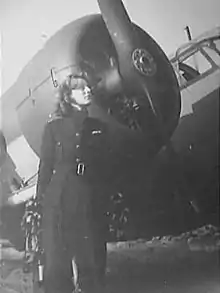
Veronica May Volkersz (née Innes; 1917 – 2000) was a British aviator and beauty queen. She flew for the RAF's Air Transport Auxiliary in the Second World War and was the first woman to fly an operational jet fighter when she ferried a Meteor from the Gloster factory to RAF Moreton Valence on 15 September 1945.[1][2][3]
Veronica Volkersz | |
|---|---|
.jpg.webp) | |
| Born | Veronica May Innes 17 April 1917 |
| Died | 13 December 2000 (aged 83) |
| Occupation | aviator |
| Spouse(s) | Gerard Volkersz (m. January 1944) |
Early life
Veronica May Innes was born in Chesterton, Cambridge on 17 April 1917.[4] Her father was G. V. d'A. Innes – a professional soldier who served with the British and Indian armies, rising to the rank of Major.
In 1934, she participated in a grand pageant at Runnymede which was organised by Gwen Lally to celebrate English democracy, the Magna Carta and to raise money for charity. This lasted for eight days and she was the Queen of Beauty on four of those days, taking the role of the Fair Maid of Kent.[5][6]
She was an enthusiastic horse rider and car driver, going hunting and racing an open-topped Aston Martin sports car.[7] But she discovered aviation at Brooklands in 1938 and then learnt to fly with the Civil Air Guard, going solo at Cambridge airfield on 13 February, 1939.[5][1] This then caused headlines in the local press, "Beauty Queen Joins Civil Air Guard".[5]
Second World War
In the summer of 1939, she encountered preparations for war while flying out of Woodley Aerodrome on her first solo cross-country flight. These were barrage balloons which were being tested at RAF Cardington. She avoided these but then wind and mist caused her to become lost. She landed at a small airfield which proved to be RAF Wyton. She was then able to get her bearings and followed a railway line to the destination of Cambridge.[5]
The Air Transport Auxiliary (ATA) was formed in 1939 and eight women were first allowed to fly for this at the start of 1940.[8][9] Veronica was driving ambulances for the Women's Auxiliary Air Force in London and wrote to ATA as soon as she saw the coverage in the press but was not accepted immediately as she had not logged enough flying hours. She persisted and was given a trial at Hatfield Aerodrome in 1940.[10] She performed well but was still not accepted until March 1941, when she started training at Hatfield with other new recruits such as Honor Pitman. After a month of training, she passed a flying test at the ATA HQ of White Waltham and was commissioned as a second officer.[5]
She had been flying Tiger Moths but then converted to more powerful aircraft. This started with the Hawker Audax in which she found that she needed a cushion to reach the controls. She then mastered the Hawker Hind, the North American Harvard and the Fairey Battle light bomber. Finally, she completed the conversion course by flying the Hawker Hurricane – "it's like an Audax with about five hundred times more guts", she told a fellow trainee.[5]
She ferried Hurricanes while still new to the type. In late 1941, she was ferrying a Hurricane to Squires Gate Airport when fog caused a near miss with another aircraft. The evasive manoeuvre put the Hurricane into a dive and it was so difficult to pull out in time that the aircraft brought down the airfield's telegraph wires. New Hurricanes were generally quite difficult with especially stiff undercarriages and unreliable brakes. In the cold January of 1942, she was ferrying a Hurricane to Ratcliffe Aerodrome when the windscreen iced up. She had to open the canopy to the icy blizzard to make out the runway and so managed to land it. But while taxiing, the wind caught the plane and flipped it forward onto its nose. She survived but the Accidents Committee found this to be her fault.[5]
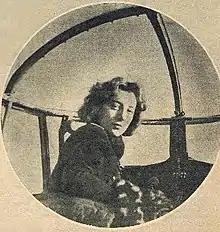
In April of 1942, she converted to fly light twin-engined planes, starting with the comparatively sedate Airspeed Oxford. Conversion to heavy twins like the Wellington then followed but she didn't like these. "It's like flying around in a pair of railway carriages", she complained, "No finesse required whatsoever." She needed four cushions to fly the Wellington, and had to lie almost flat on her back.[5]
In October of 1942, she was posted to Hamble. She then appeared in a film about the ATA shot by the Crown Film Unit at Pinewood Studios. In 1943, she did the Class 4 Plus conversion, which allowed her to fly the Hudson and Mosquito. She was then allowed to fly the powerful Typhoon too. She enjoyed this type, cruising at 300 mph, and delivered about a hundred of them.[5]
In March 1944, she was promoted to Flight Captain. At the end of the war, she was assigned to an invasion pool of pilots at White Waltham. She was still ferrying new aircaft and was the first woman to fly an operational jet fighter – a Gloster Meteor which she took to RAF Moreton Valence. The jets were simpler to operate than a variable-pitch propellor but intense when at the full throttle of 16,500 rpm – "an almighty kick in the pants".[5]
Personal life
In June 1942, she became engaged to Gerard Volkersz – a flying officer in the Royal Netherlands Naval Air Service, who served in the Fleet Air Arm after the fall of the Netherlands.[11] They married at Chelsea Registry Office and, in 1947, she gave birth to a son but he was stillborn.[12]
References
 |
Wikimedia Commons has media related to Veronica May Innes. |
- Veronica Volkersz (1939–1965), Bound Licence, Logbooks and NotesCS1 maint: date format (link)
- Veronica Volkersz (1956), The Sky and I, W.H.Allen
- Lois K. Merry (17 November 2010), Women Military Pilots of World War II, McFarland, p. 67, ISBN 9780786457687CS1 maint: date and year (link)
- "Births", FreeBMD, ONS, June 1917
- Jo Wheeler (2018), "1,2,7,8,9,11,13,22,23,26,28", The Hurricane Girls, Penguin, ISBN 9780241354643
- Seymour Vesey-Fitzgerald (1934), Pageant of Runnymede, Fleetway Press,
Queens of Beauty – Miss V. Innes: June 9th, llth, 13th and 16th.
- Julie Fountain (2016), "'The Most Interesting Work a Woman can Perform in Wartime': The Exceptional Status of British Women Pilots during the Second World War", The Journal of the Social History Society, 13 (2): 213–229, doi:10.1080/14780038.2016.1202010
- Curtis, Lettice (1971). The forgotten pilots: a story of the Air Transport Auxiliary, 1939-45. Henley-on-Thames,: Foulis. ISBN 0-85429-123-7. OCLC 314559.CS1 maint: extra punctuation (link)
- Fountain, Julie (2 April 2016). "'The Most Interesting Work a Woman can Perform in Wartime': The Exceptional Status of British Women Pilots during the Second World War". Cultural and Social History. 13 (2): 213–229. doi:10.1080/14780038.2016.1202010. ISSN 1478-0038.
- Merry, Lois K. (10 January 2014). Women Military Pilots of World War II: A History with Biographies of American, British, Russian and German Aviators. McFarland. p. 33. ISBN 978-0-7864-5768-7.
- "Forthcoming Marriages", The Times (49258), p. 7, 10 June 1942
- "Births", The Times (50665), p. 1, 22 January 1947
