Vijay Kumbhar
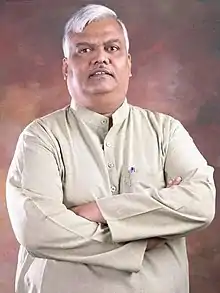
Vijay Kumbhar (born 2 July 1962) is an Indian politician of the Aam Aadmi Party.
Vijay Kumbhar | |
|---|---|
 | |
| Born | 2 July 1962 |
| Occupation | Politician, RTI Activist, Consultant, Journalist, Blogger, Social Influencer |
Career
Putting a tab on confiscation of public properties by powerful people in position through Girish Vyas case which led to resignation of then Chief Minister of Maharashtra, Mr. Manohar Joshi;
He was responsible for one of its kind Land allotment policy.[1]
Journalism
PIL movement and Girish Vyas case[2] During 90s, in the era of open economy, Kumbhar was at forefront of the PIL (Public Interest Litigation) movement. Big highlight of that movement was Manohar Joshi's resignation from the Chief Minister post (BJP Shivsena Government). It was the case of illegal shifting of reservation, on a plot of land, earmarked for a school, to favor a builder, whose contacts were with the high and mighty. Plot No 110, Prabhat Road- a 30,000 sq. feet land, which was reserved for a primary school was handed over to builder Girish Vyas, the son-in-law of then Chief Minister Manohar Joshi almost overnight. Within a few months a tall stylish building came up on the plot, with no one objecting to this at any level. Vijay Kumbhar filed a PIL in the Bombay High Court drawing attention to this rampant illegality. The High Court taking an exceptionally, strong stand on this passed strictures against the Chief Minister and ordered the builder to demolish the building immediately. The apex court upheld the decision of the high court. It laid an important guideline for protection of public properties in the cities and primary school property allotted to his son in law. This case was exceptional, because, this was the case of a single individual taking on the ruling party single-handedly.[3]
Whistle blower- CYG Scam & after effects
Kumbhar was the first one who brought out the financial irregularities in Commonwealth youth games (CYG) in 2008 by filing multiple RTIs. Whole scam was exposed beginning from the case of non-existent helipad for which an amount of Rs. 51 lakhs were spent. Civic activists had demanded that the state government file a First Information Report (FIR) in the alleged irregularities in the CYG, 2008 held in Pune. The demand came after city MP Suresh Kalmadi's arrest in the Delhi 2010 Commonwealth Games scam. The Comptroller and Auditor General (CAG) initiated an audit into the Rs 1,345 crore expenses incurred on CYG. The audit was not completed. There were irregularities in the utilization of the CYG games and the state government should file an FIR to start the probe, this point was highlighted by Kumbhar. The Maharashtra government, its sports directorate and the municipal corporations of Pune and Pimpri-Chinchwad had contributed funds for the mega event held at Shiv Chhatrapati Sports Complex in Balewadi but did not carry out an independent audit.[4]
Exposing Suresh Kalmadi
tate information commissioner (Pune bench) Vijay Kuvalekar, acting on a complaint by Kumbhar, ordered the state sports directorate to furnish all documents related to the Rs 425.50 crore expenditure, on 11 November 2010. The Maharashtra government was going slow on the issue. On 21 August 2010, soon after reports about the irregularities in the Commonwealth Games surfaced, Pune's guardian minister Ajit Pawar promised a probe. This was a big lesson for Indian politicians that they did not commit such scams openly.[5]
Blog
Kumbhar's 3-line blog asking 3 questions pointed out financial mismanagement by DSK group in Pune. Considering DS Kulkarni's social standing, it was a herculean task writing against him. Politicians, monetary strength, media, higher echelons of society all backed DSK and questioned Kumbhar's motives. However, he made a conscious decision not to indulge in sensationalism. He kept writing systematically about the financial impropriety indulged into by the DSK. His concern was the exploitation of the middle class citizens who had invested their hard earned money having faith in DSK. The matter created a furore. Prominent city newspapers wrote columns supporting DSK. But Kumbhar did not give in to pressure. Finally, the administration and judicial system took note in NCD case, Maha Rera case, Consumer court case, 3000 cheque bounce cases. 90% victims are senior citizens. Today, DSK is facing judicial proceedings behind bars. Now the forensic auditors are turning to Kumbhar for their own cases, realizing the deep investigation done by him in the DSK matter. A good example for those middle class buyers to conduct due diligence before investing into any schemes by known firms.[6]
RTI (Right to Information) Act
Kumbhar did not stop at just filing applications. He is of the firm belief that democracy is like a social contract. The government and citizens both have to discharge their responsibilities for it to succeed. They are not the government of a political party, but of the people.[7]
RTI (Right to Information) Library
Kumbhar aided the opening of the first-ever RTI library in the country at the Pune Municipal Corporation.[8][9]
RTI Katta
Then editor of Indian Express, Pune, late Mr. Prakash Kardale was his mentor.[10]
Related work
Brought 95-97% of corporation properties under proper listing by 7 years of rigorous follow up with PMC which stopped mismanagement of renting public properties for commercial use at throw away prices. This led to huge increase in corporation revenues. Bids opened up for shops rented by then MP Suresh Kalmadi's Sai Service was a big step in this.[11]
Politics
Aam Aadmi party's founders, Arvind Kejriwal and Manish Sisodia, are old compatriots. They have worked together in the past on multiple RTI (Right to Information) related occasions. He has great respect for social activism, but politics is the tool to implement changes in society. So, when he decided to join politics, AAP was the natural choice as Anti-Corruption is the main agenda of the party.
His focus on Maharashtra politics will be rural agendas related to 12 balutedar economic policies; self-sufficient villages, mapping entire state resource wise and creating opportunities accordingly for village population at local levels, being from farming background.[12]
References
- "Land Allotment Policy". PMC's land allotment policy in deep water. 5 September 2008.
- "Girish Vyas case". Indian Express. 10 February 2013.
- "Justice Smiles on Vijay Kumbhar after 13 years". DNA India. 11 October 2011.
- "Activists want FIR filed in CYG Misdeeds". Times of India. 26 April 2011.
- "Activists want FIR filed in CYG misdeeds". Times Of India. 26 April 2011.
- "Exposed 2043 crore DSK scma". Rediff. 21 June 2018.
- "Politics makes it easier to implement changes we want: Vijay Kumbhar". Indian Express. 20 June 2021.
- "RTI library in Pune". Indian Express. 18 May 2010.
- "Chandigarh is the latest to have RTI library after Pune". MoneyLife. 20 June 2012.
- "Pune Pioneered Inspection of Files Under Section 4 of the RTI Act; Nine years later, it Spreads Across Maharashtra". MoneyLife. 5 December 2018.
- "Bids open for shops rented by Suresh Kalmadi's Sai Service". dna India. 24 May 2011.
- "Have great respect for social activism, but politics makes it easier to implement changes we want". Indian Express. 20 June 2021.