Casino di Villa Boncompagni Ludovisi
The Casino di Villa Boncompagni Ludovisi is a historical building in Rione Ludovisi, Rome, Italy.
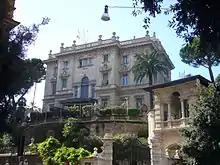
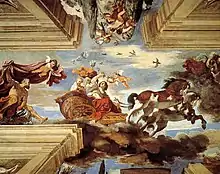
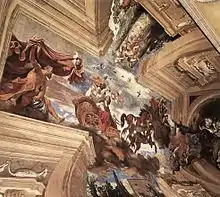
The building is often referred to as Villa Aurora or Casino dell'Aurora, after the fresco by Guercino in the main reception hall, depicting the eponymous goddess.
History

The palace represents the only remain of a much larger suburban retreat established in the 16th century by Cardinal Francesco Maria Del Monte (1549–1627). The Cardinal was a diplomat, intellectual, art connoisseur, and collector, protector and patron of famous figures such as Galileo Galilei and Caravaggio. One of the smaller rooms of the Casino boasts the only painting ever executed by Caravaggio on a ceiling, Jupiter, Neptune and Pluto (c. 1597), which reflects, in symbolic imagery derived from Classical mythology, another of the cardinal's interests: alchemy.
In 1621, del Monte sold the villa and its extensive grounds to Ludovico Ludovisi, whose uncle Alessandro Ludovisi had assumed the Papacy earlier that year as Pope Gregory XV and made his nephew a cardinal the day after his coronation, at the age of 25. The cardinal expanded the property until he had created a 30 hectare park between the Porta Pinciana, the Porta Salaria and the convent of Sant'Isidoro, whose buildings were designed by Domenichino, with gardens (purportedly designed by André Le Nôtre), of which Henry James wrote in Portrait of Places (1883):
"Certainly there is nothing better in Rome, and perhaps nothing so beautiful ... Inside there is everything: dark avenues shaped for centuries with scissors, valleys, clearings, groves ..."
The princes Boncompagni-Ludovisi, heirs to the celebrated property and its vast collections, subdivided and sold the property in 1883. Rome's Ludovisi district was built on the land where the park had been and bears the coat of arms of the family. Of the historic buildings of the villa, only the Casino and the facade and staircase of the former Palazzo Grande remain, the latter now hidden behind what became the 19th-century Palazzo Margherita after it was acquired by the Italian State as a residence for the Queen consort of Italy, Margherita of Savoy. It now houses the U.S. embassy. Meanwhile, the 2,200 square meter Villa Aurora and a small parcel of land remained in the possession of the Ludovisi family. Apart from the works by Caravaggio and Guercino, it contains important works of art by Pomarancio, Michelangelo, and a collection of Roman and Greek artefacts.[1] Encircled by high walls, it was occasionally opened to the public once a month or upon written request.
Current status
The property was put up for sale in 2021 after an inheritance dispute following the death of its last owner, Prince Nicolò Boncompagni Ludovisi, in 2018.[2]
References
- "Villa Aurora, Rome's best kept secret?". Minor Sights. Retrieved 20 November 2016.
- "Roman villa with world's only Caravaggio mural up for sale". the Guardian. 2021-10-25. Retrieved 2021-10-27.