Arevalo, Iloilo City
Villa de Arevalo, commonly known as simply Villa or Arevalo, is one of the seven districts of Iloilo City, in the province of Iloilo.[1] It was founded as La Villa Rica de Arévalo by a group of Spanish and Mexican soldiers[2] and their commanding officer who built his mansion along the coastal settlement in 1581. Though formally founded in the said year, Villa de Arevalo dates back its establishment in 1566 when Spanish conquerors established a settlement in the areas between it and the neighboring town of Oton.
Villa de Arevalo District
Distrito sang Arevalo | |
|---|---|
Iloilo City District | |
| District of La Villa Rica De Arevalo | |
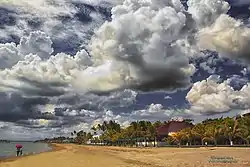 Villa Beach | |
| Nickname(s): "The Flower Capital of Iloilo City" | |
| Coordinates: 10°41′09″N 122°30′42″E | |
| Country | Philippines |
| Region | Western Visayas (Region VI) |
| Province | Iloilo (geographically only) |
| City | Iloilo City |
| Founded | 1566 (Establishment of settlement between Arevalo and Oton areas by the Spanish colonists) 1581 (Formal establishment of La Villa Rica de Arevalo) |
| Government | |
| • Mayor | Geronimo "Jerry" P. Trenas (Mayor of Iloilo City) |
| Area | |
| • Total | 7.58 km2 (2.93 sq mi) |
| Population (2020 census) | |
| • Total | 55,476 |
| • Density | 7,316.80/km2 (18,950.4/sq mi) |
| Demonym(s) | Villanon/Villa Rican Arevalnon/Arevaloño Ilonggo (masculine) Ilongga (feminine) |
| Time zone | UTC+8 (PST) |
| ZIP code | 5000 |
| Area code(s) | 33 |
| Patron saint | Santo Niño (Infant Jesus) |
| Feast day | Third Sunday of January |
| Language(s) | Hiligaynon, Kinaray-a, Filipino, English |
| Website | www |
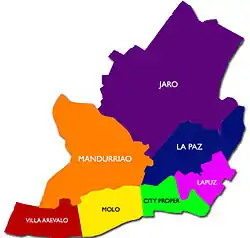

It was absorbed by Iloilo City during the 20th century along with the towns of Mandurriao, La Paz, Molo and the city of Jaro. Arevalo is the westernmost district of Iloilo City and it borders Oton to the west.
Its church possesses the third oldest Santo Niño (Infant Jesus) image in the Philippines.[3] Arevalo is sometimes given the title "Flower Capital of Iloilo", where potted plants, flowers, bouquets, wreaths can be bought.[4] Arevalo is also famous for its firecrackers and fireworks. Its prominent attraction is the Villa Beach (Playa de Villa de Arevalo) along the coast which boasts several resorts and an outdoor nightlife such as open air restaurants and bars.
Villa de Arevalo is the first Spanish named town established by the Spanish colonists in the Philippines and Asia.
History
Established on 1581 by Gobernador Ronquillo de Peñalosa as "La Villa Rica de Arevalo", named after his hometown Arévalo, Spain, it is one of the first places in the Philippine archipelago to be named in Spanish. It became the capital of the settlement in the province on 1582. It was invaded by the British in 1588 and followed by more raids by Moros in 1600 and by the Dutch in 1609, 1614 and 1616. The continuous raids forced the capital to be relocated near the mouth of Iloilo River, which is the current location of Iloilo City Proper. It was incorporated as a district of Iloilo City on July 16, 1937.
Barangays
The district of Arévalo has 13 barangays.
| Barangays | Population (2020) | Area (km²) | Pop. density (per km²) |
|---|---|---|---|
| Bonifacio | 1,994 | 0.37 | 5,346 |
| Calaparan | 9,158 | 0.33 | 28,127 |
| Dulonan | 4,616 | 0.69 | 6,729 |
| Mohon | 1,279 | 0.15 | 8,487 |
| Quezon | 1,820 | 0.16 | 11,179 |
| San José | 2,185 | 0.62 | 3,526 |
| Santa Cruz | 3,813 | 0.56 | 6,764 |
| Santa Filomina | 2,622 | 0.35 | 7,502 |
| Santo Domingo | 2,335 | 0.41 | 5,722 |
| Santo Niño Norte | 3,922 | 0.20 | 19,939 |
| Santo Niño Sur | 9,266 | 0.98 | 9,442 |
| Sooc | 8,568 | 2.26 | 3,798 |
| Yulo Drive | 3,898 | 0.51 | 7,660 |
| Total | 55,476 | 7.58 | 7,317 |
Source: Iloilo City (Philippines): Barangays - Population Statistics, Charts and Map (citypopulation.de) https://www.citypopulation.de/en/philippines/iloilo/
Schools
- Melchor L. Nava National High School, named after Melchor Nava the former barangay captain of Calaparan.
- Ramon Avanceña National High School, named after Ramon Avanceña the former Chief Justice.
- John B. Lacson Foundation Maritime University Arevalo campus, formerly known as Iloilo Maritime Academy.
Santo Niño de Arevalo Parish
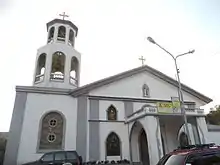
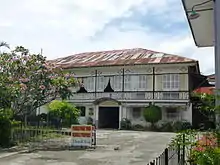
The district's parish, the Santo Niño de Arevalo Parish, is home to the third oldest Santo Niño figure in the Philippines. The church was built in such a way that when seen from above it is shaped like a cross. Adjacent to the church is the Arevalo Convent, a heritage building in a Spanish colonial design. Residing parish priest is Rev. Fr. Jose Gerardo Classico Nufable.
Events
Arevalo Town Fiesta
In January, Arevalo celebrates its town fiesta in honor of the Santo Niño. The festivities take place during the month of January, the Fiesta day is held every 3rd Sunday of January. During Fiesta day households open their doors and prepare food for fiesta goers, friends, visitors and distant relatives. A fireworks display contest is one of the highlights of the celebration held on the night of the town fiesta
Paraw Regatta
Arevalo hosts the annual Paraw Regatta, which is the oldest traditional craft event in Asia, and the largest sailing event in the Philippines. A paraw is a Filipino double-outrigger sailboat much like a pump boat which was used for transportation and fishing and still is in limited areas.
The main event is the paraw boat race along Iloilo Strait and also showcases Pinta Layag, sail painting contest; Porma Balas, sand sculpting; Pintawo, body painting contest; Miss Paraw Regatta, a local beauty pageant; Samba De Regatta, music & Mardi Gras contest; Luces by the Sea, a pyrotechnic exhibition; beach volleyball; and photo competition.
Transportation
Transportation is mainly by jeepney which serves the district to the Iloilo City Proper. Metered taxi cabs also serve the traveling public. Tricycles and trisikads operate within the district.
References
 |
Wikimedia Commons has media related to Arevalo (Iloilo City). |
- "Archived copy". Archived from the original on January 21, 2012. Retrieved February 20, 2012.CS1 maint: archived copy as title (link)
- "A History of the Philippines by David P. Barrows" Page 147. The few years of Ronquillo’s reign were in other ways important. A colony of Spaniards was established at Oton, on the island of Panay, which was given the name of Arévalo (Iloilo).
- "Archived copy". Archived from the original on May 1, 2011. Retrieved 2011-04-04.CS1 maint: archived copy as title (link)
- "Archived copy". Archived from the original on July 24, 2011. Retrieved 2011-04-04.CS1 maint: archived copy as title (link)