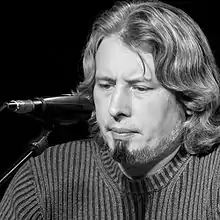
Vladimir Sorokin
Vladimir Sorokin | |
|---|---|
 | |
| Born | Vladimir Georgiyevich Sorokin 7 August 1955 Bykovo, Moscow Oblast, Russian SFSR, Soviet Union |
| Occupation | Writer |
| Nationality | Russian |
| Literary movement | Postmodernism |
| Website | |
| srkn | |
Vladimir Georgiyevich Sorokin (Russian: Влади́мир Гео́ргиевич Соро́кин; born 7 August 1955) is a contemporary postmodern Russian writer and dramatist, one of the most popular in modern Russian literature.[1][2]
Biography
Sorokin was born on 7 August 1955 in Bykovo, Moscow Oblast, near Moscow. In 1972, he made his literary debut with a publication in the newspaper Za kadry neftyanikov (Russian: За кадры нефтяников, For the workers in the petroleum industry). He studied at the Gubkin Institute of Oil and Gas in Moscow and graduated in 1977 as an engineer.
After graduation, he worked for one year for the magazine Shift (Russian: Смена, Smena), before he had to leave due to his refusal to become a member of the Komsomol.
Throughout the 1970s, Sorokin participated in a number of art exhibitions and designed and illustrated nearly 50 books. Sorokin's development as a writer took place amidst painters and writers of the Moscow underground scene of the 1980s. In 1985, six of Sorokin's stories appeared in the Paris magazine A-Ya. In the same year, French publisher Syntaxe published his novel Ochered' (The Queue).
Sorokin is a devout Christian, having been baptized at the age of 25.[3]
Sorokin's works, bright and striking examples of underground culture, were banned during the Soviet period. His first publication in the USSR appeared in November 1989, when the Riga-based Latvian magazine Rodnik (Spring) presented a group of Sorokin's stories. Soon after, his stories appeared in Russian literary miscellanies and magazines Tretya Modernizatsiya (The Third Modernization), Mitin Zhurnal (Mitya's Journal), Konets Veka (End of the Century), and Vestnik Novoy Literatury (Bulletin of the New Literature). In 1992, Russian publishing house Russlit published Sbornik Rasskazov (Collected Stories) – Sorokin's first book to be nominated for a Russian Booker Prize.[4] In September 2001, Vladimir Sorokin received the People's Booker Prize; two months later, he was presented with the Andrei Bely Prize for outstanding contributions to Russian literature. In 2002, there was a protest against his book Blue Lard, and he was investigated for pornography.[5]
Sorokin's books have been translated into English, Portuguese, Spanish, French, German, Dutch, Finnish, Swedish, Norwegian, Danish, Italian, Polish, Japanese, Serbian, Korean, Romanian, Estonian, Slovak, Czech, Hungarian, Croatian and Slovenian, and are available through a number of prominent publishing houses, including Gallimard, Fischer, DuMont, BV Berlin, Haffman, Mlinarec & Plavic and Verlag der Autoren.
His 2006 novel, Day of the Oprichnik, describes a dystopian Russia in 2027, with a Tzar in the Kremlin, a Russian language with numerous Chinese expressions, and a "Great Russian Wall" separating the country from its neighbors.[6][7][8] He was awarded in 2015 the Premio Gregor von Rezzori for this novel.[9]
In 2016 he was accused by pro-Kremlin activists of "extremism", "pro-cannibalism themes" and "going against Russian Orthodox values" in his 2000 short story Nastya, the contents of which concern a 16-year-old being cooked alive in an oven and eaten by her family and friends.[10][11]
In December 2019, Russian filmmaker Ilya Belov released the documentary "Sorokin Trip" [12] in which he portrayed and examined the writer's life and work.
Bibliography
Novels
- Норма (written 1979–1983, published by Tri Kita and Obscuri Viri, 1994). The Norm, trans. Max Lawton (New York Review Books, forthcoming)
- Очередь (written 1983, published by Syntaxe, 1985). The Queue, trans. Sally Laird (Readers International, 1988; New York Review Books, 2008; ISBN 9781590172742)
- Тридцатая любовь Марины (written 1982–1984, published by Elinina, 1995). Marina’s 30th Love, trans. Max Lawton (Dalkey Archive, forthcoming)
- Роман (written 1985–1989, published by Tri Kita and Obscuri Viri, 1994). Roman, trans. Max Lawton (Dalkey Archive, forthcoming)
- Сердца Четырех (written 1991, published 1994). Their Four Hearts, trans. Max Lawton (Dalkey Archive, 2022)
- Голубое Сало (Ad Marginem, 1999). Blue Lard, trans. Max Lawton (New York Review Books, forthcoming)
- Лёд (Ad Marginem, 2002). Ice, trans. Jamey Gambrell (New York Review Books, 2007; ISBN 1-59017-195-0)
- Путь Бро (Zakharov Books, 2004). Bro, trans. Jamey Gambrell (in Ice Trilogy, 2011).
- 23'000 (Zakharov Books, 2005). 23,000, trans. Jamey Gambrell (in Ice Trilogy, 2011).
- День опричника (Zakharov Books, 2006). Day of the Oprichnik, trans. Jamey Gambrell (2010; ISBN 978-0374134754)
- Метель (AST, 2010). The Blizzard, trans. Jamey Gambrell (Farrar, Straus and Giroux, 2015; ISBN 978-0374114374)
- Теллурия (AST, 2013). Telluria, trans. Max Lawton (New York Review Books, 2022)
- Манарага (Corpus, 2017). Manaraga
- Доктор Гарин (Corpus, 2021). Doctor Garin
Compilations and short stories
- Первый субботник (written 1979–1984, published by Ad Marginem, 1998). The First Saturday Workday
- Пир (Ad Marginem, 2000). Feast
- Заплыв (AST, 2008). Swim
- Сахарный кремль (AST, 2008). Sugar Kremlin
- Ice Trilogy (New York Review Books, 2011; ISBN 978-1590173862). Bro, Ice, and 23,000 published together in one volume.
Plays
- Пельмени (1984–1987). Pelmeni
- Землянка (1985). The Hut
- Русская бабушка (1988). Russian Grandmother
- Доверие (1989). Confidence
- Дисморфомания (1990). Dysmorphomania
- Юбилей (1993). Anniversary
- Hochzeitsreise (1994–1995). The Post-Nuptial Journey
- Щи (1995–1996). Shchi
- Dostoevsky-Trip (1997).
- С Новым Годом (1998). Happy New Year
- Капитал (2006). Capital
- Занос (2009). The Snow Drift
Film scripts
- Безумный Фриц ("Mad Fritz") (1994). Directors: Tatiana Didenko and Alexander Shamaysky.
- Москва ("Moscow") (2000). Director: Alexander Zeldovich. First Prize in the festival in Bonn; Award of Federation of Russian Film-Clubs for best Russian movie of the year.
- Копейка ("Kopeck") (2002). Director: Ivan Dykhovichny. Nomination for Zolotoy Oven Award for best film script.
- Вещ ("Thing") (2002). Director: Ivan Dykhovichny.
- 4 (Four) (2005). Director: Ilya Khrzhanovsky. Grand Jury Prize of International Film Festival Rotterdam.
- Мишень ("Target") (2011). Director: Alexander Zeldovich.
Other works
- Photograph album В глубь России ("Into the Depths of Russia"), in cooperation with painter Oleg Kulik.
- Libretto for opera Дети Розенталя ("The Children of Rosenthal'"), with music by Leonid Desyatnikov; written on request of the Bolshoi Theater, Moscow.
- Dozens of stories published in Russian and foreign periodicals.
References
- russianwriters.eu
- nybooks.com
- "Владимир Сорокин: Мы все отравлены литературой" [Vladimir Sorokin: We are all poisoned by literature]. Official site of Vladimir Sorokin (srkn.ru) (in Russian). Moscow. January 2004. Retrieved 11 April 2020.
- Contributor: Vladimir Sorokin. Words Without Borders. Retrieved 11 April 2020.
- "Russian satirist sued over 'gay Stalin'". BBC News. 11 July 2002.
- Vladimir Sorokin » A Day in the Life of an Oprichnik. Literary Agency Galina Dursthoff (www.dursthoff.de). Retrieved 11 April 2020.
- Sam Munson (11 February 2011). "Vladimir Sorokin: Of human brutality". The National.
- Stephen Kotkin (11 March 2011). "A Dystopian Tale of Russia's Future". The New York Times.
- "2015 Winners". Festival degli Scrittori - Premio Gregor von Rezzori. Retrieved 3 October 2016.
- "Dissident Author Sorokin Accused of 'Promoting Cannibalism' in Work". The Moscow Times. 23 August 2016. Retrieved 2 December 2021.
- "Рассказ Владимира Сорокина «Настя» попросили запретить за «экстремизм»" ["[Activists] asked to ban Vladimir Sorokin's short story "Nastya" for extremism"]. MediaZona (in Russian). 23 August 2016. Retrieved 2 December 2021.
- "Sorokin Trip".
External links
- Official Webpage.
- Full bibliography (in Russian).
- Vladimir Sorokin at the Internet Speculative Fiction Database
- Vladimir Sorokin at IMDb.
- "Russia Is Slipping Back into an Authoritarian Empire", interview to Der Spiegel, 2 February 2007.
- "The Wait: On Vladimir Sorokin", The Nation, Elaine Blair, 25 March 2009
- "Ice by Vladimir Sorokin", Bookslut, February 2007
- Kalfus, Ken (15 April 2007). "They Had a Hammer". The New York Times.
- "Ice Trilogy by Vladimir Sorokin", nthWORD Magazine Shorts, Ryan O'Connor, July 2011
Authority control  | |
|---|---|
| General | |
| National libraries | |
| Other | |