Voice of Cards: The Isle Dragon Roars
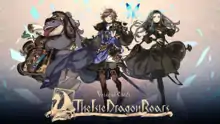
Voice of Cards: The Isle Dragon Roars[lower-alpha 1] is a 2021 role-playing video game developed by Alim and published by Square Enix for PlayStation 4, Nintendo Switch and Microsoft Windows. Using the aesthetic of a tabletop role-playing game, the player controls a party of adventurers in the wake of a legendary dragon's reappearance, exploring the world while fight their way towards the destination.
| Voice of Cards: The Isle Dragon Roars | |
|---|---|
 | |
| Developer(s) | Alim |
| Publisher(s) | Square Enix |
| Director(s) |
|
| Producer(s) | Yosuke Saito |
| Artist(s) | Kimihiko Fujisaka |
| Writer(s) |
|
| Composer(s) |
|
| Platform(s) | |
| Release | October 28, 2021 |
| Genre(s) | Role-playing |
| Mode(s) | Single-player, multiplayer |
The game staff included several veterans of the Drakengard series and its spin-off Nier, including creative director Yoko Taro, executive producer Yosuke Saito, composer Keiichi Okabe, and artist Kimihiko Fujisaka. The game was initially pitched by Yoko and Fujisaka as a social game for mobiles, but Saito ultimately decided to turn it into a paid downloadable title.
Premise and gameplay
Voice of Cards: The Isle Dragon Roars is a role-playing video game in which players take control of a party of characters, navigating a fantasy world fulfilling quests. The entire world, from its character interactions to the world map to battles, is represented using cards.[1][2] The game uses a turn-based battle system, triggered through random encounters and scripted boss fights. Crystals generated one per turn are used to trigger special abilities, some of which also rely on dice rolls for their effectiveness.[3][2]
The storyline follows a group of adventurers who travel across the game's world as a dragon reappears threatening to destroy the world, crossing paths with other characters including the Ivory Order.[1][4]
Development
Voice of Cards was developed by Alim, a company who had previously worked mobile projects, including Final Fantasy Brave Exvius with publisher Square Enix.[4] Multiple staff members from the Drakengard series and its spin-off Nier were involved in production. These included creative director Yoko Taro, executive producer Yosuke Saito, artist Kimihiko Fujisaka, and music director Keiichi Okabe of Monaca.[1][5] Alim's Maasa Mimura acted as the game's director.[5] The scenario was written by Yuki Matsuo, a lead writer on Nier Reincarnation.[6][7] The project was proposed by Yoko and Fujisaka, with Yoko originally pitching it as a mobile social game. Saito instead insisted that the project be a small-scale console title, as he felt Yoko would be overworked due to his existing commitment to managing several mobile games including Nier Reincarnation.[8] According to Saito, production took place during and between Nier Reincarnation and the remastered version of Nier: Replicant, taking much longer than was initially planned. Production was also challenging for Alim as it was the company's first console project, and being developed for three consoles at once.[9] When Yoko gave the game pitch to Alim, he described it as a normal RPG design with analogue expression through cards. He wanted to emulate the feeling of being an "otaku gamemaster".[5] With this in mind, a single voice actor was used for all characters, emulating a gamemaster telling the story.[5][6] Yoko also said that the game's limited budget played a part in the decision.[9] The gamemaster was voiced by Todd Haberkorn in English and Hiroki Yasumoto in Japanese.[4]
While using a tabletop aesthetic, it was designed as a standard RPG. Mimura paid attention to the analogue expression of the world design and gameplay.[6] Alim worked hard to create expression actions for the cards, through Yoko later asked for some of the in-battle card effects to be removed as he felt them unnecessary.[5] Fujisaka's early illustrations were strongly inspired by medieval Europe, but he disliked these early drafts and after the setting was created, he adjusted the art to its final design.[6] He also gave them an "inorganic" aesthetic to match with his earlier work with Yoko.[9] Matsuo wrote the scenario based on Fujisaka's illustrations, aiming to create a story to match the artwork's beauty. Yoko was not directly involved in writing the scenario, instead contributing rewrites and expansions to Matsuo's work.[6] The inclusion of two dragons was attributed by Yoko to Matsuo. Matsuo remembered getting into trouble during production as work on the scenario was behind schedule.[9]
Music
The music was composed primarily by Oliver Good, with additional work by Shotaro Seo and Okabe.[9] The soundtrack formed part of a push by Okabe to distance his company Monaca from himself, allowing other composers to find prominence.[10] The music was written with an "Irish atmosphere".[6] Okabe described Good as creating a consistent and delicate sound, while Seo contributed to vocal tracks as male chorus as he had done with Nier: Automata.[9][10] Seo's style of "catchy" tunes was brought in to balance with Good's melodic Celtic sound.[10] To create an analogue atmosphere, the music was recorded using live instruments. Around ten music tracks were created in total, not counting variations used in-game.[9]
The female vocals for the main theme and the track "Twin Recollections" were performed by Saki Nakae, while the violin was performed by Mitsuri Shimada, and Good performed the guitar parts for his own and Seo's work. Due to the COVID-19 pandemic, Good had to work from his home in England much of the time, though as he lived next to a forest area, he was able to use his environment to inspire his work. Good's favorite track was the field theme "The Adventures of the Self-proclaimed Hero", which was performed correctly on the first attempt. Seo's favorite track was the battle theme "Pulsing Powers", which he described as a fantastical take on Good's Celtic elements. Okabe's cited favorite was "Twin Recollections", which he cited as closest in style to his work on Yoko's other projects and evoking the vocal style of Irish singer Enya. The track titles were created by Yoko and the scenario team.[10]
Release
Due to its unconventional design, Square Enix's marketing had trouble working out how to promote it.[9] Voice of Cards was officially announced on 9 September 2021.[11] Yoko later clarified that it was not part of his Drakengard series despite the shared staff, nor was it a social game.[12] Its release date of October 28 on Microsoft Windows, Nintendo Switch and PlayStation 4 was announced on September 23.[4] A demo was released alongside the announcement, following the Ivory Order's search for a royal treasure.[1][4] The game also included paid DLC items themed after the setting and characters of Nier.[4] A digital soundtrack album was released on November 12.[10]
Reception
| Aggregator | Score |
|---|---|
| Metacritic | NS: 77/100[13] PS4: 75/100[14] |
| Publication | Score |
|---|---|
| Destructoid | 7.5/10[15] |
| Jeuxvideo.com | 14/20[16] |
| Nintendo World Report | 7.5/10[17] |
| Push Square |   [18] [18] |
Voice of Cards: The Isle Dragon Roars received "generally favorable" reviews, according to review aggregator Metacritic.[13][14]
Destructoid praised the visual style, calling it "a unique look... bolstered further by the excellent character art". PC Gamer disliked the way the visual style was used, feeling it became repetitive later in the game, "But the wow wears off. There's little variety or poetry in these building blocks, just acres of repeated grass and mountains, as sparse and basic as the 8-bit tilesets of a NES Dragon Quest".[19] While feeling mixed about the combat, Nintendo Life enjoyed the narrative, especially the narrator, writing, "every line of dialogue has a smooth and relaxing cadence that really sells the idea that you’re sitting by firelight at a table with a guy who loves telling stories".[20]
Nintendo World Report wrote that the game could have used more challenge or a higher difficulty, with the reviewer saying, "I avoided about half of random battles and only faced a bit of difficulty in the game's final dungeon". GameSpot felt the story was purposeful, writing, "Every story thread feels like it's there for a reason, with anything dark or unusual serving the story rather than being there to merely shock you".[21] Rock Paper Shotgun disliked how long animations and random battles affected the pacing, "If the endless grey and brown tiles of its dungeons weren't tiring enough, the combination of its repetitive battles, the slow slide of its card animations and the one too many seconds it takes to jab over to the run menu meant I was yearning for a fast forward button in the style of Bravely Default II before I'd even hit the halfway mark".[22]
References
- Kurse, Darren (2021-09-23). "Announcing Voice of Cards: The Isle Dragon Roars". PlayStation Blog. Archived from the original on 2021-09-24. Retrieved 2021-10-04.
- Tack, Daniel (2021-09-24). "Voice Of Cards: The Isle Dragon Roars". Game Informer. Archived from the original on 2021-09-24. Retrieved 2021-10-04.
- Ramsey, Robert (2021-09-25). "Hands On: Don't Sleep on Voice of Cards - It Could Be a Special RPG". Push Square. Archived from the original on 2021-09-26. Retrieved 2021-10-04.
- Torres, Josh (2021-09-23). "Voice of Cards: The Isle Dragon Roars shows its hand on October 28 for the PlayStation 4, Nintendo Switch, and PC via Steam". RPG Site. Archived from the original on 2021-09-24. Retrieved 2021-10-04.
- [TGS 2021]ヨコオ氏が「Voice of Cards ドラゴンの島」の制作秘話を語った生放送をレポート。コンセプトは“四畳半で安元GMと遊ぶTRPG”. 4Gamer.net (in Japanese). 2021-10-03. Archived from the original on 2021-10-03. Retrieved 2021-10-04.
- 『Voice of Cards ドラゴンの島』起用声優は安元洋貴さんのみ! 裏コンセプトなど多数の開発秘話が語られたTGS2021放送をリポート【TGS2021】. Famitsu (in Japanese). 2021-10-03. Archived from the original on 2021-10-03. Retrieved 2021-10-04.
- 『ニーア リィンカーネーション』配信記念インタビュー。シリーズ初のスマホアプリ、『ニーア』シナリオ班が本格稼動などさまざまな挑戦が詰まった作品. Famitsu (in Japanese). 2021-02-22. Archived from the original on 2021-02-22. Retrieved 2021-04-17.
- Kiya, Andrew (2021-10-03). "Yoko Taro Originally Pitched Voice of Cards as a Mobile Game". Siliconera. Archived from the original on 2021-10-04. Retrieved 2021-10-04.
- 『DOD』『NieR』との繋がりは? 『Voice of Cards ドラゴンの島』ヨコオ氏ら主要スタッフインタビュー. Dengeki Online (in Japanese). 2021-10-21. Archived from the original on 2021-10-21. Retrieved 2021-10-21.
- 『Voice of Cards ドラゴンの島』サントラ配信記念インタビュー。すべてがカードで表現されたゲームに響くMONACAサウンドの新境地【プレゼントあり】. Famitsu (in Japanese). 2021-11-12. Retrieved 2021-11-12.
- Hashimoto, Kazuma (2021-09-09). "Voice of Cards is Yoko Taro's New Table-Top RPG Video Game". Siliconera. Archived from the original on 2021-09-09. Retrieved 2021-10-04.
- Hashimoto, Kazuma (2021-09-09). "Yoko Taro Says Voice of Cards is Not Connected to Drakengard". Siliconera. Archived from the original on 2021-09-09. Retrieved 2021-10-04.
- "Voice of Cards: The Isle Dragon Roars for Switch Reviews". Metacritic. Red Ventures. Retrieved November 9, 2021.
- "Voice of Cards: The Isle Dragon Roars for PlayStation 4 Reviews". Metacritic. Red Ventures. Retrieved November 11, 2021.
- Van Allen, Eric (27 October 2021). "Review: Voice of Cards: The Isle Dragon Roars". Destructoid. Retrieved 1 November 2021.
- Gregoire, Aubin (31 October 2021). "Test Voice of Cards The Isle Dragon Roars : Une nouvelle pépite par le créateur de NieR Automata ?". Jeuxvideo.com. Retrieved 1 November 2021.
- Rudek, Jordan (27 October 2021). "Voice of Cards: The Isle Dragon Roars Review". Nintendo World Report. Retrieved 1 November 2021.
- Ramsey, Robert (28 October 2021). "Mini Review: Voice of Cards: The Isle Dragon Roars (PS4) - A Memorable JRPG That Loses Steam Later On". Push Square. Retrieved 1 November 2021.
- Castle, Matthew (2021-11-04). "Voices of Cards: The Island Dragon Roars review". pcgamer. Retrieved 2021-12-02.
- Life, Nintendo (2021-11-08). "Review: Voice Of Cards: The Isle Dragon Roars - Yoko Taro Deals An Impressive Card-Based RPG". Nintendo Life. Retrieved 2021-12-02.
- "Voice Of Cards: The Isle Dragon Roars Review - Cards Against Humanity". GameSpot. Retrieved 2021-12-02.
- Castle, Katharine (2021-11-03). "Voice Of Cards: The Isle Dragon Roars review: a JRPG in card game cosplay". Rock, Paper, Shotgun. Retrieved 2021-12-02.