Volksraad (Dutch East Indies)
The Volksraad (People's Council) for the Dutch East Indies was provided for by law in 1916, but its establishment was procrastinated until the actual installation of the Council in 1918. It was a hesitant and slow attempt at democratisation of the Dutch East Indies. The power of the Volksraad was limited as it only had advisory powers. Although part of the council was elected only a small proportion of the population had voting rights. [1]
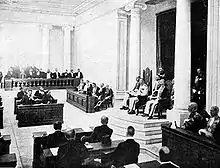
Initially the Volksraad had 39 members, eventually rising to 60. It was reconstituted every four years. The members were partly chosen, partly appointed by the colonial administration.[1]
History
During the World War I, the Dutch were worried about a possible Japanese threat to their East Indies colony. Given the small size of the local Dutch forces available for defense, the colonial authorities asked Indonesian leaders if Indonesians would be willing to be drafted into military service. The Indonesians rejected this idea, refusing to fight for a colony in which they had no legislative representation. Although the Dutch refused to consider any power sharing, they realized that limited concessions might be necessary. This took the form of an advisory body without any legislative powers, the Volksraad, although its members had parliamentary immunity. Half the members were appointed by the colonial government, while the other half were elected, albeit by local councils dominated by appointed officials. Because it lacked legislative powers, many Indonesians refused to cooperate with the body.[2][3][4]
_Kan_Hok_Hoei_(benoemd)_R._Sastro_Widjono_(gekozen)_en_mas_ngab%C3%A8hi_Dwidjo_Sewojo_(benoemd)_TMnr_10001376.jpg.webp)
The Volksraad was founded in Weltevreden, Batavia, Java, as an infant form of democratic representation on 18 May 1918 by the colonial chief executive Johan Paul, Count van Limburg Stirum (1873–1948), who was Governor-General of the Dutch East Indies from 1916 to 1921.
There were two short Volksraad sessions every year. In its first session in May 1918, a motion to send a "loyal cable" to the Queen of the Netherlands was rejected, while another allowing debates to be conducted in Malay was passed. In the second session that year, there was strong criticism of the colonial administration from both Indonesian and Dutch members which, given the turbulent political events in Europe at the time caused so much concern that the in November Governor-General van Limburg Stirum addressed the Volksraad and promised extensive administrative reforms. This motivated Indonesian nationalist figures, but the promises were not kept and became known bitterly as the "November promises".[5][6][7]
In 1927 the Volksraad was made a semi-legislative body; although decisions were still made by the Dutch government, the governor-general was expected to consult the Volksraad on major issues but retained a veto.[8] In 1931 the body gained the authority to approve the Dutch East Indies budget, and also to appoint a board to approve legislation, although any rejections could be overturned by the government.[9]
The Soetardjo Petition was submitted by some progressive members in 1936, led by Soetardjo Kartohadikusumo, requesting autonomy for Indonesia as part of a Dutch commonwealth within ten years.[10]
The last election was in 1939, although this was still an indirect process. One tenth of the population chose 937 electors, and a further 515 were appointed by the colonial administration. The process resulted in eleven of the 19 Indonesian Volksraad members being active or former government officials. In 1942 the Volksraad was dissolved during the Japanese occupation.[8][11]
The building used for the Volksraad, built by the Dutch in 1830, is on Jalan Pejambon in Central Jakarta. In 1945 it was used for meetings of the Investigating Committee for Preparatory Work for Independence, and as future president Sukarno gave his famous Pancasila speech there, it is now known as the Pancasila Building (Indonesian: Gedung Pancasila).[12]
Membership
At the start, 15 of the 39 members were native-born Indonesians, with the other seats occupied by Europeans and "foreign orientals". In 1927 the total number of seats was increased to 60. Of the 30 native-born members, 20 were elected, and 10 appointed.[9][13]
In 1922, the Dutch constitution was revised to state that unless specially reserved, all authority was delegated to the East Indies, the constitution of which also had to be revised and the approved by the Dutch parliament. One result of this was that the three groups represented in the Volksraad, the Dutch, Indonesians and other orientals, had separate elections for their representatives. This ensured the Indonesian representatives would not have a majority, thus protecting Dutch interests.[14]
The term of office for Volksraad members was three years, in 1925 increased to four years. Famous Indo-European members included Karel Zaalberg and Dick de Hoog.
There were also representatives of the colony's Vreemde Oosterlingen, or 'Foreign Orientals', including Chinese members, such as Khouw Kim An, Majoor der Chinezen, H. H. Kan, Loa Sek Hie and Phoa Liong Gie. Arab members included Sayyid Ismail bin Sayyid Abdoellah bin Alwi Alatas.
Among prominent indigenous parliamentarians in the Volksraad were the Javanese Tjokroaminoto and Mohammad Husni Thamrin, the Bantenese-Sundanese Ahmad Djajadiningrat, the Sumatran Agus Salim and the Menadonese Sam Ratulangi.
| Year of election /appointment |
Total seats | Elected | Appointed | Indonesians | Europeans | Other | Notes |
|---|---|---|---|---|---|---|---|
| 1917 | 38 | 19 | 19 | 15 | 20 | 3 | 39 seats including the chairman |
| 1921 | 48 | 24 | 24 | 20 | 25 | 3 | "Other" was ethnic Chinese |
| 1924 | 48 | 24 | 24 | 20 | 25 | 3 | |
| 1927 | 60 | 37 | 21 | 25 | 30 | 5 | |
| 1931 | 60 | 38 | 22 | 30 | 25 | 5 | |
| 1935 | 60 | 38 | 22 | 30 | 25 | 5 | "Other" was ethnic Chinese and Arab |
| 1939 | 60 | 38 | 22 | 30 | 25 | 5 | |
| Sources: Schmutzer,[13] Kahin[15] | |||||||
Gallery
 Volksraad building. Weltevreden, Batavia.
 Dick de Hoog, president of the I.E.V. and member of the Volksraad.
References
Notes and citations
- Benda & van der Wal 1965.
- Jones 1971, pp. 87–88.
- Fischer 1959, p. 56.
- Palmier 1965, p. 94.
- Palmier 1965, p. 95.
- Kahin 1952, p. 74.
- Soerjono 1980, pp. 64–65.
- Kahin 1952, p. 40.
- Cribb & Kahin 2004, p. 448.
- Abeyasekere 1973, p. 82.
- Britannica 1998.
- Merrillees 2015, pp. 34, 45.
- Schmutzer 1977, p. 68.
- Palmier 1965, p. 95-97.
- Kahin 1952, pp. 40–41.
Bibliography
- Abeyasekere, Susan (April 1973). "The Soetardjo Petition" (PDF). Indonesia. 15 (15): 81–107. doi:10.2307/3350793. ISSN 0019-7289. JSTOR 3350793.
- Benda, Harry J.; van der Wal, S.L. (1965). De Volksraad en de staatkundige ontwikkeling van Nederlandsch-Indië: The Peoples Council and the political development of the Netherlands-Indies. J.B. Wolters.
- Britannica, The Editors of Encyclopaedia (20 July 1998). "Volksraad". Encyclopedia Britannica. Retrieved 15 August 2021.
- Fischer, Louis (1959). The Story of Indonesia. London: Hamish Hamilton.
- Jones, Howard Palfrey (1971). Indonesia: The Possible Dream. New York: Harcourt Brace Jovanovich. ISBN 0-15-144371-8.
- Cribb, R.B; Kahin, Audrey (2004). Historical Dictionary of Indonesia. Scarecrow Press. ISBN 9780810849358.
- Kahin, George McTurnan (1952). Nationalism and Revolution in Indonesia. Ithaca, New York: Cornell University Press.
- Merrillees, Scott (2015). Jakarta: Portraits of a Capital 1950–1980. Jakarta: Equinox Publishing. ISBN 9786028397308.
- Palmier, L.H. (1971). Indonesia. London: Thames and Hudson.
- Palmer and Colton. A History of the Modern World (McGraw-Hill, Inc. 1992). ISBN 0-07-557417-9
- Ricklefs, M.C. (2008) [1981]. A History of Modern Indonesia Since c.1300 (4th ed.). London: MacMillan. ISBN 978-0-230-54685-1.
- Schmutzer, Eduard J. M. (1977). Dutch colonial policy and the search for identity in Indonesia 1920-1931. The Netherlands: Brill. ISBN 9789004054011.
- Soerjono (April 1980). "On Musso's Return" (PDF). Indonesia. 29 (29): 59–90. doi:10.2307/3351005. ISSN 0019-7289. JSTOR 3351005.