Waering
Waering is a Germanic surname. Although Grant Allen[1] and Isaac Taylor[2] described Wæring as an Anglo-Saxon clan name equivalent to the Norse Væringjar (autonym of the Varangians), the eminent British philologist Walter William Skeat suggested that it might be a patronymic.[3]
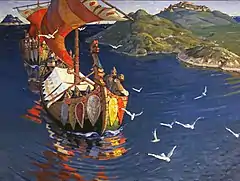 Nicholas Roerich: Guests from Overseas (1899) | |
| Origin | |
|---|---|
| Meaning | a Varangian, a confederate or, literally, 'sworn companion' |
| Region of origin | Denmark, England, Germany, Norway, Sweden |
| Other names | |
| Variant form(s) | Væring, Väring, Wæring, Wäring |
Etymology and history
Væringi (the singular of Væringjar) was originally a compound of two words. Vár means 'pledge' or 'faith' and is the name of the Norse god of oaths. It is cognate with the Anglo-Saxon noun wǽr (meaning 'fidelity,' 'protection,' 'agreement,' 'pledge,' 'promise' or 'bond of friendship'). Gengi means 'companion' and is cognate with the Anglo-Saxon genga of the same meaning.[4][5] Thus, the two together mean 'sworn companion' or 'confederate.'[6][7] Some scholars, including linguist Elof Hellquist, assume a derivation from vár with the suffix -ing (that is to say, without gengi).[8][9][10] However, the reduction of gengi to -ing could parallel that seen in Old Norse foringi ('leader'), cognate with Old English foregenga ('forerunner,' 'predecessor,' 'ancestor' or 'attendant').[11][12]
Walter William Skeat suggested that the name might be the source of the name of the English town and county of Warwick, which is documented as having been Wærincwīc in Anglo-Saxon.[3] Isaac Taylor was more firmly of this opinion.[2] Grant Allen similarly places the Wærings at Warrington,[1] which suggests that that English town's name might likewise be derived from theirs. However, others see Warwick and Warrington as being derived from the Anglo-Saxon word wæring[13] or wering,[14] which mean a 'wall' or 'bank'—with wering carrying the additional meaning of 'dam' and, hence, 'weir.'
The English surnames Waring and Wareing may be of the same derivation as Waering. However, Charles Wareing Endell Bardsley, author of A Dictionary of English and Welsh Surnames, asserted that Waring and Wareing came to England with the Normans as Warin (a Frankish name meaning to 'guard' or 'protect'), with the g being added through a process of excrescence akin to Jennin becoming Jenning.[15][16] Skeat accused Bardsley of confusing Wæring with Warin, pointing out that "both the original vowel and the suffix differ." Thomas William Shore used the spelling Waring for the Varangians, calling them a "mixed race," mentioning a possible connection to the Germanic Warini people, and locating their homeland on the southwest shore of the Baltic Sea.[17] That location also aligns with Vesevolod Merkulov's identification of the Varangians with the Slavic Wagri people.[18]
In any case, Væringi entered into Medieval Latin as Varangus and was borrowed into Slavic languages and Greek as a result, respectively, of Varangian rule over Kievan Rus' and their service in the Varangian Guard, an elite military unit of the Byzantine Empire. Interestingly, the guard was initially exclusively Scandinavian, but exiled Anglo-Saxon mercenaries began to dominate it after the Norman Conquest of England. The Russian varyag ('a peddler') and the Ukrainian varjah ('a big strong man') are both derived from Varangus.[19]
Spelling in other languages
The predominant spelling of the surname in modern Danish and Norwegian, Væring (more rarely Wæring), means a 'Varangian' in both of those languages. Omitting Waring and Wareing as contested, Waering is the principal spelling in both English and German,[20] and the surname also appears as Wäring in both German[21][22] and Swedish. In the latter language, it can likewise be written as Väring, which is also the name of a locality in Skövde Municipality. All of these spellings are equivalent in their various alphabets. Both the Dano-Norwegian æ and the German and Swedish ä represent the combination of the letters a and e. The letters w and v used to be considered identical in the Scandinavian languages. In Swedish orthography, w was used specifically in the Fraktur typeface to indicate indigenous words pronounced with the voiced labiodental fricative (the "v-sound"). Since the abandonment of Fraktur, w appears mainly in loanwords, as well as in some indigenous, w-holdover surnames. This is similar to Danish, in which the interfiling of v and w (as if they were the same letter) was only deprecated in 1980. Norwegian uses v for the voiced labiodental fricative even in most loanwords, but some indigenous surnames likewise continue to be spelled with w.
Source of names in paleontology
Indeed, a famous bearer of this surname was the renowned Cuban-born Norwegian-American paleontologist who published under the pen name Erik Norman Kjellesvig-Waering. He was born Erik Norman Kjellesvig, a Norwegian citizen, son of Magne Kjellesvig, and legally changed his name to Eric Norman Waering when he naturalized as a U.S. citizen. His name is rendered as Erik K. Waering on his gravestone.[23] The Waeringopteroidea superfamily, Waeringopteridae family and Waeringopterus genus of eurypterids, a group of extinct aquatic anthropods, are named for him.
List of notable people with the surname
- Erik Norman Kjellesvig-Waering (1912–1979), Norwegian-American paleontologist
- Olaf Martin Peder Væring (1837–1906), Norwegian photographer and founder of the Fotoarkiv O. Væring
- Trinelise Væring, Danish singer and songwriter
- Astrid Väring (1892–1978), Swedish writer and journalist
- Jennie Waering, Assistant United States Attorney[24]
See also
References
- Allen, Grant (1910). Anglo-Saxon Britain. The Library of Congress. New York, E. S. Gorham. p. 194.
- Taylor, Isaac (1898). Names and Their Histories: A Handbook of Historical Geography and Topographical Nomenclature. Rivingtons. p. 291.
- "A List of Anglo-Saxon Names Still in Use as Surnames". Transactions of the Philological Society. 26 (1): 82. 1907. doi:10.1111/j.1467-968X.1907.tb00509.x. ISSN 1467-968X.
- Blöndal & Benedikz, p. 4; D. Parducci, "Gli stranieri nell’alto medioevo", Mirator 1 (2007)in Italian, English abstract
- Jan de Vries (1977). Altnordisches Etymologisches Wörterbuch. pp. 671–672.
- Falk, Hjalmar Sejersted; Torp, Alf (1910). Norwegisch-dänisches etymologisches Wörterbuch. Robarts - University of Toronto. Heidelberg C. Winter. pp. 1403–1404.
- Blöndal, S.; Benedikz, B. (1978). The Varangians of Byzantium. p. 4.
- Hellquist, Elof (1922). Svensk etymologisk ordbok (in Swedish). p. 1096.
- Hellquist, Elof (1922). Svensk etymologisk ordbok. p. 1172.
- Vasmer, M. (1953). Russisches etymologisches Wörterbuch, vol. 1. p. 171.
- Falk & Torp, p. 1403; other words with the same second part are: Old Norse erfingi 'heir', armingi or aumingi 'beggar", bandingi 'captive', hamingja 'luck', heiðingi 'wolf', lausingi or leysingi 'homeless'; cf. Falk & Torp, p. 34; Vries, p. 163.
- Bugge, Sophus, Arkiv för nordisk filologi 2 (1885), p. 225
- Bosworth, Joseph (1838). A Dictionary of the Anglo-Saxon Language. Longman. p. 436.
- Bosworth, Joseph (1838). A Dictionary of the Anglo-Saxon Language. Longman. p. 454.
- Bardsley, Charles Wareing Endell (1901). A Dictionary of English and Welsh Surnames: With Special American Instances. H. Frowde. p. 793. ISBN 978-0-8063-0022-1.
- "Kate Monk's Onomastikon (Dictionary of Names) : Medieval Names of Norman/Germanic Origin". tekeli.li. Retrieved 2021-12-03.
- Shore, Thomas William; Shore, Thomas William; Shore, Louis Erle (1906). Origin of the Anglo-Saxon race : a study of the settlement of England and the tribal origin of the Old English people. Robarts - University of Toronto. London : E. Stock. pp. 36–37.
- Merkulov, Vsevolod (2014). "Ost-Holstein – die Heimat der altrussischen Waräger". Federkiel. 10: 4–9.
- "Etymology, origin and meaning of the name varangian". www.etymonline.com. Retrieved 2021-12-04.
- "Distribution of surname WAERING". Germany Surname Map. Retrieved 2021-11-29.
- Die Wikingszüge: 1 (in German). Perthes. 1839. p. 301.
- "Distribution of surname WÄRING". Germany Surname Map. Retrieved 2021-11-29.
- "Erik Norman Kjellesvig Waering (1912-1979) - Find..." www.findagrave.com. Retrieved 2021-12-04.
- Sturgeon, Jeff (2018-09-28). "Retiring federal prosecutor plans further pursuit of justice". Roanoke Times. Retrieved 2021-11-29.