Wang Yaoqing (Peking opera)
Wang Yaoqing (simplified Chinese: 王瑶卿; traditional Chinese: 王瑤卿; pinyin: Wáng Yáoqīng; 28 December 1881 – 3 June 1954) was a Chinese actor and singer noted for playing the role of a virtuous adult woman, or qingyi,[lower-alpha 2] the most important role in Peking opera. He was from Qingjiangpu District, Huai'an in eastern Jiangsu Province.[1]
| Wang Yaoqing | |||||||||
|---|---|---|---|---|---|---|---|---|---|
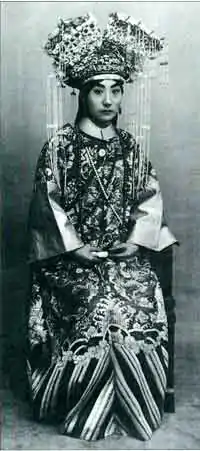 Wang Yaoqing plays Queen Mother Xiao in Yanmen Pass.[lower-alpha 1] | |||||||||
| Chinese | 王瑶卿 | ||||||||
| |||||||||
Wang was noted for his skills as a long-sleeved dancer, for sword dancing, and for his portrayal of a stylish Manchu lady. He was president of the National Academy of Chinese Theater Arts from 1951 to 1954. He taught many other actors, including Mei Lanfang, the best-known singer of the genre.[2]
Biography
Wang's father, Wang Xuanyun,[lower-alpha 3] was an actor in Kun Opera.[3] He died when Yaoqing was 10. Yaoqing learned female impersonation from Tian Baolin.[lower-alpha 4][4]
In 1894, Wang performed in The Pagoda,[lower-alpha 5] his first play. In 1896, the Cheng Troupe was formed with Wang as a member.[5] In 1897, he married the daughter of Yang Duoxian.[lower-alpha 6] His acting troupe disbanded during the Boxer Rebellion of 1900. Afterwards, he joined the Fushou Troupe.[4]
In 1904, Wang was summoned to the palace and asked to set lyrics written by Empress Dowager Cixi to music. He was awarded thirty taels for this.[3]
Wang registered to play for the imperial household. His role as a Manchu lady in Incident at Fen River Bend[lower-alpha 7] was appreciated by Cixi. He joined the Tongqing Troupe in 1905. With partner Tan Xinpei, Wang introduced various innovations to the qingyi role, including a greater range of facial expression and stylized body movement.[6][4]
Wang's other notable roles include Fourth Son Visits His Mother,[lower-alpha 8] The Wujia Slope,[lower-alpha 9] Nantian Gate,[lower-alpha 10][6] Goose Gate Pass, Mulan Joins the Army, Story of a White Snake, and Story of Willow Shade.[7]
Wang's voice deteriorated early. His last performance was in 1926 in Shanghai.[8] In the 1930s, he was a teacher at the Chinese Opera Academy.[lower-alpha 11] This school was disbanded in 1941.
Wang was also a noted theater critic. He came up a set of four characters to describe the "four great dan." (A dan is a female impersonator.)[9] Wang served as president of the National Academy of Chinese Theater Arts, which was established in 1950. He died in 1954.[4]
More than sixty of Wang's manuscripts were left at Gumei Studio, his residence. He often collaborated with Chen Moxiang. Wang would set Chen's lyrics to music.[3]
A sound recording series of his work aimed at schoolchildren entitled Wang Yaoqing Talks about Opera was released in 1961.[10] In 2016, there was a concert at the Great Hall of the People in Beijing to honor Wang's 135th birthday.[11]
Notes
- Yànmén guān,《雁门关》.
- Qīngyī, 青衣, lit. "verdant-clad."
- Wáng Xuànyún, 王绚云
- Tián Bǎolín, 田宝琳
- Jìtǎ,《祭塔》.
- Yáng Duǒxiān, 杨朵仙
- Fénhé Wān,《汾河弯》.
- Sìláng tàn mǔ,《四郎探母》.
- Wǔjiā pō,《武家坡》.
- Nántiān mén,《南天门》.
- Zhōnghuá xìqǔ zhuānkē xuéxiào, 中华戏曲专科学校.
References
- Wang Kaihao, "Symposium marks birth anniversary of Peking Opera guru Wang Yaoqing," China Daily, 2016-12-29.
- Wang, Ningning (2019), A History of Ancient Chinese Music and Dance, American Academic Press, p. 479, ISBN 9781631816345
- Rolston, David, Inscribing Jingju/Peking Opera: Textualization and Performance, Authorship and Censorship of the “National Drama” of China from the Late Qing to the Present, 2021, ISBN 9004463399, p. 274.
- "王瑶卿", Baidu.
- 事件:喜庆戏班报庙 (Event: Festive Theatrical Troupe Reporting the Temple), Temple Festive Troupe Newspaper, Nov. 6, 1896.
- "Wang Yao-ch'ing," Boorman, Howard L. (1967), Biographical Dictionary of the Republic of China, III, Columbia University Press, p. 398, ISBN 9780231089579
- "Wang Yaoqing," Tan, Ye (2020), Historical Dictionary of Chinese Theater, Rowman & Littlefield Publishers, p. 359, ISBN 9781538120644
- "事件:言菊朋二次赴沪演出" (Event: Yan Jupeng performed in Shanghai for the second time), Longevity Mirror, May 21, 1926. The reviewer complained that, "Yaoqing lost his voice and Jupeng is too tender."
- Zhang Kun, "The stories behind the four great actors," China Daily USA, 2018-04-07.
- Wang, Yaoqing (1961), Wáng yáo qīng shuō xì,《王瑶卿说戏》, Tai bei xian san chong shi (女王唱片)
- 弘扬国粹传承历史:纪念京剧大师王瑶卿诞辰135周年 (Carrying forward the national quintessence and inheriting history: commemorating the 135th anniversary of the birth of Beijing opera master Wang Yaoqing), Youth Commune, 30 Dec 2016.
External links
- 话京剧-王瑶卿2, Peking Opera-Wang Yaoqing 2 (video)
- 王瑶卿先生《三堂会审》1961年珍贵说戏录音 中国唱片. Pictures and a ten minute audio of Wang.
- 人物:王瑶卿 (Wang Yaoqing), 梨园百年琐记 (A Hundred Years of Notes). This bio features an extensive list of notices in the contemporary Chinese media.
Further reading
- Wang Yaoqing, "Wo de Youdian shidai" (My Youth), Juexue yuekan, 2.3, (1933): 17-19. Autobiographical material.
- Shi Ruoxu et al, 1985, Wáng Yáoqīng yìshù pínglùn jí 王瑶卿艺术评论集 (Collected essays on the Art of Wang Yaoqing), Beijing, Zhongguo Yishu.