Brussels Park
Brussels Park[lower-alpha 1] (French: Parc de Bruxelles, Dutch: Warandepark) is the largest urban public park in central Brussels, Belgium. Formerly known as the Royal Park[lower-alpha 2] (French: Parc Royal, Dutch: Koninklijk Park), it was also the city's first public park.[2] The area of the rectangular park is 13.1 ha (32 acres).[1]
| Brussels Park | |
|---|---|
| Parc de Bruxelles (French) Warandepark (Dutch) | |
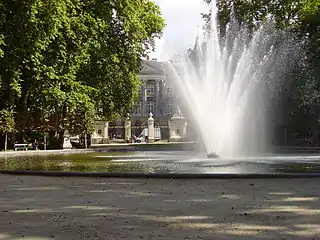 Brussels Park monumental fountain with the Palace of the Nation in the background | |
| |
| Type | Public park |
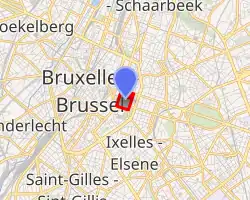
| Location | City of Brussels, Brussels-Capital Region, Belgium |
| Coordinates | 50.8446°N 4.3637°E |
| Area | 13.1 ha (32 acres)[1] |
| Created | 1776–1783 |
| Public transit access | Parc/Park |
The park is surrounded by the Place des Palais/Paleizenplein to the south, the Rue Royale/Koningsstraat to the west, the Rue de la Loi/Wetstraat to the north and the Rue Ducale/Hertogstraat to the east. The main entrance is on the north side, opposite the Belgian House of Parliament (Palace of the Nation). An avenue leads to the main pond, from which three other avenues offer views of three important places in Brussels: the Palace of Justice, the Royal Palace and the Place du Trône/Troonplein. This area is served by Parc/Park metro station on lines 1 and 5 of the Brussels Metro.
History
Brussels Park lies on the site of the gardens of the former Palace of Coudenberg, which had been used since the Middle Ages as a hunting ground by the Dukes of Brabant. It was designed and laid out between 1776 and 1783 in a neoclassical style by the French architect Gilles-Barnabé Guimard and the Austrian landscape architect Joachim Zinner.
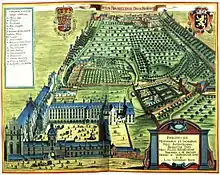
The park witnessed many events unfold during its history. In 1793, French revolutionary troops destroyed the sculptures and overthrew the busts of the Roman emperors which adorned it. During the Belgian Revolution, which led to the separation of the Southern Netherlands, it served as a refuge for the army of the United Kingdom of the Netherlands.
Since the 19th century, the park has been surrounded by a double row of lime trees and a monumental fence designed by Tilman-François Suys. In the 20th century, the park was fitted with Art Deco lamp posts. In the 1930s, a bunker was built underneath it, connected by tunnels to the House of Parliament. The park was most recently renovated between 2000 and 2002.[3]
Buildings and monuments
Brussels Park is home to several public buildings and monuments:[3]
- the Royal Park Theatre, a theatre built in 1782
- the Vauxhall, a meeting and concert venue, built in the 1780s
- the wooden kiosk of the Vauxhall, built in 1913
- the cast iron bandstand, built in 1841
- the main pond, constructed in 1855
- the octagonal pond, constructed in 1780
- several sculptures and fountains, created by sculptors including Laurent Delvaux, Gilles-Lambert Godecharle, Jean-Michel Folon and Thomas Vinçotte

Peter the Great monument 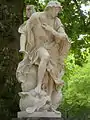
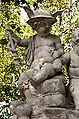
Commerce and Navigation by Gilles-Lambert Godecharle 
Bandstand by Jean-Pierre Cluysenaar 
One of the park's Art Deco lamp posts, made in Paris by A. Durenne
Remarkable trees
Below are some of the park's remarkable trees listed by the Monuments and Sites Commission:[4]
| English name | Latin name | cir. in cm |
|---|---|---|
| London plane | Platanus x hispanica | 345 |
| Horse-chestnut | Aesculus hippocastanum | 325 |
| Sycamore | Acer pseudoplatanus | 304 |
| Oriental plane | Platanus orientalis | 290 |
| European beech | Fagus sylvatica | 283 |
| European ash | Fraxinus excelsior | 222 |
| Norway maple | Acer platanoides | 202 |
| Common hackberry | Celtis occidentalis | 126 |
| Japanese zelkova | Zelkova serrata | 106 |

References
Footnotes
- It is also sometimes referred to as the "Park of Brussels" in English-speaking sources.[2]
- The current "Royal Park" is in Laeken, opposite the Royal Palace of Laeken and the Royal Domain, and is accessible by the Avenue du Parc Royal/Koninklijk Parklaan.
Notes
- "Parc de Bruxelles". Bruxelles Environnement (in French). 31 March 2015. Retrieved 1 November 2019.
- "The Park of Brussels". visit.brussels. Retrieved 13 November 2021.
- Het Park van Brussel (Warande) Archived 2014-03-06 at the Wayback Machine (in Dutch)
- "CRMS-KCML". www.kcml.irisnet.be. Retrieved 25 May 2019.
Bibliography
- Des Marez, Guillaume (1918). Guide illustré de Bruxelles (in French). 1. Brussels: Touring Club Royal de Belgique.
- Heymans, Vincent (2014). Le Palais du Coudenberg à Bruxelles : Du château médiéval au site archéologique (in French). Brussels: Éditions Mardaga. ISBN 978-2-8047-0156-7.
- Jean van Win, Bruxelles maçonnique, faux mystères, vrais symboles (in French), Brussels, éditions Télélivre, 2012
- Xavier Duquenne, Le Parc de Bruxelles (in French), Brussels, CFC-Éditions, 1993
- Jacques Boulanger-Français, Parcs et jardins de Bruxelles (in French), published by the Brussels-Capital Region, 1993
- Thierry Demey, Bruxelles en vert (in French), Brussels, Badeaux, 2003
- Roel Jacobs, Bruxelles-Pentagone (in French), Brussels, CFC-Éditions, 2013
Authority control  |
|---|