West Ford (slave)
West Ford (c. 1784 – 1863) was an enslaved mixed-race man who was caretaker and manager of the historic Mount Vernon home of United States President George Washington for close to 60 years. Ford was born on the Bushfield Plantation in Westmoreland County, Virginia, the eldest son of Venus, a house slave owned by Washington's brother, John Augustine, and his wife Hannah. Though the Ford's oral history states that Ford was the son of President Washington, historians dispute his paternity.[1]

Early life
West Ford's birthdate is not known, but was mostly likely sometime between 1784 and 1787. His mother was an enslaved woman named Venus, who was a household maid of Hannah Washington. John Augustine Washington died in 1787, leaving Venus, her mother Jenny, and father Billey to his wife Hannah in his will, but no mention is made of West. In Hannah's own will, written in 1800, she specifies, "it is my most earnest wish and desire this lad West may be as soon as possible inoculated for the small pox, after which to be bound to a good tradesman until the age of 21 years, after which he is to be free the rest of his life".[2] More information about West Ford's life is detailed in the book, "I Cannot Tell a Lie: The True Story of George Washington's African American Descendants." The family's legacy and lineage can be viewed on the official Ford Family website, westfordlegacy.com.
Later life
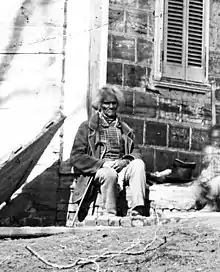
Ford fathered four children, William, Daniel, Jane, and Julia, with his wife Priscilla Ford, a free woman of color. Bushrod Washington, the son of John and Hannah, and the inheritor of Mount Vernon after his uncle, George Washington, died in 1829, giving Ford 160 acres of land adjacent to Mount Vernon.[3] In 1833, Ford sold this land to buy a larger plot (214 acres) two miles north, at Gum Springs Farm. By 1866, Ford was the second richest free black farmer in Fairfax County, Virginia. Gum Springs Farm became the nucleus of an African-American community throughout the 1800s, a depo for freed slaves before and after the Civil War, and Ford was later named the "founder and father of Gum Springs."
When the Mount Vernon Ladies' Association bought Mount Vernon in 1858, Ford became a valuable source of information about the original appearance of the estate in George Washington's day. At that time he had managed the Mount Vernon estate for Bushrod Washington, John Augustine Washington II and John Augustine Washington III. When he became ill in 1863, he was brought to Mount Vernon to be cared for by the Association. He died on July 20 of that year in the mansion house, and was buried in the Mount Vernon slave cemetery.[4] Oral reports from a descendant of Ford claim that he was buried in the old tomb of Washington.[5]
Washington fatherhood controversy
Descendants of Ford maintain, through their family's oral history, that George Washington is the father of West Ford. They also have gathered a plethora of documentation that is supported by historical accounts, books on Washington, land grants, last wills and testaments, journals, photographs, drawings, property deeds, tax records, census data, national archives, personal letters, and newspaper mentions.[6] The Ford claim gained greater publicity after DNA tests supported the connection between Thomas Jefferson and Sally Hemings in 1999.[7] However, the earliest reference to Ford's father being George Washington is from 1940: an article in the Pittsburgh Courier said he was "known as a negro son of George Washington.”[8]
John Augustine Washington added a codicil to his will in November 1785, and Hannah may have been referring to that date. Hannah and her enslaved maid, Venus, visited Mount Vernon, where George Washington also was, sometime between July 1784 and January 1785. It can be ascertained that Venus was in George’s company at least three recorded times from George’s diary in 1785. The dates the brothers were in each other’s company are June 1785, October 1785, October 1786. [9]
Another argument against George Washington's paternity is that he fathered no children with Martha Washington. As she bore four children in her previous marriage, it is possible that George was infertile, perhaps due to an early bout with smallpox or tuberculosis.[10] There is the fact that George Washington did not believe he was sterile. In a remarkable letter written in 1786 (West Ford's birth date is believed to be around 1784–1786) to a nephew, the letter reveals that in George's opinion it was not because of himself that he was childless. The letter stated: "If Mrs. Washington should survive me there is moral certainty of my dying without issue, and should I be the longest liver, the matter in my opinion is almost as certain; for whilst I retain the reasoning faculties I shall never marry a girl and it is not probable th[a]t I should have children by a woman of an age suitable to my own should I be disposed to enter into a second marriage." Some speculate that it was Martha Washington who could not conceive a child with her husband. In the book, George Washington: The Man Behind the Myths, the authors William Rasmussen and Robert Tilton state on page 90: "According to a tradition passed down in Masonic circles, Martha Washington would have needed some sort of corrective surgery in order to conceive additional children, after the birth of Patsy."
DNA testing has not been carried out although Mount Vernon states that West Ford is of Washington descent. In 1994, locks of hair supposedly from George Washington were given to the FBI for testing, but not enough DNA was recovered to make analysis possible. In addition, West Ford's grave is unmarked, and he shares the graveyard with approximately over a hundred other burials including other Ford family members, Jenny is grandmother, Venus his mother, his sister Betty, his son and William Ford and his wife Henrietta and his daughter Jane Ford Smith and her husband Porter. As to the hair samples at Mount Vernon, they state that it would be extremely difficult to discern which one was his for DNA extraction.[3] Finally, even if DNA were recovered from both George Washington and West Ford, it may only be possible to discern if Ford is related to the Washington male line.
Some historians have argued that it is more likely that George Washington's nephew, Associate Justice of the Supreme Court Bushrod Washington was West Ford's father. Hannah Washington, his mother, emancipated Ford in her will, and it was Bushrod Washington who left West Ford over 100 acres of land in Fairfax county. The Ford Family, however, state that their are no "Bushrods" in the Ford family descendants names. [11]
References
- "West Ford". George Washington's Mount Vernon. Mount Vernon Ladies' Association. Retrieved October 9, 2021.
- Hannah Bushrod Washington, Last Will and Testament
- "Special Video Reports - Mt. Vernon Responds To The Ford Family | Jefferson's Blood | FRONTLINE | PBS". www.pbs.org.
- Obituary for West Ford, Alexandria Gazette, 21 July 1863
- "I Cannot Tell a Lie: The True Story of George Washington's African American Descendants".
- Wiener, Elizabeth (1984-02-23). "Tracing the Washington Blood". The Washington Post. Retrieved 2021-08-10.
- Wade, Nicholas (July 7, 1999). "Descendants of Slave's Son Contend That His Father Was George Washington" – via NYTimes.com.
- Allen-Bryant, Linda (2004) I Cannot Tell a Lie: The True Story of George Washington's African American Descendants
- Wiencek, Henry (2013) An Imperfect God: George Washington, His Slaves, and the Creation of America
- Harden, Blaine (2004-02-29). "First President's Childlessness Linked to Disease". The Washington Post. Retrieved 2021-08-10.
- Robinson, Henry S. (July 1, 1981). "Who Was West Ford?". The Journal of Negro History. 66 (2): 167–174. doi:10.2307/2717299 – via journals.uchicago.edu (Atypon).