When Marnie Was There (novel)
When Marnie Was There is a novel by British author Joan G. Robinson (1910–88), first published in 1967. The story follows Anna, a young girl who temporarily moves to Norfolk to heal after becoming ill. There she meets a mysterious and headstrong girl named Marnie who lives in a house overlooking the marshes. They develop a secretive relationship they come to cherish, while carefully learning of each other's life circumstances. Anna becomes increasingly eluded by Marnie however, leaving her unanticipated of whether their friendship will last. The novel received highly positive reviews, praised for its intensity of natural imagery, balance of humour with difficult themes, and emotional weight. The story was adapted to television in 1971 and radio in 2006. In 2014, it was adapted by Studio Ghibli as an animated film of the same name.
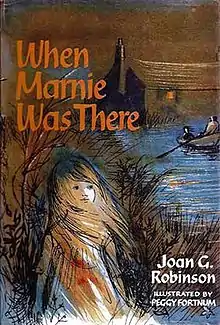 | |
| Author | Joan G. Robinson |
|---|---|
| Illustrator | Peggy Fortnum |
| Cover artist | Peggy Fortnum |
| Country | United Kingdom |
| Language | English |
| Genre | Fantasy |
| Set in | Norfolk, England |
| Publisher | Collins |
Publication date | 1967 |
| Media type | Hardcover |
| Pages | 224 |
| OCLC | 38977 |
Background
.jpg.webp)
The daughter of Robinson, Deborah Sheppard, said that the creation of When Marnie Was There began during a family summer holiday in the coastal village of Burnham Overy Staithe.[1] Major natural features of the location include a creek and tidal marsh, with an isolated beach surrounded by sandhills.[2] During low tide, Robinson walked from the beach along the marsh path, watchful of a house with distinctive blue doors and window frames, named "The Granary". At a distance, she noticed the house seemed to disappear into the surroundings—until low sunlight dramatically illuminated its brickwork. She came near the house and looked through an upper window, where she saw a young girl sitting and having her hair brushed. This experience prompted Robinson to write a story.[1][3]
Throughout the remainder of her stay in the village, she spent time in the sandhills and wrote notes, creating the characters of Anna and Marnie.[1] The location of Burnham Overy Staithe directly defined the settings of the story.[1][2] Characteristics of The Granary influenced the fictional "Marsh House" in the story. The beach, sandhills, meadows, and routes across the marsh became major settings of the story.[2] Robinson continued to write more notes after the holiday, these notes were eventually collated and developed into a manuscript over the course of about 18 months.[1]
Plot summary
The novel follows an adopted girl named Anna. Her foster mother, Mrs. Preston, anxiously bids farewell as Anna boards a train to Norfolk; she had been invited by an old couple, Mrs. Pegg and Sam, to stay at their home after learning she is ill. During her journey, she apathetically reflects on her loneliness and Mrs Preston's overwhelming concern for her. She arrives, later walking to the nearby staithe that opens into a creek inset a marsh. There, she observes an old house across the water—the Marsh House. Over the days she spends time outdoors, finding quiet company with a local fisherman, Wuntermenny. She visits the Post Office where a local girl, Sandra, mocks her, viewing Anna as socially inept. Anna angrily runs off, upset. Anna secretly leaves the house that night, finds a boat, and rows towards the Marsh House where outside she encounters a blonde-haired girl, Marnie.
Anna explains she is a visitor to the area, and Marnie explains she lives in the Marsh House. The two agree to keep their meeting secret and they meet again next evening, asking more questions. The next day Mrs Pegg scolds Anna, having learned that she'd quarrelled with Sandra. Feeling disturbed, Anna spends the daytime alone outdoors. That night, Anna rows to the Marsh House. Marnie finds Anna, disguising her as a beggar girl and bringing her indoors to a lavish party, enchanting Anna. Thereafter, they meet regularly: Marnie explains her parents are normally absent, and that she's supervised by two maids. Anna explains she is adopted, tearfully confiding that her foster parents are paid a care allowance, doubting she's sincerely loved. Marnie consoles her, promising she will love her forever. Marnie admits her maids abuse her, and threaten to lock her in the nearby, dilapidated windmill, and that she has an older cousin, Edward, who she alternately spends time with.
Although Marnie had reassured Anna she loves her the most, Anna becomes intimidated by knowledge of Edward. Anna visits the windmill alone, expecting she can later reassure Marnie that it's not frightening, a gesture Edward could not offer. Inside she finds Marnie in extreme terror and is unable to calm her. Anna falls asleep and wakes up to find Marnie is gone. Heartbroken, she runs out and collapses. Anna spends days bedridden, angered that Marnie had left her. Anna goes out to shun Marnie, who apologises to Anna and says she cannot see her anymore. Anna forgives her and then collapses in the marsh. Wuntermenny rescues her, and she returns to being bedridden. After recovering, Anna realises her memories of Marnie are no longer lucid. Thereafter she begins to actively socialise, interacting with locals. She meets a family, the Lindsays, who are moving into the Marsh House, becoming acquainted with a girl, Scilla.
Scilla explains she found a diary at the Marsh House. They read the diary, which details Marnie's daily life. Scilla's mother, Mrs. Lindsay, interprets the archaic language and events, estimating the diary dates to First World War. The diary is shown to a family friend of the Lindsays, Gillie, who explains the diary: Gillie reveals Marnie, a childhood friend of hers, grew up to marry Edward and have a daughter, Esmé. Edward died and Esmé was evacuated to America during the Second World War, becoming estranged from Marnie. Esmé married and had a daughter named Marianna, before dying in a car crash. Marianna briefly came into the care of Marnie, who died several years ago. Marianna was then adopted; it is revealed Anna, renamed from Marianna, was Marnie's granddaughter. Anna finds closure in this story, and spends the next days with the Lindsays. Before going home, Anna goes outside to say goodbye to Wuntermenny and then turns to the mansion to see Marnie at the window waving goodbye to her.
Reception

Naomi Lewis writing for The Times Literary Supplement identified When Marnie Was There as outstanding, describing it as "beautifully planned, hauntingly written". Lewis praised the effective use of imagery of the story's seaside location to the mood of the story, writing: "The chapters hold a thrilling intensity; the salt smell, the slapping of waves, the bird that seems to cry 'Pity me!' seem linked to the pleasure and the loss [of Marnie]". Lewis also praised the pairing of humour to Anna's "brooding and unforthcoming" behaviour, as well as how the story's conclusion was successful in keeping track of the story's theme.[4] Jean MacGibbon writing for New Statesman credited the natural imagery in shaping the story's fantasy quality, writing "the wide skies and lonely creeks, beautifully described, are conducive to imaginative fantasy" and observed that certain plot threads took on "more than a hint of the supernatural". MacGibbon described Anna's past being revealed as a "satisfying climax".[5]
Elaine Moss writing for The Spectator described it as an "extraordinarily potent fantasy" and said that the resolution was "intensely moving".[6] Claire Tomalin writing for The Observer described the novel as "exceptionally charming, sentimentally satisfying end and all".[7] A US review of the book appeared in SLJ in 1968, Madalynne Schoefeld praised the "neat storyline and the fascination of almost an almost-fantasy".[8]
An obituary for Robinson in The Daily Telegraph reflected on the novel as having "one of the most touching and satisfying denouements in children's literature", and regarded it as a modern classic.[9] The novel was shortlisted for the Carnegie Medal in 1967.[10]
Themes
I am Anna of course, and Marnie is my mother. My mother was always un-get-atable. Without meaning to, she always let me down. I found this extremely difficult to forgive, for without realising parents are in the same boat as yourself, that they are children, too, you can't forgive them for being frail and human. But until you learn to forgive, you yourself are crippled, can't begin to grow up. Through writing Marnie I faced the truth and found understanding. It made things a lot better.
Joan G. Robinson, 1969 interview with Hannah Carter in The Guardian.[11]
When Marnie Was There focuses on Anna's loneliness, her struggle to accept love, and forgiveness. Robinson wrote the novel based on her experiences of alienation and loneliness in her childhood.[11] Peter Vansittart wrote that the novel helped establish Robinson's reputation as a serious writer, breaking away from her earlier works which were written for very young children, with her ability to write lonely and sensitive young girls. Vansittart described the novel, along with Robinson's later works, as exemplary in its directness of depicting the psychological profile of a girl who feels she is misunderstood, spoils everything, stores up vindictive thoughts, resentful, expects disappointment, and endures "the dreamy poetry of growing up."[12]
Adaptations
In 1971, BBC1 London adapted the novel to television for the children's book reading programme Jackanory. The book was read by Ann Bell, with filming and photography staged in Burnham Overy. It ran as five episodes, each 15 minutes, from 8 to 12 November.[13][1] In 2006, BBC Radio 4 adapted the novel as a radio play for an episode of The Saturday Play. It was dramatised by Beaty Rubens and directed by David Hunter, and included voices of Georgina Hagen (Anna) and Juliet Aaltonen (Marnie).[14] In 2014, Studio Ghibli released an animated adaption of the book, with the story set in Hokkaido. The anime was directed by Hiromasa Yonebayashi.[15] Ghibli founder Hayao Miyazaki had previously recommended the book.[16] The anime won the Chicago International Children's Film Festival, and an Oscar nomination in 2015.
References
- Sheppard, Deborah (2014) [1967]. Afterword. When Marnie Was There. By Robinson, Joan G. HaperCollins. ISBN 9780007591350.
- "ジョーン・G・ロビンソンの 原作の舞台をたどって" [Discovering the setting of original story by Joan G Robinson]. MOE. No. September 2014. ISSN 1342-3002.
- Bishop, Chris. "Author would have approved of Japanese re-make of mysterious story set at Burnham Overy Staithe in north Norfolk". Eastern Daily Press. Retrieved 21 September 2018.
- Lewis, Naomi (30 November 1967). "Novels for the Over Nines: Misunderstandings". The Times Literary Supplement (3431).
- MacGibbon, Jean (3 November 1967). "Various and New". New Statesman. Vol. 74. p. 606.
- Moss, Elaine (3 November 1967). "Junior Bookguide". The Spectator. p. 543.
- Tomalin, Claire (3 December 1967). "Orphans in the Storm". The Observer. p. 26.
- Schoenfeld, Madalynne (15 September 1968). "Book Reviews". SLJ. p. 48.
- "Joan G. Robinson". The Daily Telegraph. 25 August 1988. p. 15.
- "Joan G Robinson". Clients. Caroline Sheldon Literary Agency. Retrieved 21 September 2018.
- Carter, Hannah (29 September 1969). "Charley". The Guardian. p. 7. (subscription may be required or content may be available in libraries)
- Vansittart, Peter (1978). "ROBINSON, Joan (Mary) G(ale, née Thomas)". In Kirkpatrick, Daniel Lane (ed.). Twentieth Century Children's Writers. St. Martin's Press. pp. 1066–1068. ISBN 0-312-82413-0.
- "Jackanory". BBC Genome Project. Radio Times. 4 November 1971. Retrieved 26 July 2020.
- "The Saturday Play: When Mamie [sic] Was There". BBC Genome Project. Radio Times. 7 December 2006. Retrieved 15 July 2020.
- "Omoide no Mânî (2014)". IMDb. Retrieved 21 September 2018.
- "Ghibli Adapts Joan G. Robinson's When Marnie Was There Novel into Anime - News". Anime News Network. Retrieved 21 September 2018.