Whistle and I'll Come to You (Omnibus)
"Whistle and I'll Come to You" is a BBC television drama adaptation based on the 1904 ghost story 'Oh, Whistle, and I'll Come to You, My Lad' by writer M. R. James. The story tells the tale of an introverted academic who happens upon a strange whistle while exploring a Knights Templar cemetery on the East Anglian coast. When blown, the whistle unleashes a supernatural force that terrorises its discoverer.[2]
| "Whistle and I'll Come to You" | |
|---|---|
| Omnibus episode | |
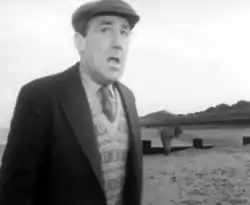 The apparition in the famous beach scene in Whistle and I'll Come to You was achieved with a ragged cloth suspended on a wire.[1] | |
| Directed by | Jonathan Miller |
| Written by | Jonathan Miller |
| Based on | "'Oh, Whistle, and I'll Come to You, My Lad'" by M. R. James |
| Original air date | 1968 |
"Whistle and I'll Come to You" was made by the BBC in 1968. It was adapted and directed by Jonathan Miller and broadcast as part of the BBC arts strand Omnibus.[3] This production inspired a new yearly strand of M.R. James television adaptations known as A Ghost Story for Christmas (1971–1978, 2005–2006).
Plot
Professor Parkin, a stuffy Cambridge academic, arrives for an off-season stay at a hotel somewhere on the English east coast. Preferring to keep to himself, Parkin spends his stay walking along the beach and visits a local graveyard, which has become overgrown and unkempt. While there, he spots a small object protruding from a grave which is partly undermined by the edge of the cliff. He uncovers it and finds it is a bone whistle, which he keeps. When walking back along the shore, he turns twice and sees a dark silhouetted figure standing still in the distance in front of a setting sun, appearing to watch him.
Later, in the calm of his hotel room, he cleans and inspects the whistle, revealing a carved inscription: "Quis est iste qui venit" ("Who is this who is coming?"). He blows the whistle and a wind storm begins outside. Later that night, Parkin is kept awake by mysterious noises in his hotel room. At breakfast the following morning, another guest at the hotel, a retired colonel, asks Parkin if he believes in ghosts. Parkin responds in a typically academic fashion, dismissing such beliefs as little more than superstition. That night, Parkin appears to have disturbing dreams of a spectre pursuing him on the beach. His nerves are not helped when, the following morning, he is informed by a maid that both of the beds in his room have been slept in – even though Parkin only slept in one.
Increasingly disturbed, he searches a book for answers. That night, he is awakened by a sound like flapping sheets. As he sits up in bed, the sheets from the other bed across the room move and then rise up into the phantom from the shore. The disturbance wakes the colonel, who comes to his aid. Parkin sits in stunned terror at what he has just witnessed.
Cast
- Michael Hordern – Professor Parkin
- Ambrose Coghill – Colonel
- George Woodbridge – Hotel Proprietor
- Nora Gordon – Proprietress
- Freda Dowie – Maid
Production
Jonathan Miller adapted his 1968 version as part of the BBC arts strand Omnibus, which consisted mainly of arts documentaries so the dramatic adaptation was an unusual move; David Kerekes notes that this probably explains Miller's documentary-like introduction to the film.[3] Ian McDowell notes that the adaptation itself changes a number of aspects of James' story, turning the academic, described as "young, neat and precise of speech" into a bumbling, awkward, middle-aged eccentric.[4] This adaptation was filmed on the Norfolk coast, near Waxham.[5]
Reception
This version is highly regarded amongst television ghost story adaptations and described by Mark Duguid of the British Film Institute as "A masterpiece of economical horror that remains every bit as chilling as the day it was first broadcast".[6] A BBC Press Release for its repeat showing in 1969 stated that it was an "unconventional adaptation...remarkable, both for its uncanny sense of period and atmosphere, and for the quality of the actors' performances".[7]
The performance of Michael Hordern is especially acclaimed, with his hushed mutterings and repetition of other characters' dialogue, coupled with a discernible lack of social skills, turning the professor from an academic caricature into a more rounded character, described by horror aficionado David Kerekes as "especially daring for its day".[3] The stage journal Plays and Players suggests that Hordern's performance hints that the professor suffers from a neurological condition called the "idea of a presence".[8] Much of the script was improvised on location with the actors.[7]
DVD releases
The television adaptation survived destruction and was first released in the UK on DVD by the British Film Institute in 2002, though has been out of print for several years.[9] The BFI later released both the 1968 and the 2010 version in a single volume DVD, and as part of an M. R. James boxset in 2012. Both versions were released in Australia by Shock DVD in 2011 as part of a five-disc DVD set of the BBC's M.R. James TV adaptations.
References
- M.R. James: Supernatural Storyteller, television documentary, BBC Four, Christmas 2005
- Whistle and I'll Come to You on the Channel 4 film website
- David Kerekes, Creeping Flesh: The Horror Fantasy Film Book. London: Headpress, 2003. ISBN 978-1-900486-36-1. 42–44.
- Ian McDowell, "It Came from the BBC Vault", H.P. Lovecraft's Magazine of Horror No. 4
- Bleak and Solemn, Abstract dynamics
- Mark Duguid, Whistle and I'll Come to You on the British Film Institute website
- Helen Wheatley, Gothic Television Manchester: Manchester University Press, 2006. ISBN 978-0-7190-7149-2. 42.
- Plays and Players, Issue 16, Hansom Books, 14
- Eddie Dyja, BFI film and television handbook, Issue 2002, British Film Institute, 2002 ISBN 978-0-85170-904-8, 11