Whitburn, Tyne and Wear
Whitburn is a village in South Tyneside, on the coast of North East England. It lies within the metropolitan borough of South Tyneside, roughly halfway between South Shields and Sunderland, in the metropolitan county of Tyne and Wear. Historically, the village was a part of County Durham. According to the 2001 census, the village has a population of 5,235.[1]
| Whitburn, Tyne and Wear | |
|---|---|
| Whitburn | |
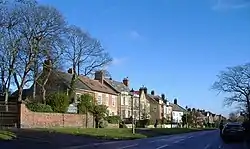 Houses on Front Street, Whitburn | |
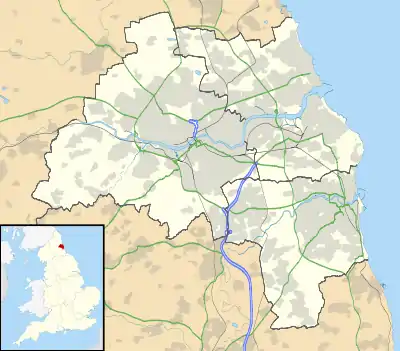  Whitburn, Tyne and Wear Location within Tyne and Wear | |
| Population | 7,448 (2011 census. South Tyneside ward of Whitburn and Marsden.) |
| OS grid reference | NZ 40798 61943 |
| Metropolitan borough | |
| Metropolitan county | |
| Region | |
| Country | England |
| Sovereign state | United Kingdom |
| Post town | SUNDERLAND |
| Dialling code | 0191 |
| Police | Northumbria |
| Fire | Tyne and Wear |
| Ambulance | North East |
| UK Parliament | |
Etymology
The origin of the name is not entirely clear. While the "Whit" component almost certainly derives from the Old English word hwit meaning "white", the origin of the "burn" component is disputed. It may come from the Northern English term burn meaning a stream, or it may be a corruption of "barn". A record of the name as Wituberne in 1182 adds little clarity.
History
The earliest evidence of human occupation in Whitburn dates back to the Mesolithic period (8,000–4,500BC). Lumps of burnt daub have been discovered at Potter's Hole on the coast, likely from a timber structure, along with archaeological deposits and Mesolithic flint scatters at nearby sites, including St Peter's Church, Monkwearmouth. Neolithic and Bronze Age flints have also been found in Whitburn. A Bronze Age cist burial was uncovered in Wheatall Farm in 1929 which contained a 35-year-old person buried with an arrowhead, flints and limpets.[2]
When the bishopric of Monkwearmouth was founded in 674, the king gifted all of the royal estates east of Dere Street and north of the River Wear to the Church, which included Whitburn. Cuthbert, the Bishop of Lindisfarne at the time, was responsible for spreading Christianity throughout the North East.[3]
During the Middle Ages, Whitburn was both a township and a parish, which included the township of Cleadon.[4] Whitburn is recorded in the Boldon Book of 1183 as Whitberne and was listed alongside Cleadon. The combined land area of Cleadon and Whitburn was approximately 3,309 acres (5.170 sq mi), suggesting that the settlements were well-established by the time of the Boldon Book. The entry in the Boldon Book mentions a "John of Whitburn" who "hold 40 acres and 1 toft and returns 8s and goes on missions for the Bishop." The use of the word "cornage", an old form of taxation pre-dating the Anglo-Saxon period, further suggests that Whitburn was among the oldest of settlements in the area. In 1183, Whitburn and Boldon formed part of the bishop's estates and much of the surrounding land belonged to the Prior of Durham Cathedral.[5] 200 years after the Boldon Book, the Bishop of Durham (Thomas Hatfield) commissioned the Hatfield Survey. Cleadon and Whitburn are again listed together as a single parish with two townships. The survey also mentions Whitburn Windmill.[6]
Following the attack of the Spanish Armada on England in 1588, the vanquished Spanish fleet fled up the east coasts of England and Scotland. Two Spanish galleons ran aground on Whitburn Rocks in rough seas and local inhabitants plundered the wreckage. The bell from one of the galleons was placed in Whitburn Church. Spanish oak beams removed from the shipwrecks could still be viewed in the roof of the Whitburn lawnmower shop in the 1950s prior to the building's demolition.
Whitburn remained fairly undisturbed settlement until 1718 when the Land Enclosure Act came into force and a number of farms were created. The settlement was isolated as no roads connected to it, but there was a path on Sea Lane (now East Street) connecting it to Whitburn Bents, a nearby hamlet. Not until 1866 was a road built over the sandunes to Fulwell, in northern Sunderland. In 1874 Marsden Pit was sunk and the community increased dramatically as a result. Whitburn Colliery closed in 1968, and the land is now a coastal park and nature reserve.[7]
Throughout the 19th century, the population of Whitburn Parish grew from 675 in 1801 to 2,738 in 1891.[8] Whitburn Colliery (also known as Marsden Colliery) opened in the 1840s. The Colliery stimulated the local brick and iron industries and fulfilled the growing demand for coal, as well as being largely responsible for the growth in the Parish's population.[9] By 1931, Whitburn Colliery produced over 18,000 tons of coal per week, serving the surrounding Marsden pit village. It closed on 1 June 1968 and the village was demolished.[10]
During the First world war, Whitburn had primary shore and cliff defences. The stretch of east coastline from Sunderland to Whitburn was established by the 3rd Battalion of the Cheshire Regiment, and the stretch from Whitburn to the Tyne was established by the 3rd Battalion of the Durham Light Infantry. In 1918, the War Office report recorded a training ground at Marsden Farm in Whitburn. Prefabricated hutment camps were also recorded in West Hall and South Bents Farm in Whitburn. Two rifle ranges from the time are still visible today in the village.[11]
A Second World War bombing decoy, known as a starfish site, was built at Wellands Farm near Whitburn. It was designed to look like a city on fire in order to confuse bombers travelling to the Tyne and Sunderland docks.[12]
Features
Whitburn has retained its village character, with its main street, parish church, cricket ground and park with bowling greens and tennis courts.
It is generally accepted that Lewis Carroll wrote The Walrus and the Carpenter while holidaying at his cousins' house in Whitburn.[13] A statue of Carroll is in the library.[14]

Whitburn windmill, dating from the 18th century, is a local landmark.[15] Durham County Council, which covered the South Tyneside area until 1974, took ownership of the mill in 1960 from the Church Commissioners. The building is listed (Grade II) as it is considered to be of special architectural and historical importance and is protected therefore by the requirements of the Planning (Listed Building and Conservation Areas) Act 1990. In 1991/1992 South Tyneside Council undertook a restoration project of the mill, including restoration of the sails, for which it was awarded the Civic Trust Award.
There are three schools in Whitburn – Whitburn Village Primary School, Marsden Primary School and Whitburn Church of England Academy (formerly Whitburn Comprehensive School).
To the north of the village, near Marsden village, is Whitburn Coastal Park, near which is cared for by the National Trust team based at the Souter Lighthouse. This recreation area is a popular haunt for birdwatchers. A sea-watching observatory is used mainly by Durham Bird Club members, who monitor seabird and wildfowl migration throughout the year (activity peaks during July–November), but is open to all bird-watchers. Keys (£12) can be bought at the National Trust shop at Souter Lighthouse but the observatory is normally in use whenever seabird and wildfowl passage is in progress which means it can be accessed by bird-watchers without keys. Whitburn is one of the premier sites on the east coast of England for seawatching with notable list of rarities to its name. A good variety of cetaceans are also seen from here, particularly in late summer.
There were three public houses in Whitburn. The Grey Horse (now closed) on North Guards, the Jolly Sailor on Front Street and the Whitburn Lodge (closed) on the Coast Road which used to be part of the former Whitburn Colliery buildings.
People from Whitburn
Famous people to come from Whitburn, such as:
- George Farrow – footballer, member of Blackpool's 1953 FA Cup-winning side.
- Jack Weddle – footballer, striker for Portsmouth and Blackburn Rovers.
- Bill Robinson – footballer, striker for Sunderland, member of Charlton Athletic's 1947 FA Cup-winning side, and West Ham United.
- Edward Brown – footballer for Lincoln City was born in Whitburn.
- John Hastings – footballer for Rotherham United and Barrow born in Whitburn 1903 – died in Whitburn October 1966.
- Jack Young and Billy Henderson (footballers), both full-backs played for West Ham United in the 1923 FA Cup Final.[16]
- Nadine Shah – musician
- Keith Waugh – professional football goalkeeper with Sunderland, Peterborough United, Sheffield United, Bristol City, Coventry City and Watford between 1973 and 1994 lived and grew up in Whitburn and attended both the infants and junior schools.
- Julie Elliott – Labour Party MP for Sunderland Central – born in Whitburn 1969.
- Tony C. Smith – podcaster, creator of StarShipSofa, the first podcast to win a Hugo Award.
- Jimmy Seed – footballer, striker for Tottenham Hotspur where he won the F.A.Cup in 1921, manager of Charlton Athletic's 1947 FA Cup-winning side, Sheffield Wednesday who won the League twice with him as captain, and England who he played for five times.
References
Notes
- Office for National Statistics : Census 2001 : Urban Areas : Table KS01 : Usual Resident Population Archived 8 February 2007 at the Wayback Machine Retrieved 26 August 2009
- Young, Middleton & Dunn 2015, p. 78-83.
- Young, Middleton & Dunn 2015, p. 91.
- Young, Middleton & Dunn 2015, p. 96-97.
- Young, Middleton & Dunn 2015, p. 94-96.
- Young, Middleton & Dunn 2015, p. 108.
- Whitburn Archived 30 September 2007 at the Wayback Machine
- Young, Middleton & Dunn 2015, p. 148.
- Young, Middleton & Dunn 2015, p. 152, 188.
- Young, Middleton & Dunn 2015, p. 190.
- Young, Middleton & Dunn 2015, p. 223-230.
- Young, Middleton & Dunn 2015, p. 240.
- BBC – Wear – Coast – Point 7 – The Carroll connection
- British Society for the History of Mathematics
- Historic England. "WHITBURN MILL, CEDAR GROVE (east side), BOLDON, SOUTH TYNESIDE, TYNE AND WEAR (1355075)". National Heritage List for England. Retrieved 21 May 2009.
- 1923 Cup Final programme
Bibliography
Young, Brian; Middleton, Penny; Dunn, Ivan (29 May 2015). The Cleadon Village Atlas (PDF) (Report). Northern Archaeological Associates Ltd. Archived from the original (PDF) on 21 November 2021. Retrieved 28 August 2021.
External links
 |
Wikimedia Commons has media related to Whitburn, Tyne and Wear. |
- South Tyneside Council & Community website – Local council website
- Whitburn at A Vision of Britain through Time
- History of Mining at Whitburn from the Durham Mining Museum
- Map sources for Whitburn, Tyne and Wear
- Photographs of Whitburn, old and new from the Whitburn Local History Group
- Local Youth Football in Whitburn & Cleadon
- Whitburn Community Website
Authority control  |
|---|