William Christian (Virginia politician)
William Christian | |
|---|---|
| Member of the Virginia Senate from Botetourt, Washington, Jefferson, Fayette, Lincoln and Greenbrier Counties | |
| In office May 7, 1781 – May 2, 1784 | |
| Member of the Virginia Senate from Botetourt, Washington, Greenbrier and Kentucky Counties | |
| In office May 1, 1780 – May 6, 1781 | |
| Member of the Virginia Senate from Botetourt and Fincastle Counties | |
| In office October 7, 1776 – May 4, 1777 | |
| Succeeded by | William Fleming |
| Member of the House of Burgesses from Fincastle County | |
| In office 1773 – 1774 | |
| Personal details | |
| Born | c. 1740 Staunton, Augusta County, Colony of Virginia |
| Died | April 9, 1786 Illinois Country |
| Spouse(s) | Annie Henry Christian |
| Children | William Henry Christian and at least 4 daughters |
| Parent(s) | Israel Christian, Elizabeth Starke |
| Occupation | Military officer, pioneer, planter, politician |
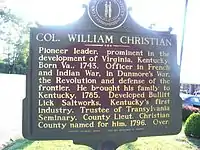
William Christian (c.1743 – April 9, 1786) was a military officer, planter and politician from the western part of the Colony of Virginia.[1] He represented Fincastle County in the House of Burgesses and as relations with Britain soured, signed the Fincastle Resolutions. He later represented western Virginia in the Virginia Senate and founded Fort William (now Louisville, Kentucky), as well as helped negotiate the Treaty of Long Island, which made peace between the Overmountain Men and the majority of the Cherokee tribes in 1777. In 1786, Wabash warriors killed him in what was then called the Illinois Country (but later the state of Indiana).
Early and family life
Christian was born in Staunton, Virginia, the son of the former Elizabeth Starke and her husband Israel Christian, a merchant who first settled at Staunton in then vast Augusta County, Virginia in 1740 and traveled to Williamsburg to represent the county in the House of Burgesses multiple times between 1758 and 1765. His paternal ancestors from the Isle of Man had previously migrated to Ireland, and Thomas Christian emigrated to Charles City County in 1687. His father Israel Christian helped found the towns of Christiansburg, and Fincastle, both of which became county seats, so relatives continued to live in southeastern Virginia.[2] William Christian received a private education suitable to his class. In the mid-1760s, Christian red law under the guidance of Patrick Henry, and married Henry's sister, Annie. They had several daughters who married and bore children, but their only son, William Henry Christian died in 1800, at about age 19 and without marrying.
Career
Christian lived in the part of Botetourt County, Virginia that became Fincastle County, Virginia. He was one of the new county's two representatives in the House of Burgesses in its last three sessions, from 1773 to 1775.[3] As relations with Britain soured, Christian became one of the signers of the Fincastle Resolutions, the earliest statement of armed resistance to the British Crown in the American Colonies. In 1775, as the American Revolutionary War neared, Christian served on the Fincastle Committee of Safety and was elected to represent the county at the first four of the five Virginia Conventions after Virginia's royal governor, Lord Dunmore, dismissed the legislature.[4] After the fifth revolutionary convention established the Commonwealth of Virginia, voters from Botetourt and Fincastle counties elected Christian as their representative in the Virginia Senate. However, in the next session, the district boundaries changed, with Botetourt County joining Washington, Montgomery, Greenbrier and Kentucky counties in a district that elected William Fleming as their state senator for a four year part time term.[5] Christian soon returned, after yet another boundary change as settlers moved southwest along the Cumberland Road through Washington County and Greenbrier County into what was first Kentucky County, then Jefferson, Fayette, and Lincoln Counties -- all before Kentucky became a state in its own right, but after this man's battlefield death on the other side of the Ohio River as discussed below.
The Town of "Christiansburgh," Virginia – as it was originally spelled – was named in honor of his family, his father being an early settler in the region. Originally a concentration of taverns and rest stops along the Great Wilderness Road (present-day U.S. Route 11), the Virginia General Assembly chartered the original 1.1-square mile Town on November 10, 1792. The Town of Christiansburg was later incorporated on January 7, 1833.
Military officer
Beginning when he was about 18 years old, William Christian served as a captain in the Anglo-Cherokee War under Colonel William Byrd. In 1774, Capt. Christian commanded a regiment of militia from Fincastle County in Dunmore's War, but he and his troops arrived too late to participate in the decisive Battle of Point Pleasant.
On February 13, 1776, he was appointed lieutenant colonel of the 1st Virginia Regiment of the Continental Army, and within a month was promoted to colonel. When the British-allied Cherokees under Dragging Canoe and Oconostota went to war with the colonies in 1776, Christian resigned his commission in July, accepting instead a commission as colonel in the militia from the Virginia Council of Defense.
Christian led an expedition against the Overhill Cherokees, which involved little combat, but razed several villages, and compelled some of the chiefs to agree to peace. Christian was one of the commissioners who negotiated the "Treaty of the Long Island of the Holston" with the Cherokees, signed on July 20, 1777. He was also a commissioner in a second treaty with the Cherokees – in 1781.
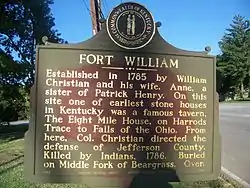
William Christian and his wife helped establish Fort William, Kentucky, where Col. Christian directed the defense of what is now Louisville from Native American attacks.[6]
Post-Revolution
In 1785, Christian moved his family to what became Jefferson County, Kentucky and the Louisville settlement. Although his name appears in Jefferson County records of the era, he is not in the 1789 tax list.[7] Col. Christian started a plantation near fellow pioneer and politician Alexander Scott Bullitt (who married one of Christian's daughters and began a family) and executed claims for 9,000 acres (36 km²) of land as a bounty for his military service.
Death and legacy
On April 9, 1786, Wabash warriers killed Col. Christian in the Illinois Country (in the area which is now Jeffersonville, Clark County, Indiana). Troops returned Christian's remains for burial in Jefferson County, Kentucky in the Bullitt cemetery in Oxmoor. His son would later be buried in the same graveyard, although his widow moved east and died in Norfolk, Virginia in 1790. TWo of their daughters died in Jefferson County in 1806, and the youngest married Dr. William Fishback and died in 1840. The Christians' early Kentucky log house still stands.
Several places are named after him or family members, including:
Notes
- Perrin, William Henry (1884). Counties of Christian and Trigg, Kentucky : historical and biographical. F.A. Battey Publishing Company. pp. 48–49.
- McCormick, Thomas Denton. "William Christian" in the Dictionary of American Biography, vol. III, p. 96, edited by Dumas Malone. New York: Scribner's, 1936; revised 1964.
References
- Lyon Gardiner Tyler, Encyclopedia of Virginia Biography (1915) Vol. 1 pp. 209-210
- Tyler p. 209
- Cynthia Miller Leonard, Virginia's General Assembly 1619-1978 (Richmond: Virginia State Library 1978) pp. 103, 105
- Leonard pp. 109, 112, 114, 117
- Leonard pp. 124
- Kentucky Historical Marker Number 974, Kentucky Historical Society, Jefferson County Kentucky at Eight Mile House
- Netti Shreiner-Yabntis and Florene Speakman Love, The 1787 Census of Virginia (Genealogical Books in Print, Springfield Virginia 1987) p. 1479
- The Register of the Kentucky State Historical Society, Volume 1. Kentucky State Historical Society. 1903. pp. 34.
External links
- Historical marker in Jefferson County, Kentucky
- Historical marker in Hopkinsville, Kentucky, noting that Christian County was named for him in 1797.
- William Christian at Find a Grave
