William McAndrew (educator)
William McAndrew Jr.[5] (August 20, 1863 – June 13, 1937) was an American educator and an editor who served as Superintendent of Chicago Public Schools in the 1920s. McAndrew was, at the peak of his career, one of the best-known educators in the United States.[6]
William McAndrew | |
|---|---|
.png.webp) McAndrew, c. 1925 | |
| 13th Superintendent of Chicago Public Schools | |
| In office January 9, 1924 – January 9, 1928 | |
| Preceded by | Peter A. Mortenson[1] |
| Succeeded by | William J. Bogan[2][3] |
| Superintendent of Schools for St. Clair, Michigan | |
| In office 1886–1887 | |
| Preceded by | William Galpin[4] |
| Succeeded by | J. C. Shattuck[4] |
| Personal details | |
| Born | August 20, 1863 Ypsilanti, Michigan, U.S. |
| Died | June 13, 1937 (age 73) Mamaroneck, New York, U.S. |
| Resting place | Ypsilanti, Michigan, U.S. |
| Spouse(s) | Susan Irvine Gurney |
| Children | 3 |
| Parents |
|
| Alma mater | University of Michigan (BA) Michigan State Normal School (M.Ed) |
| Profession | |
Before becoming Chicago school superintendent, he worked as superintendent of schools in St. Clair, Michigan; principal of Hyde Park High School in Chicago, Pratt Institute High School in New York City, and Washington Irving High School in New York City; and assistant superintendent of schools for New York City.
McAndrew was appointed Superintendent of Chicago Public Schools in 1924. He made numerous reforms, including establishing middle schools, implementing standardized testing, expanding vocational training, putting in place more rigid requirements and supervision of teachers, and championing the creation of a mandatory retirement age. While he garnered national reverence in some circles, he also became an enemy of local teachers unions.
William Hale Thompson, during his successful 1927 campaign against incumbent mayor William Emmett Dever, made allegations that McAndrew was a British agent sent by King George as part of a grand conspiracy to manipulate the minds of American children and set the groundwork for the United Kingdom to repossess the United States, with Dever being in on this alleged plot. After Thompson was elected mayor that year, he sought to quickly oust McAndrew, who had nine months left before his contract as superintendent expired. The school board, which came under Thompson's control, charged McAndrew with both insubordination (for opposing a school board action that he believed would amount to reviving patronage in the school system) and conduct incompatible with and in violation of his duty (stemming from allegations of unpatriotic actions), and suspended him from acting as superintendent. They held a well-publicized trial on whether McAndrew was guilty and should be removed as superintendent, and ultimately found him guilty two months after his tenure as superintendent had already expired. The Superior Court of Cook County would void this, ruling that McAndrew had not been insubordinate, and that the school board had no authority to charge McAndrew for being “unpatriotic”. McAndrew subsequently worked as the editor of The Educational Review until his death in 1937.
Early life, family, and education
McAndrew was born August 20, 1863 in Ypsilanti, Michigan.[7][6][8] His parents were both Scottish immigrants to the United States.[7][9] His father, William McAndrew, was a furniture maker, and his mother, Helen Walker McAndrew, was an obstetrician, and the first female physician in Michigan.[7][6][9] He was their second-born son,[9] and had an older brother named Thomas.[10] His parents were each political liberals, and were involved in local reform activism.[7][9] They hosted Sunday afternoon forums which drew such participants as Susan B. Anthony and John Bartholomew Gough to speak.[9] McAndrew's father would quit his profession to join McAndrew's mother in operating the sanatorium she founded.[9]
McAndrew graduated from the local Ypsilanti elementary school and from Ypsilanti High School.[11][10]
McAndrew first studied at Michigan State Normal School (today's Eastern Michigan University), before entering the University of Michigan, from which he graduated in 1886 with a Bachelor of Arts from the literary department.[6][9][11] At University of Michigan, he was a member of Phi Beta Kappa.[6][9]
He would later return to Michigan State Normal School to receive his Master of Education in 1916.[9]
Early career
McAndrew, upon his graduation from University of Michigan, was hired to be the superintendent of schools for St. Clair, Michigan.[6][12] He served in this role from 1886 through 1887.[4]
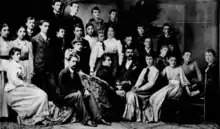
In 1888, he moved to Chicago, being hired as one of the first five teachers at the new Hyde Park High School.[13][14] He became the school principal of Hyde Park High School in 1889.[13] He was fired in June 1891 for insubordination, because he refused to certify a diploma that would falsely state that a book publisher's son had successfully completed a course of study in botany that he had actually failed.[6][8][13] He had been ordered to certify the diploma by Superintendent George Howland, who justified doing so by arguing that the course was not a prerequisite for college.[6][13]
Disillusioned, he left the field of education and, in July 1891, became an advertising manager and district passenger agent in St. Paul, Minnesota for the Great Northern Railway.[6][8][13] He worked this job for roughly two years, before returning to the field of education.[6]
In 1892, McAndrew found a job in Brooklyn, New York as the principal of Pratt Institute High School (Public School 44), holding this job until 1902.[6][15][16]
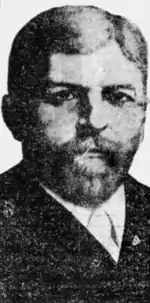
McAndrew then helped to organize Washington Irving High School in Manhattan, New York City, serving as the inaugural principal of the school for twelve years.[6][17][18] Irving became the most publicized high school the city during his tenure.[17] Under his leadership, it became one of the leading all-girls schools in the United States.[19] By 1912, the school had approximately 8,000 pupils.[11] McAndrew's philosophies on education were publicized by the New York state board of education and the media.[17][19] McAndrew garnered an esteemed reputation as an educator in the New York City school system.[20] In 1912, he declined an offer to serve as Superintendent of Detroit Public Schools.[21] Before he declined their offer, Detroit's Board of Education had, on July 18, 1912, voted 10 to 8 to select McAndrew as their superintendent, ousting fifteen year incumbent W. C. Martindale from his post in a single round of balloting.[8][11] Among those that had given their recommendation to Board of Education members of McAndrew as a quality prospective candidate for he job was former President of the University of Michigan James Burrill Angell.[11]
On October 28, 1914, McAndrew was promoted to Associate Superintendent of Schools for New York City, putting him on the city's Board of Superintendents.[6][8][20][21][22] While the president of the New York City Board of Education Thomas W. Churchill supported him for the position, it took the board ten ballots to elect McAndrew, with McAndrew defeating the front-runner for the job, Brooklyn district superintendent Charles W. Lyon along with several other candidates for the position.[22] McAndrew's selection had been opposed by New York City mayor John Purroy Mitchel.[1] McAndrew would serve in this role until he assumed his role in Chicago in January 1924.[6][21] Among the tasks assigned to McAndrew at various points in this job was overseeing the city's "new-program" schools, overseeing the city's "duplicate and intermediate" schools, and overseeing the Division No. 1 elementary schools.[23][24][25] While in this role, McAndrew authored a series of popular magazine articles.[19] He wrote for publications such as The Educational Review and The World's Work.[8] McAndrew built a reputation as a powerful writer and orator on topics related to education.[18] He became a leading figure in the field of education.[26] McAndrew supported the policies of superintendent William L. Ettinger, who had proven controversial, dividing the Board of Superintendents.[18] McAndrew avoided politics.[23] Two years prior to leaving New York City, McAndrew had several politicians oppose his reappointment as associate superintendent, but the school board nevertheless unanimously reelected him.[6] McAndrew's name had been floated as a prospective replanement for the outgoing Thomas E. Finegan as New York state's deputy commissioner of education, but he was ultimately not chosen for this role.[27] By the end of his tenure, McAndrew had come into conflict with the Tammany Hall-aligned majority that sat on the Board of Education.[19][18]
Superintendent of Chicago Public Schools
_Chicago_Tribune_photo.png.webp)
Appointment
In 1923, the city of Chicago elected William Emmett Dever as its mayor.[14] Dever was a reformer.[14][28] Early into his mayoralty, Dever appointed seven new members to the Chicago Board of Education (the city's school board).[14] Throughout his tenure, he would provide the Chicago Board of Education with independence from political interference.[14] The school board, recomposed after Dever's appointments, sought to find a superintendent that would strengthen the educational authority of the office, cut fiscal waste, and improve educational standards.[14] McAndrew was appointed Superintendent of Chicago Public Schools on January 9, 1924.[1][29] He agreed to take the job after being reassured by the Chicago Board of Education that they would "clean up" the administration of the city's schools.[30] His selection was the result of compromise, as four school board members, wanting a Chicago educator to be elected to the job, favored William J. Bogan.[31] On the final vote, he was denied a unanimous vote by board member John Dill Robertson, who abstained from casting a vote.[1][31][29] His election was to a four year tenure.[1] Among those that had endorsed him for the job was Lane Tech High School principal William J. Bogan.[1] Many in the city and school system greeted McAndrew's appointment positively, hoping that he would restore faith in a school system that had weathered years of scandal and discord.[32] Among those approving was Margaret Haley,[14] the powerful chief of the Chicago Teachers' Federation.[33] With the annual salary of the superintendent being newly raised to $15,000, McAndrew was, perhaps, one of the highest-paid educators in the United States at the time.[1][34] He would actively start in the position weeks later.[21][35] While his tenure had begun in January, he started working on February 1, 1924.[36]
Early actions
Among the early changes he made was requiring the school board staff wear uniforms and prohibiting teachers from attending meetings during school hours.[6][37][38] He decreased the number of holidays, and imposed time checks for all the Chicago Board of Education employees.[33]
.png.webp)
McAndrew was greatly opposed to political patronage and favoritism.[33]
His changes made the schools run with greater efficiency.[33] He was influenced, in part, by scientific management.[39] McAndrews reforms were well received by most, but he'd also angered some people, including politicians, along the way.[40][6] Many teachers opposed his strict and quick changes, as did Margaret Haley.[33][41][42] The Chicago political machine was frequently in opposition to him.[6] Within months of his tenure beginning, some demanded he resign, but the Board of Education continued to support him.[6]
Four months into his tenure, he submitted his first annual report to the Board of Education.[43] It recommended significant reforms.[43] It recommended using the "service center" concept of schooling, in which instruction in civics was stressed.[43] It also recommended using experimental classes, adopting the Winnetka Plan for vocational training and individual instruction.[43] It proposed increasing the use of research, test data, and teacher observations and ratings to enhance teaching.[43] It proposed increased focus on moral and religious education, as well as increased focus on physical education.[43] It also proposed restructuring the administration of schools with the creation of assistant and district superintendents.[43] He also called into question the value of teaching of Latin language and other classical studies, as they were out-of-step with the practical studies curriculum for which he advocated.[43]
McAndrew placed great stress on business efficiency.[44] He put in place greater supervision over teachers, including fixed criteria which did not make any variances for the size of classrooms or the backgrounds of the pupils.[44] He also implemented standardized testing, as well as IQ testing,[44][28] doing so against opposition.[45] To enforce adherence to his new policies, he put in place a supervision system.[44] He also required teachers to fill out time sheets four times per day.[44][28][46] He took teachers to task for inefficiency reported by this system.[47] He also believed it was important to instill social efficiency in students.[48] He had stated that his philosophy was that education's role was, "to produce a human, social unit, trained in accordance with his capabilities to the nearest approach to complete social efficiency possible in the time allotted."[49]
He also opposed efforts by teachers, politicians, and businessmen to impose educational policy.[50] However, he was more interested in seeking the advice of businessmen than that of parents or teacher's unions.[50] He sought businessmen's advice on efficiency for the schools.[50] He also put in place programs of complete mastery of the basics of reading, writing, and arithmetic, which were curriculum that businessmen favored seeing taught.[50][51] He sought to produce students with skills that would meet the marketplace's demands.[50] But he did not believe that employers should ever be entrusted with direct control over schools.[50] As a result of his receptiveness to them, McAndrew received the backing of the city's business community.[50]
McAndrew saw teachers as a threat to his authority, and largely disregarded their concerns over his changes.[46] McAndrew encouraged school principals to be more strict in their administration.[52]
During his tenure, Chicago established its first middle schools.[28][53] While four middle schools had been approved to be established in Chicago in 1918, none had yet opened by the time McAndrew became superintendent.[54] In December 1923, before McAndrew was hired as superintendent, the Chicago Board of Education established a committee to study the establishments of using the junior-high-school model in the city. The committee recommended this, and such a model was adopted on May 14, 1924.[54] However, McAndrew had to work to get the Elementary General Council to approve of middle schools in order for them to be more widely established in the city.[55] The Chicago Teachers' Federation gave complete opposition to the plan for middle schools. Other groups such as the Chicago Federation of Labor and the Federation of Men's Teachers gave McAndrew opposition to adopting middle schools system-wide, instead proposing to only adopt them as a smaller-scale experiment. The Federation of Women Teachers gave qualified support to middle schools.[56][57] McAndrew went ahead with his plan for middle schools, and the city's first middle schools opened their doors in September 1924.[58]
McAndrew unsuccessfully proposed running the new middle schools on the "platoon system" (also known as the "Gary Plan") developed by William Wirt in Gary, Indiana. The committee of the Chicago Board of Education was sharply split on this idea. Teachers in the city strongly opposed it. The Women's City Club supported it, and the organization consequentially saw high school teachers that belonged it resign from the club. Incidentally, McAndrew's wife joined the club's board.[59]
Elimination of teachers' councils
McAndrew eliminated teachers' councils.[44][28][60] On April 8, 1925, the Board of Education approved a plan McAndrew presented in which teachers councils were replaced by a council of organizations that would provide the superintendent advice only at his request. The member were four principals (one elementary school, one middle school, one high school, and one district principal), the superintendent, representatives of the three large teachers unions, and a small number of truant officers chosen by the City Civil Service Commission. The principals and superintendent, as a group, had more voting power that the three large teachers unions would collectively have. Additionally, the truant officers would collectively have the same voting power as each of the three large teachers unions individually had. This drew outrage from teachers and their unions.[61]
Effort to increase teachers' salaries

When McAndrew began, the teachers of Chicago received lesser salaries than teachers in many other major cities. It was argued that the salaries had not kept up with the increase of salaries in other fields, nor the increase in the cost of living.[63] From the start of his tenure, McAndrew advocated for an increase in teachers' salary.[64] McAndrew issued a proposal for an increase. A number of civic organizations came to support McAndrew's plan for increasing teachers' salary, while Margaret Haley and her Chicago Federation of Teachers opposed it.[63][62] The union argued their opposition to McAndrew's plan by arguing that the funds for it were not available; that lower ranked teachers would be given small raises, while principals and assistant superintendents would receive substantial raises; and by accusing the McAndrew's pay increase scheme of being a veiled attempted to break apart all of the teachers unions.[65] Edward B. Ellicott, the president of the Chicago Board of Education, also opposed McAndrew's proposal, arguing that it would increase the board's deficit.[65]
Efforts to create a mandatory retirement age
In 1925, McAndrew supported a bill introduced to the Illinois State Legislature by Walter R. Miller (an Illinois state representative and teacher at Lindblom High School), that required the retirement of public school teachers over 75 years old after immediately after going into effect, and, five years after going into effect, required that teachers retire once they reach the age of 70. The bill also provided them with an annuity of $1,500 for the remainder of their lives.[66] The bill had been written by Board of Education lawyers at the request of McAndrew.[67] While the state legislature did pass it, the clerk of the Illinois House of Representatives refused to send it to the governor, arguing that the House had never voted on it a second time after it passed in the Illinois Senate. This was despite the fact that no changes had been made to the bill in the Senate, thus meaning no second vote in the House was actually required. Nevertheless, the bill was not sent to the governor at this time, and thus, meaning that it had not become law.[67]
After the failure of bill introduced by Miller to become state law, the Chicago Board of Education itself, at McAndrew's urging, adopted a similar rule, dubbed the "Emeritus Rule", on December 9, 1925. The law stated that no teacher over seventy, except the superintendent, was to be employed in Chicago Public Schools. The rule would face legal challenges.[66][67][68][69][70] The Chicago Federation of Labor stood in strong opposition to the rule.[71] Former governor of Illinois Edward F. Dunne represented 74 teachers and principals that would be forced to retire who filed a lawsuit against the rule. Also involved in the case was Dunne's son and lawyers from the Chicago Federation of Teachers. The teachers in the lawsuit were denied an injunction in September 1926 by Cook County Circuit Court judge Hugo Friend. Arguing that the rule violated the tenure of office law, Dunne appealed the case to the Supreme Court of Illinois.[71][72] The Illinois Supreme Court ruled in October 1926 that the board had had no authority to pass the "Emeritus rule", and ordered the board to restore the jobs of the teachers it had forced to retire under the law, and to pay them back salary The board paid nearly $250,000 in back salary.[71] However, while Dunne had been appealing the case against the "Emeritus rule" to the Illinois Supreme Court, the Illinois Attorney General Oscar E. Carlstrom sent Speaker of the Illinois House of Representatives Robert Scholes an opinion that the law introduced by Miller in the Illinois State Legislature had in fact been legally passed by the legislature. The bill was then sent to the governor on May 19, 1926, a year after it had passed. It was signed into law by Governor Len Small, and took effect on July 1, 1926, meaning that Chicago Public Schools only had to rehire those under the age of 75 after the Illinois Supreme Court's ruling.[71]
Other actions
In 1925, McAndrew hosted a summer educational training camp for boys ages 12 to 16 under government supervision at Fort Sheridan.[73][74]
During his tenure, McAndrew expanded vocational training programs in the city.[28]
In 1926, the school district saw a construction boom, with thirty-two new school buildings being completed that year. John E. Byrnes, the business manager of the Chicago Board of Education, noted in his annual report that year that this was thrice as many new school buildings as had been completed in the city in any prior year.[75] The sites for new schools in the city now utilized scientific studies to find the best locations in regards to population and other factors.[75] McAndrew had established the Bureau of Building Survey, which would collect information from educators and architects to provide guidance for buildings and sites throughout the system.[76] They would also be responsible for drawing attendance boundaries, choosing sites for schools, recommending new structures and additions, and providing research on a multitude of aspects of educational facilities.[76] This new way of school planning would be retained by the school system for decades after his tenure.[76]
In May 1926, McAndrew denied a request by the United States Navy to allow them to fundraise for the restoration of the USS Constitution by soliciting contributions from students in the schools. The Chicago Tribune editorial board praised McAndrew for this decision on the grounds that they believed that financial solicitations of any kind had no place in the city's public schools.[77]
Criticisms and opposition
McAndrew continued to attract criticism and opposition. McAndrew attracted some criticism from Chicago Federation of Labor president John Fitzpatrick.[78] Margaret Haley F of the Chicago Federation of Teachers was not the only local teachers union leader that opposed McAndrew. At the 1925 annual meeting of the American Federation of Teachers, Florence Hanson of the Women's High School Teachers' Federation and C.W. Stillman of the Mens' Teachers' Federation characterized McAndrew as an "autocrat". However, Stillwell softened his characterization by conceding that McAndrew was, "an autocrat with good educational ideas".[79] It was evident that, by the end of 1925, he had made an enemy of the three large teachers unions.[57] McAndrew had become unpopular among teachers.[45] By 1926, among those that wanted to see McAndrew ousted from his job was Chicago alderman Leo M. Brieske, who chaired the Chicago City Council's schools committee. Brieske declared that local men should hold local offices in Chicago, taking issue with McAndrew, who was seen to be a New York City transplant. Brieske launched an investigation into Board of Education appointees, with the stated primary objective of laying the groundwork to oust McAndrew.[80][81] Despite this opposition and criticism, McAndrew also attracted national renown and praise.[34]
Role as a campaign issue in 1927 mayoral election

During his successful 1927 campaign against incumbent Democratic mayor William Emmett Dever, Republican nominee William Hale Thompson alleged that McAndrew was a British agent sent by King George as part of a grand conspiracy to manipulate the minds of American children and set the groundwork for the United Kingdom to repossess the United States, and accused the "left-handed Irishman" Dever of being part of the plot.[83][28][84] Thompson based these claims on McAndrew being critical of such artworks as Archibald Willard's The Spirit of '76 and allowing the use in schools of textbooks which Thompson alleged were unpatriotic and full of, "treason tainted histories".[28][83][45]
Thompson accused McAndrew of conspiring with the University of Chicago's Charles Hubbard Judd and Charles Edward Merriam to, "destroy the love of America in the hearts of children by encouraging teachers to attend special classes at 'Chicago University' at which the text was used which pictured George Washington as a rebel and a great disloyalist."[85]
In his campaign speeches, Thompson attacked Homer Davis, the director of the school district's Bureau of Building Survey, as "the foreigner Superintendent McAndrew brought here from Arizona to tell us where to put our schools."[86]
Thompson was not a lone actor in publicly painting McAndrew as unpatriotic. In 1926, the "Citizens' Committee on School Histories", a group led by far-right ex-United States congressman George Gorman, published a document that denounced three United States history textbooks that were in use in Chicago Public Schools as pro-British, and argued that heroes of other nationalities had been overlooked by the books in numerous instances. While Mayor Dever brought this document to McAndrew's attention, McAndrew did not give it any concern.[85] In 1927, Thompson would add the report published by this group to his campaign literature.[45] Additionally, at the City Council's first meeting after McAndrew made an off-hand remark criticizing Archibald Willard's The Spirit of '76 for not being an accurate picture of war, Adlerman John Coughlin denounced McAndrew's comments as being traitorous, and proposed an ordinance to denounce McAndrew. However, Alderman William D. Meyering, a decorated veteran of World War I, stood up and stated that he actually agreed with McAndrew's statement, which served to quash the momentum of Coughlin's ordinance.[85]
Among the textbooks that Thompson criticized as unpatriotic were A History of the United States by Willian Fiske Gordy, Our United States by William Backus Guitteau, and The Silent Reader by Albert Lindsay Lewis and William D. Rowland.[87] Former president of the Chicago Board of Education Charles Moderwell, who had served during the earlier part of Dever's mayoralty, argued that textbooks which Thompson attacked as being unpatriotic had actually been approved by the school board Thompson had appointed during his previous mayoralty.[85] Indeed, the school's history textbooks had not been chosen by McAndrew but had rather been chosen by his predecessor.[45]
Thompson, seeking the African-American vote, also seized on McAndrew's alleged failure in 1926 to act upon complaints by the Chicago Defender that there were anti-black stereotypes in civics text books, written by University of Chicago, that were used in the city's high schools.[28] After these complaints were made, the school board, not McAndrew, had been the ones who acted to request the publisher change the passages in question.[28]
Thompson made the campaign promise of appointing, "a patriotic school board...who will rid the city of Superintendent McAndrew," and "his pro-English 'yes' men and women".[28] He faulted Dever and Democratic political boss George E. Brennan as responsible for McAndrew's hiring.[28]
McAndrew did not stay neutral in the mayoral race. In an unprecedented move for a Chicago school superintendent, he signed a letter urging support for Dever's campaign. He printed copies of this letter in school print shops and had the Women's City Club distribute them to each of the school system's school principals. He also made an appearance wearing Dever campaign apparel at a public dinner for Dever hosted by the Women's City Club.[88]
Thompson boasted of his role in ousting then-school superintendent Charles Ernest Chadsey during his previous tenure as mayor, claiming now that Chadsey had also been part of a pro-British conspiracy, declaring, "I threw out Chadsey, who was imported here by friends of British propaganda, and I'll throw out McAndrews [sic]".[85]
While it is not clear why Thompson chose to single-out McAndrew for such attacks, in a 1980 journal article, Dennis F. Thompson speculated that Thompson might have chosen him as an enemy, in part, due to McAndrew being a force against political patronage in schools, as well as due to McAndrew's ties to Dever[45] Another aspect that Dennis F. Thompson speculated may have been a factor was McAndrews unpopularity with teachers.[45] Dennis F. Thompson argued that there is strong evidence that teachers, indeed, very actively backed Thompson's candidacy in hopes of ousting McAndrew.[45]
Initial months under Thompson mayoralty
Having won the 1927 mayoral election, Thompson was sworn in as mayor on April 18, 1927.[89] In his inaugural address, Thompson declared,
"I will proceed vigorously to oust Superintendent McAndrew from the schools of Chicago, and restore to the school children the true history of George Washington and the other fathers and heroes of our country, and expose the treason and propaganda which insidiously have been injected into our schools and other educational institutions."[89]
At the time, McAndrew still had nine months left in his contract as superintendent.[40] Thompson was impatient to get rid of McAndrew.[40] On April 27, a private group with close connections to Thompson offered McAndrew $15,000 if he would resign as superintendent, but McAndrew refused to on principle.[45]
In May 1927, tension was demonstrated between McAndrew and the Chicago City Council on a few occasions. On May 16, alderman Wiley M. Mills, a former Board of Education member and an ally of Margaret Haley, sent McAndrew a letter requesting him to explain a statement from shortly before the Board of Education had selected him as superintendent in 1924 which the Chicago Tribune had quoted of him saying that he had been brought to the city to "loose the hold of the City Hall and certain outside agencies on the schools". Mills demanded that McAndrew answer who he was saying had brought him to Chicago, and what agencies he was speaking of. McAndrew provided a response in which he listed the members of the Chicago Board of Education that had voted in favor of his appointment and provided greater context to the remarks from which the statement excerpted. In his response, he also opined that "city school systems which had ejected political influence from promotions, choices of sites and textbooks and improved their services.[90] On May 19, the City Council Committee on Schools, Fire and Civil Service requested that he appear before them. After this, the new Board of Education Committee on School Administration approved a resolution opining that McAndrew should obey the City Council's summons. However, McAndrew resisted, writing the chairman of the City Council committee, "Your resolution suggests that you are proposing to try me before your committee. I don't see what, other than personal satisfaction to yourself, could come of it. Much as I love you, I'll have to deny myself that favor to you.[90]
On May 25, J. Lewis Coath was elected by the Chicago Board of Education as the board's new president. Coath was Thompson's personally-backed candidate for the job. Coath, as a board member, had spent months as a top foe to McAndrew. The board voted to select Coath by a 6-3 vote, with 3 of the votes in Coath's favor coming from board members that had originally been appointed by Dever (the three votes against his appointment also came from Dever appointees). However, the three Dever appointees who voted in support of electing Coath president of the board made it known that they would not back ousting McAndrew as superintendent.[91] In July, Coath stated that the "bunk shooting educator" McAndrew was barely grasping onto his position and was promising that he would be ousted before the start of the new school year in September.[45]
After becoming mayor, Thompson appointed former U.S. congressman John J. Gorman as a special assistant corporation counsel, with the assignment of looking through school textbooks for lies and distortions. Gorman, who was considered to have been an Anglophobe, would reach the conclusion that books used by Chicago Public Schools were "poisoned" with British dogma, and that the British were taking over America, "not by shot and shell but by a rain of propaganda."[92]
Background
By August, reshaped by appointments Thompson had made to it, the Chicago Board of Education was under Thompson's influence.[40] Thompson had been able to gain control so quickly due to the resignations of a number of board members, as well as threats made to remaining members.[45]
Since 1909, the Chicago Public Schools' school clerks had simply been certified teachers who were assigned clerical duties. However, in April 1927, the Board of Education's attorney, at the urging of a Thompson-allied board member, rendered an opinion that the school clerks must be selected by the City Civil Service Commission, pointing to an opinion that the Illinois Appellate Courts had rendered in March 1927, which found that the schools' janitors and engineers needed to be selected by that commission. On August 3, 1927, the Chicago Board of Education adopted a resolution that would dismiss all 350 of the school system's school clerks, and have them be replaced with Civil Service Commission appointees. McAndrew was outraged by this, seeing it as an attempt by Thompson to return patronage to the education system, and resisted this order.[40][93] McAndrew assisted the school clerks in preparing to file an injunction against their dismissal. He appeared as a witness to argue for the injunction, testifying that an injunction against the Board should be granted and that the school board attorney had signed his name to papers without his knowledge.[93]
Board of Education votes to suspend McAndrew, pending a trial
On August 29, the school board attorney presented charges of insubordination against McAndrew due to his support of the school clerks. The attorney had been directed by the board's president J. Lewis Coath to prepare such charges against McAndrew. That same day, by a 6–5 vote, the board voted to suspend McAndrew and charge him with insubordination pending a public trial to be held before the board for the purposes of deciding whether to remove McAndrew from office.[40][94][95][96][97] In suspending him, they installed William J. Bogan in August as acting superintendent to carry out the duties during his suspension.[2][94] McAndrew refused to resign, by which means he could have avoided a trial.[40] He declared, "They'll fire me alright, but they'll have to stage a burlesque show to do it."[40] On September 29, the day the trial was set to begin, the school board added the additional charge that McAndrew had contaminated the school curriculum with British propaganda.[95] McAndrew's lawyers protested these charges, and requested thirty days to study them before trial.[95] This request was denied by Chicago Board of Education president J. Lewis Coath, and the trial began that day as scheduled.[95] He was read sixteen charges of insubordination and an additional charge for conduct incompatible with and in violation of his duty (stemming from allegations of unpatriotic actions) at his arraignment, and pleaded not guilty to any acts which would be grounds for his removal.[98][99]
This was not the first time that Thompson or a school board composed of his appointees had conspired to oust a superintendent. An ouster of Charles Ernest Chadsey had occurred during Thompson's first mayoralty, which would result in several school board members being charged in Cook County Circuit Court of conspiracy.[100]
During the trial, Time characterized the Chicago Board of Education as, "a partial set of false teeth in Mayor William Hale Thompson's capable mouth", writing that they had, "orders to chew up Superintendent McAndrew".[98]
The trial attracted national attention from the media, being treated as a ridiculous example of Chicago's messy politics.[6][40] It was viewed by many as a ridiculous spectacle, in a similar vein to the Scopes Trial.[6][92]
McAndrew's attorneys were Francis X. Busch (former Chicago corporation counsel) and Angus R. Shannon (former attorney for the Chicago Board of Education). Frank S. Righeimer served as the Chicago Board of Education's representative in the trial.[101][102]
During the trial, McAndrew lacked the support of the unionized teachers, as they did not approve of the strict rules he had put in place for teachers.[6]
Trial proceedings
During the first weeks of proceedings, McAndrew sat, often reading a newspaper.[101][40] On October 24, a hearing was canceled when McAndrew failed to show. Before the proceedings were canceled, Chicago Board of Education attorney Righeimer asked "what is the superintendent doing that is more important than this trial", to which McAndrew's attorney Shannon retorted, "anything is more important than this trial. It would be revealed the following day that McAndrew had been out of the city for a speaking engagement.[102][103] On November 20, after six weeks, a fed-up McAndrew stood and asked whether the board would actually address the specific charge they had brought against him. Receiving no answer, he left, declaring that he would return if the Board desired to dismiss the charges.[6][40][101] The trial would go on with McAndrew in absentia.[6][40] McAndrew's lawyers joined him in refusing to attend the trial.[104]
During the final trial date he attended (November 20), McAndrew attempted to have the Board read a statement he had written.[98] The statement, in part, read,
It is now seven months since the new mayor in his official inaugural address declared his intention, though he has no proper jurisdiction over the schools, to proceed to oust the superintendent...It is now nearly five months since your president and five members voted to charge me with insubordination and improper conduct in having entered into an unlawful confederacy with certain employees of the board, designated as extra teachers....Instead of trying me on the alleged misdemeanor for which I was suspended, you have permitted to be added a host of irrelevant allegations....The repeated published assertion of your president that he will put the superintendent out, the degradation of your school system in the eyes of the entire country by editorial condemnation of the trial as a farce and vaudeville; the cloud of aspersion you permit to remain upon you best teachers that they recommended to the superintendent the adoption of poisoned books; the effect on your school children of the continued characterization of your proceedings as a travesty on justice; the repeated and uncontradicted editorial designation of his trial as before a packed jury and an admittedly prejudicial judge, all lead me to desire to escape being a party to the continuance of what is almost universally regarded as a burlesque.[105]
In total, 27 hearings were held with more than 100 witnesses testifying.[95][92] This amounted to more than 6,000 pages of testimony.[92] Those who testified included more than 80 principals, teachers, and school officials.[101] Many of the witnesses were recruited by Thompson to strengthen his charges of propaganda.[95] From the start of the trial, witnesses were brought before the board to testify about McAndrew, regularly testifying of his supposed "un-Americanism".[6][40] They testified that he made derisive comments about the Boston Tea Party, that he disallowed students to fundraise for the restoration of the USS Constitution, that he ordered the removal of prints of The Spirit of '76 from schools, that he had adopted textbooks that were supposedly subversive (including one that stated that the British considered George Washington a traitor).[40] They alleged that British propagandists had effectively taken over the Chicago educational system under McAndrew.[6] As a witness accusing McAndrew of placing British propaganda in the school curriculum, John J. Gorman attacked McAndrew for the use of a textbook written by David Saville Muzzey. Gorman would later write an apology letter on October 11, 1929, admitting that he had never actually read that textbook and that the sworn statements he had made were, in fact, written by someone else. He claimed to have been misled, and to have now realized there was nothing to criticize in Muzzey's textbooks.[95][106] Witnesses also criticized the use of texts written by Arthur M. Schlesinger Sr..[45] Among the witnesses that testified in the trial were three pseudo-historians, who each went on long rants attacking history textbooks in use in Chicago schools. The textbooks attacked by these three witnesses, however, were standard fare, and were widely utilized in schools across the United States.[101] Figures from faux organizations such as the "Anti-British Citizens Committee on School Histories" testified as well.[101]
McAndrew also was accused, during the trial, of nefariously conspiring with the English Speaking Union.[101] As a witness, during the trial, Charles Edward Russell alleged that this was the world's most dangerous organization, claiming, "the world is threatened now with the greatest menace to the advance of the Anglo-Saxon"."
Allegations were levied by Thompson allies that McAndrew was conspiring with Charles Edward Merriam and others at the University of Chicago (decried as a "stronghold of King George") to, "destroy love of America in the hearts of children".[92] During the trial, it was revealed that Thompson had, during his campaign, hired a court reporter to pose student and spy on a University of Chicago professor who was teaching a history class that had been recommended for public school teachers.[45] This spy reported that the professor had called George Washington a "rebel" and referred to the Boston Tea Party as a "vandal raid".[45] John J. Gorman, on October 14, accused the University of Chicago of being a "hotbed of un-American and pro-British teachings".[45] Two weeks later, he further testified that the University was a "British cast" and a stronghold for pro-British propaganda.[45] On November 11, 1927, J. Lewis Coath went as far as banning articles written by University of Chicago faculty from being published in the school board's publication, Chicago Schools Journal, and the following month's edition of the publication would feature a title page promoting an "America First" campaign.[45]
In the trial, the American Library Association, which had once been headed by a Canadian, was accused of being a distributor of British propaganda.[45][92] The Chicago Public Library's association with the Association became of issue in the trial.[45] Also of issue was the fact that Great Britain had once donated books to Chicago in the aftermath of the 1871 Great Chicago Fire.[92] Amid this, Thompson tasked Urbine J. "Sport" Herrmann, both a close friend of Thompson's and appointee of his to the board of the Chicago Public Library, with examining the library's books for "pro-British" works.[45][92][101] During the trial, Hermann announced that he would conduct a book burning of pro-British books on the city's lakefront.[107] Thompson joined in, threatening to burn any book in the library found to have a single passage of "pro-British propaganda" in a lakefront bonfire. These plans were faced with two injunctions.[102] The bonfire never took place, however, it gave Chicago a period of notoriety as being perceived as, what the Chicago Tribune would retrospectively describe, "the book-burning capital of the free world".[92] The threat of book burning had received criticism from notable individuals, such as Clarence Darrow.[92] In an effort to prevent the burning of books, head librarian Carl B. Roden made the suggestion of the books labeled "pro-British" being placed in a cage, only to be read under the supervision of "mature" historians.[45][92] Ultimately, it would take court injunctions to put an end to the Chicago Public Library's censorship activities.[45] Amid these activities, there was a public backlash to the idea of book burning and general censorship.[45] However, some supported it. The state chapter of the Ku Klux Klan applauded the book censorship efforts of Thompson, and encouraged him to expand this to a full effort against books related to Catholics and Jews.[45] Fredrick Rex, the head of the city's Municipal Reference Library, agreed to clear his collection of "pro-British" books, and claimed that his library had previously been the recipient of such propaganda from both the English Speaking Union and the Carnegie Corporation and that he would hand over such works to Herrmann immediately. Days later, Rex claimed that he had destroyed all the books, pamphlets, and letters in the library's collection that were of a pro-British nature.[45]
In the trial, allegations were levied that Cecil Rhodes, who had founded the Rhodes Scholarship program, was conspiring to unite all English-speaking people under the control of Britain.[92] Some witnesses even speculated of an impending war between Britain and the United States.[92] Other organizations invoked and attacked in the course of the trial included Columbia University and the Carnegie Corporation.[45]
During the trial, the board read a letter written to them by Thompson, naming a number of Polish, German, and other ethnic "heroes" that he demanded to be taught in the city's schools.[101] A moment which drew national attention during the trial saw Righeimer yell at McAndrew, "and you left out of the schools the name of that great hero, Ethan Allen, who said he had only one life to give for his country!" In response to this, Busch remarked, "It was Nathan Hale who said it."[108] This exchange elicited laughter in the courtroom and ridicule, not only due to Righeimer's misattribution of a quote associated with Hale to Allen, but also because many were unfamiliar with Allen, and did not see him as the high-stature historical figure Righeimer was implying him to be.[101][108]
McAndrew's contract as superintendent expired January 9, 1928, and was not renewed.[109][110] On March 21, 1928, already two months after McAndrew's term as superintendent had already expired, the board found him guilty.[40] The vote to convict him was 8–2.[95]
Post-trial developments
McAndrew's lawyers immediately petitioned for a writ of certiorari to review the trial.[95] McAndrew also filed lawsuits against the Board of Education for salary lost and Thompson for libel and slander (suing Thompson for the amount of $250,000).[40][104] Less than two years after the trial, in December 1929, Judge Hugo Pam of the Superior Court of Cook County ruled the decision by the Board of Education void.[6][40][95] Pam ruled that McAndrew had not been insubordinate, and that the school board lacked the authority to have tried him for the additional charge stemming from the allegations of pro-British propaganda.[95] Pam dubbed the allegations of pro-British conduct levied against McAndrew, "improper".[92] After this, McAndrew dropped his two lawsuits.[6][40][95]
After George Gorman wrote his apology letter to Muzzey about the statements he read during the trial, Chicago Board of Education member James Mullenbach read the letter into the Board's official record and introduced a resolution that would have seen the Chicago Board of Education apologize to Chicagoans for wasting their money on McAndrew's "so-called trial", to Muzzey for the accusations the Board of Education raised against him, and to Charles H. Judd and Charles E. Merriam for accusing them of conspiring against the city's children. However, this resolution was buried in committee.[106] Mullenbach also called for the Cook County state's attorney and the Chicago Bar Association to take note that Gorman had admitted to perjury.[106]
Later career and death
Soon after he left his position as Superintendent of the Chicago Public Schools, McAndrew was made a life member of the National Education Association.[111]
Following his departure from Chicago, McAndrew traveled outside of the country.[6] After returning to the United States, he moved to Mamaroneck, New York and became the editor of The Educational Review, a job he would continue to hold until his death.[6] McAndrew worked as the editor of School and Society.[111] McAndrew lived in the Silvermine Hill neighborhood of Norwalk, Connecticut for some time.[112]
McAndrew felt in poor health for the last year of his life.[6] On May 24, 1937, he entered White Plains General Hospital for a procedure and left for his residence in Mamaroneck, New York on June 13.[6] McAndrew died June 28.[7][6] There was no funeral service, but a memorial service was held.[6] He was buried in his birthplace and hometown of Ypsilanti, Michigan.[6]
Personal life
McAndrew was married in Dover, Maine on June 28, 1894, to Susan Irvine Gurney, who took the name Susan Irvine Gurney McAndrew.[8][6] They had three children, daughters Helen (born 1895) and Mary (born 1897), and son John (born 1904).[6][8] Their son, John McAndrew, would become the curator of New York City's Museum of Modern Art.[6]
References
- "Newly Elected Head of School System Talks". Newspapers.com. Chicago Tribune. January 10, 1924. Retrieved February 12, 2021.
- "Education: McAndrew's Successor". Time. July 9, 1928. Retrieved December 30, 2020.
- "Education: Superintendent in Chicago". Time. May 4, 1936. Retrieved December 31, 2020.
- Jenks, William Lee. "St. Clair County, Michigan, its history and its people; a narrative account of its historical progress and its principal interests". Retrieved March 14, 2021.
- McAndrew, William Jr.; Marshall, Albert P. (1996). Helen Walker McAndrew : Ypsilanti's Lady Frontier Doctor. Ann Arbor, Mich.: Proctor Publications for Marlan Publishers. ISBN 188279236X.
- "Wm. M'Andrew, 73, Educator, is Dead; When School Superintendent in Chicago, He Had Clash With Mayor Thompson a School Principal Here Also Served as an Associate Superintendent in New York Spent 40 Years in Work Fight Against Politics Vindicated by Court Taught in Chicago in 1889 Backed by the Board (Published 1937)". The New York Times. June 29, 1937. Retrieved December 30, 2020.
- Smead, Kevin J. (February 2000). "McAndrew, William (1863-1937), educator and editor". 1. doi:10.1093/anb/9780198606697.article.0900482. Retrieved December 30, 2020. Cite journal requires
|journal=(help) - "CHICAGO'S NEW SUPERINTENDENT". I (1). September 1923: 283–285. Retrieved March 13, 2021. Cite journal requires
|journal=(help) - Tarvardian, p. 120
- William McAndrew Jr., Helen Walker McAndrew, 1826-1906, Ypsilanti, Michigan, 1931
- "Martindale Ousted From Board by 10 to 8; McAndrew Chosen". Detroit Free Press. July 12, 1912.:
- "Martindale Ousted From Board by 10 to 8; McAndrew Chosen". Detroit Free Press. July 12, 1912. p. 1. Retrieved February 12, 2021.
- "Martindale Ousted From Board by 10 to 8, McAndrew Chosen". Detroit Free Press. July 12, 1912. p. 2. Retrieved February 12, 2021.
- Tarvardian, pp. 120-121
- Tarvardian, p. 121
- Herrick, p. 143
- Tarvardian, pp. 121–122
- "Public School Notes". Newspapers.com. The Brooklyn Daily Eagle. October 21, 1900. Retrieved February 12, 2021.
- Tarvardian, p. 122
- "M'Andrew To Head Schools of Chicago". Newspapers.com. The Standard Union. January 10, 1924. Retrieved February 12, 2021.
- "Dr. McAndrew's Translation". Newspapers.com. The Standard Union. January 10, 1924. Retrieved February 12, 2021.
- "Associate Superintendent Is Former Brooklynite". Newspapers.com. The Brooklyn Citizen. October 29, 1914. Retrieved February 12, 2021.
- Tarvardian, p. 123
- "Brooklyn Members Defeat Supt. Lyon". Newspapers.com. The Brooklyn Daily Eagle. October 29, 1914. Retrieved February 12, 2021.
- "HOW THE GARY SCHOOLS WORK". Newspapers.com. The Brooklyn Daily Eagle. September 25, 1917. Retrieved March 13, 2021.
- "Gary School Plan as a City Campaign Issue". Newspapers.com. The New York Times. October 21, 1917. Retrieved March 13, 2021.
- "MAXWELL AT DESK; ORDERS A SHAKE-UP". Newspapers.com. The Brooklyn Daily Eagle. January 3, 1918. Retrieved March 13, 2021.
- "Canny M'Andrew Backed Here To Win Chicago School Fight". Newspapers.com. Times Union (Brooklyn, New York). August 31, 1927. Retrieved March 13, 2021.
- "State Wide News". The Journal of the New York State Teachers' Association. New York State Teachers Association. XI (1): 48. February 1924.
- Carl, James (Jim) C. (February 2009). ""Good P "Good Politics Is Good Go olitics Is Good Government": The T ernment": The Troubling Hist oubling History of Mayoral Contr al Control of the Public Schools in T ol of the Public Schools in Twentieth-centur wentieth-century Chicago". American Journal of Education (115). doi:10.1086/595666. S2CID 145078307. Retrieved December 31, 2020.
- Proceedings of the Chicago Board of Education, January 9, 1924
- William McAndrew to Charles H. Judd, April 12, 1927, C.H. Judd Papers, Special Collections, University of Chicago Library. Quoted in David John Hogan, Class and Reform: School and Society in Chicago. 1880-1930 (Philadelphia: University of Pennsylvania Press, 1985)
- Tarvardian, p. 125
- Tarvardian, p. 126
- Tarvardian, p. 127
- "Every One Should Hear This Address on Important Subject". Newspapers.com. Central New Jersey Home News. September 22, 1925. Retrieved February 12, 2021.
- "Chicago's New School Chief Is Here; Talks Not". Newspapers.com. Chicago Tribune. February 3, 1924. Retrieved February 12, 2021.
- Counts, p. 71
- "Education: In Chicago". Time. October 6, 1924. Retrieved December 30, 2020.
- James, Michael. "The Chicago Board of Education Desegregation Policies and Practices [1975-1985]: A Historical Examination of the Administrations of Superintendents Dr. Joseph P. Hannon and Dr. Ruth Love". Loyola University Chicago. Retrieved March 11, 2020.
- Tarvardian, p. 135
- Schmidt, John R. (September 30, 2011). "The trial of the school superintendent". WBEZ Chicago. Retrieved December 30, 2020.
- Haley, Margaret A. (1982). Battleground : the autobiography of Margaret A. Haley. Urbana: University of Illinois Press. p. 209. ISBN 0252009134.
- "Teachers Have McAndrew on the Defense" (PDF). www.marxists.org. The Daily Worker. October 17, 1924. Retrieved December 31, 2020.
- Tarvardian, p. 128
- Tarvardian, p. 129
- Thompson, Dennis (1980). "The Private Wars of Chicago's Big Bill Thompson". The Journal of Library History (1974-1987). 15 (3): 261–280. ISSN 0275-3650. Retrieved November 3, 2021.
- Bukowski, Douglas (September 22, 1988). "THE SCHOOLS: 'GOOD OLD DAYS' WERE BAD, TOO". chicagotribune.com. Retrieved December 31, 2020.
- "100 TEACHERS FACE TRIAL FOR INEFFICIENCY". Newspapers.com. Chicago Tribune. June 26, 1925. Retrieved February 14, 2021.
- Moser, Whet (March 14, 2015). "How Big Business Has Driven Chicago Public School Reform". Chicago Magazine. Retrieved December 31, 2020.
- Moser, Whet (May 14, 2015). "How Big Business Has Driven Chicago Public School Reform". Chicago Magazine. Retrieved November 3, 2021.
- Tarvardian, p. 131
- ""Chicago principals secure 100 per cent in arithmetic computation from every child," is the statement in a letter to the United States Commissioner of Education from the superintendent, Dr. William McAndrew. The annual report of the Chicago public schools relates how it is done, he says". The Virginia Teacher. 7 (10): 322. Retrieved December 31, 2020.
- Tarvardian, p. 130
- "Schools and Education". www.encyclopedia.chicagohistory.org. Encyclopedia of Chicago. Retrieved December 30, 2020.
- Counts, p. 145
- Counts, pp. 145–146
- Counts, p. 147
- Herrick, p. 155
- Counts pp. 145 and 148
- Herrick, pp. 148–150
- Herrick, p. 150
- Herrick, p. 154
- Chicago Teachers Federation (March 15, 1925). "First of all -"a seat for Every Child"?". Newspapers.com. Chicago Tribune at Newspapers.com. Retrieved February 12, 2021.
- "KEEPING GOOD TEACHERS DOWN". Newspapers.com. Chicago Tribune. October 28, 1925. Retrieved February 12, 2021.
- "TRUSEE GROUP O.K.'S 10 TO 30% TEACHER BOOST". Newspapers.com. Chicago Tribune. April 19, 1925. Retrieved February 12, 2021.
- "Teachers Ask Dever to Halt Raise in Pay". Newspapers.com. Chicago Tribune. September 5, 1925. Retrieved August 20, 2021.
- "M'andrew Asks Law Retiring Teachers at 70". Newspapers.com. Chicago Tribune. April 3, 1925. Retrieved February 12, 2021.
- Herrick p. 163
- "Teachers Seek Legal Test on Age Retirement". Newspapers.com. Chicago Tribune. January 16, 1926. Retrieved February 12, 2021.
- "School Board Votes Today on Pension Project". Newspapers.com. Chicago Tribune. December 9, 1925.
- "Emeritus Rule Upheld Despite New Pension Act". Newspapers.com. Chicago Tribune. May 21, 1926. Retrieved February 12, 2021.
- Herrick, p. 164
- "Injunction Refused School Teachers On Retirement Rule". Newspapers.com. Chicago Tribune. September 23, 1926. Retrieved February 12, 2021.
- "SUMMER CAMP FOR BOYS AT FORT SILL". Newspapers.com. The Tribune (Scranton, Pennsylvania). May 8, 1925.
- "BOY SOLDIERS PARADE BEFORE SCHOOL HEADS". Newspapers.com. Chicago Tribune. August 7, 1925. Retrieved March 13, 2021.
- "Chicago Tribune". Newspapers.com. Vast School Building Program Will Be Continued in 1927. January 2, 1927. Retrieved August 13, 2021.
- "CHICAGO PUBLIC SCHOOL BUILDINGS, PRE-1940 CONTEXT STATEMENT" (PDF). chicago.gov. City of Chicago (prepared by Bauer Latoza Studio). Retrieved December 31, 2020.
- "Not in the Public Schools". Newspapers.com. Chicago Tribune. May 20, 1926. Retrieved August 20, 2021.
- Tarvardian, p. 132
- "Evolution Trial and Supt. McAndrew Get Teachers' Attention". Newspapers.com. Chicago Tribune. June 30, 1925. Retrieved August 13, 2021.
- "Admits Purpose of School Row To Oust McAndrew". Newspapers.com. Chicago Tribune. December 4, 1926. Retrieved February 12, 2021.
- "Dever Declares He's Neutral In McAndrew War". Newspapers.com. Chicago Tribune. December 6, 1926. Retrieved February 12, 2021.
- Tarvardian, pp. 210
- Schmidt, John R. (1995). "William E. Dever (1923–1927)". In Green, Paul M.; Holli, Melvin G. (eds.). The Mayors: The Chicago Political Tradition (Revised ed.). Carbondale, Illinois and Edwardsville, Illinois: Southern Illinois University Press. p. 94. ISBN 0-8093-1963-2.
- Bright, John (1930). Hizzoner Big Bill Thompson, an idyll of Chicago. New York, New York: Jonathan Cape and Harrison Smith. p. 253. OCLC 557783528.
- Herrick, p. 167
- "Davis Quits at Chief of Schools Building Survey". Newspapers.com. Chicago Tribune. April 16, 1927. Retrieved August 13, 2021.
- Counts, p. 267
- Herrick, p. 166
- "Mayor William Hale Thompson Inaugural Address, 1927". www.chipublib.org. Chicago Public Library. Retrieved December 31, 2020.
- Herrick, p. 168
- "Thompsan Man, M'andrew Foe, New Board Head". Newspapers.com. May 26, 1927. May 26, 1927. Retrieved August 13, 2021.
- Sawyers, June (February 5, 1989). "Campaigning For Mayor with King George as Enemy". Chicago Tribune. Retrieved November 3, 2021.
- Herrick, p. 165
- Tarvardian, pp. 215–216
- "M'Andrew Is Vindicated; All Suits Dropped". Newspapers.com. Chicago Tribune. December 19, 1929. Retrieved March 11, 2021.
- Counts, p. 3
- Herrick, pp. 168–169
- "Education: McAndrew Walks Out". Time. December 5, 1927. Retrieved August 27, 2021.
- "Educator on trial for Insubordination". Newspapers.com. The Burlington Free Press. Associated Press. September 30, 1927. Retrieved March 12, 2021.
- Counts, p. 68–69
- Herrick, p. 169
- "Return Fire". Newspapers.com. The Cincinnati Enquirer. The Associated Press. October 25, 1927. Retrieved August 13, 2021.
- "Return Fire". Newspapers.com. The Cincinnati Enquirer. The Associated Press. October 25, 1927. Retrieved August 13, 2021.
- "M'ANDREW SUES MAYOR THOMPSON". Newspapers.com. The Bridgeport Telegram at Newspapers.com. Associated Press. March 3, 1928. Retrieved March 13, 2021.
- Counts, p. 278
- Herrick, p. 170
- Herrick, pp. 169–170
- "McAndrew Explains His Walkout". Newspapers.com. Chicago Tribune. November 24, 1927. Retrieved August 31, 2021.
- Tarvardian, p. 216
- Korsunsky, Boris (October 9, 2013). "When What's Old Is New Again in Education (Opinion)". Education Week. Retrieved December 31, 2020.
- "Who's Who in the Alumni University". The Michigan Alumnus. XLI (14). February 16, 1935. Retrieved March 14, 2021.
- McAndrew, William (1931). "Helen Walker McAndrew, 1826-1906". Ypsilanti, Mich. Retrieved March 11, 2021.
Works cited
- Counts, George S. (1928). School and Society in Chicago (1978 reprint ed.). Arno Press , Inc. ISBN 040503704X.
- Herrick, Mary J. (1971). The Chicago Schools: A Social and Political History. Beverly Hills, Calif.: Sage Publications. ISBN 080390083X.
- Tarvardian, Arthur Norman (1992). "Battle Over the Chicago Schools: The Superintendency of William Mcandrew". Loyola University Chicago. Retrieved March 11, 2020.