William Utermohlen
William Charles Utermohlen (December 5, 1933 – March 21, 2007) was an American figurative artist who became known posthumously for the self-portraits that he created after his diagnosis of Alzheimer's disease in 1995.
William Utermohlen | |
|---|---|
 Self-portrait, mixed media on paper, 1967 | |
| Born | December 5, 1933 South Philadelphia, Pennsylvania, U.S. |
| Died | March 21, 2007 (aged 73) London, England |
| Nationality | American (1933–1992) British (1992–2007) |
| Education | Philadelphia Academy of Fine Arts |
| Years active | 1957–2002 |
| Known for | Drawing self-portraits after his diagnosis of Alzheimer's disease |
| Spouse(s) | Patricia Redmond (m. 1965) |
| Signature | |
 | |
Born to first-generation German immigrants in South Philadelphia, Utermohlen earned a scholarship at the Philadelphia Academy of Fine Arts (PAFA) in 1951. After completing his military service, he began studying in Western Europe in 1953. There, he gained inspiration from Renaissance and Baroque artists. He graduated from PAFA in 1957. Utermohlen's career lasted from 1957 to 2001, and his artworks have been condensed into six cycles. The Dante cycle (1964–1966) was influenced from Dante's Inferno, and serieses such as the Mummers cycle (1968–1970) and the Conversation pieces (1989–1991) were based around his early memories. In 1962, Utermohlen moved to London, and married art historian Patricia Redmond there in 1965. Utermohlen moved to Massachusetts in 1972, and would return to London in 1975.
Utermohlen experienced early symptoms of memory loss in 1991, and was diagnosed with Alzheimer's disease in 1995. Following his diagnosis, he began creating self-portraits and continued it for another six years, until he made the final self-portraits in 2001. He died on March 21, 2007 at the age of 73. In the years after the publication of his works in The Lancet in 2001, Utermohlen's self-portraits have been displayed in several exhibitions in Chicago and London. His self-portraits were also the inspiration for the 2019 short film Mémorable.
Early life
William Charles Utermohlen[1] was born in Southern Philadelphia, Pennsylvania, on December 5, 1933,[2] and was the only child of first-generation German immigrants.[3] In 1951, he earned a scholarship to the Pennsylvania Academy of Fine Arts (PAFA), where he was educated under the realist artist Walter Stuempfig.[4] Utermohlen completed his military service in 1953,[5] which featured two years of service in the Caribbean. Shortly after completing his military service, Utermohlen began studying in Western Europe. He travelled through Italy, France, and Spain[lower-alpha 2] where he was heavily influenced by the works of Giotto and Nicolas Poussin.[7] In 1957 he graduated from PAFA.[8]
Career
1957–1990
The first artworks that Utermohlen made were a series of self-portraits, which were created between 1955 to 1957.[9] From 1957 to 1959, Utermohlen also enrolled in the Ruskin School of Art in Oxford,[4] where he met R. B. Kitaj.[10] After Utermohlen left Ruskin, he returned to the U. S. and stayed there for three years.[11] In 1962, Utermohlen moved to London, and met art historian Patricia Redmond, whom he married in 1965.[3][lower-alpha 1] In 1969, Utermohlen's artwork was featured in an exhibition at the Marlborough Gallery.[13] In 1972, Utermohlen began teaching art at the Amherst College in Massachusetts,[14] where Patricia received her master's degree.[15] By 1975, Utermohlen had returned to London.[16] In 1992, he gained British nationality.[11]
Utermohlen's works have been classified as figurative by The Times, NBC and Emmanuelle Tulle.[17] For a short while in the late 1970s, Utermohlen adopted the technique of printing a photograph onto a canvas and painting directly over the photograph, which was a response to the photorealist movement. An example of this technique can be seen in a self-portrait from 1977 titled "Self-Portrait (Split)". Utermohlen would use this technique to make two portraits of his wife.[18]
Most of the paintings that Utermohlen made throughout his career have been classified into six cycles: the Mythological series of 1962–1963, the Cantos cycle (or the Dante cycle) of 1964–1966, the Mummers Cycle of 1969–1970, the War series of 1972–1973; Nudes series of 1973–1974,[lower-alpha 3] and the Conversation pieces of 1989–1991. The Mythological series consists of relatively dim water scenes.[20] The Dante cycle was inspired by Dante's Inferno, but the art style was also influenced by 1960s movements including pop art.[21] The War series were artworks that referenced the Vietnam War.[22] A 1973 painting in the Nudes series titled "Five Figures", was influenced by events that happened at Amherst College.[19]
Both the Mummers Cycle and the Conversation pieces were based on early memories. The Mummers Cycle, created by Utermohlen between 1968 to 1970, is based on the Mummers Parade of Philadelphia,[23] but in a letter from November 1970, Utermohlen stated that the Mummers Cycle was also created as a "vehicle for expressing my anxiety".[24] His wife, Patricia states that the Conversation pieces were "an empathetic vision of the lower classes, but also his own projected self-image".[25] The Conversation pieces have been described by Patrice Polini as Utermohlen trying to fix the events of his life before they fade away, with artwork titles such as W9 and Maida Vale referencing the district and neighborhood, respectively, that Utermohlen lived in at the time.[26]
For a short while in the early 1980s, Utermohlen's work had expanded to making murals in places as the Liberal Jewish Synagogue and the Royal Free Hospital.[27][28] The mural at the Liberal Jewish Synagogue was inspired by Italian painter Piero della Francesca.[29] Utermohlen had also been commissioned to paint portraits, which were created from the late 1960s to 1990.[30]
Alzheimer's disease and death
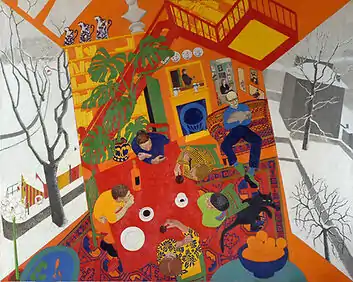
During the creation of the Conversation pieces, Utermohlen started to experience the early symptoms of memory loss. Utermohlen's symptoms at the time included having issues tying a necktie, having problems remembering recent events, and forgetting the route to his apartment.[32] From 1993 to 1994, Utermohlen created a series of multiple lithographs, which depicted short stories written by the World War I poet Wilfred Owen.[26] Chris Boicos, Utermohlen's art dealer, said that the subject matter of the lithographs were a metaphor for the forthcoming Alzheimer's diagnosis a year later.[33] By the time Utermohlen had finished these lithographs, he would often forget to show up to the art classes that he would teach.[34]
In August 1995,[35] at the age of 61, Utermohlen was diagnosed with Alzheimer's disease.[36] Following his diagnosis, Utermohlen was initially sent to the Queen's Square Hospital.[37] One of the nurses at the hospital, Ron Isaacs, was interested in Utermohlen's drawings, and told him to start drawing self-portraits.[16] The first painting made after his diagnosis, entitled Blue Skies,[lower-alpha 4] is a self-portrait of Utermohlen gripping onto a yellow table, in a place which The Wall Street Journal described as "an empty studio".[7] When neuropsychologist Sebastian Crutch visited Utermohlen in late 1999, he described this painting as representative of him trying to hang on and avoid being swept out of the open window above.[39] Blue Skies was also the last painting that Utermohlen created that has been considered to be "large scale".[40]
Utermohlen started drawing self-portraits in 1995, and continued making them until 2001.[41] Utermohlen also began working on a series of watercolours around this time. These watercolours were titled the Masks series. The series continued from 1994 to 1999, but showed the most activity in 1996.[42] The last non-self-portrait was made in 1997, and was of his wife.[43] Utermohlen's wife explained that his later work such as the Masks series had similarities to movements like German Expressionism.[44]
Shortly after Utermohlen's diagnosis, he and his wife went on a trip to Europe. While in Europe, Utermohlen had his attention towards Diego Velázquez's 1650 Portrait of Pope Innocent X,[45] and according to New Statesman, he had saw the portrait and likened it to versions of the portrait created by Francis Bacon.[37] When the Utermohlens returned to England in 1996, Utermohlen created Self Portrait (In the Studio), which includes the screaming mouth that was a common aspect in Bacon's works.[46]
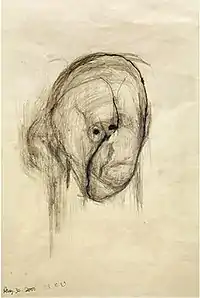
Alzheimer's disease had began to affect his artworks, as over the next six years, Utermohlen’s self-portraits became increasingly unrecognizable.[47] Utermohlen's wife said in a 2013 interview that she had to cover up all of the mirrors in their house because he was terrified by what he saw there, so Utermohlen did not use a mirror to create these self-portraits. However, this did not affect Utermohlen's transition from figurativism to abstract artworks, according to Sebastian Crutch and his research team.[48] The 1997 self-portrait "Self Portrait with Saw" contains a carpenter's saw to the far right, which his wife thought was referencing an autopsy that would have offered the definite diagnosis of his disease.[49] "Erased Self Portrait" from 1999, was the last attempt of making a self-portrait with a paint brush,[5] and according to Utermohlen's wife, he worked on that self-portrait for nearly two years.[50] The self-portraits from 2000–2001 consist of just a head. "Head I", made in 2000, features the attributes of a head with eyes, a mouth, and a smudge on the left that appears to be an ear. The rest of the portraits were of a blank head, one of them erased.[41] In a 2001 interview with Margaret Discroll, Utermohlen created the self-portrait in order to try to understand "what was happening to me in the only way I can"[51]
In December 2000, Utermohlen had retired from oil painting.[52] By 2002, Utermohlen could no longer draw, and he was sent to the Princess Louise nursing home in 2004. Utermohlen died at the Hammersmith Hospital, on March 21, 2007, from pneumonia, at the age of 73.[16] Utermohlen's wife commented on his death by saying; "He died in 2007, but really he was dead long before that, Bill died in 2000, when the disease meant he was no longer able to draw."[53]
Legacy
Critical reception
Utermohlen's self-portraits gained further attention after they were published in a 2001 paper from The Lancet, which has often been attributed for the self-portrait's popularity.[54][lower-alpha 5] The director of the Loyola University Museum of Art (LUMA), Pam Ambrose, commented on Utermohlen's self-portraits, stating that "If you did not know that this man was suffering from Alzheimer's, you could simply perceive the work as a stylistic change".[56] Other commenters of Utermohlen's works compared them to Vincent van Gogh, Pablo Picasso and Edvard Munch.[57] A 2012 article by New Scientist said that Utermohlen's artworks provided viewers with a "unique glimpse into the effects of a declining brain."[58] The existence of his previous self-portraits (which have allowed viewers to create a time-lapse of his mental decline), and the idea that his works give a rare view into the mind of an Alzheimer's patient, were two aspects contributing to the popularity of the self-portraits.[59]
In popular culture
Utermohlen's self-portraits were the inspiration for the 2019 short film Mémorable, which was created after Utermohlen's self-portraits were discovered by the film's director, Bruno Collet.[60] It was nominated for the Academy Award for Best Animated Short Film in 2020.[61]
Exhibitions
Utermohlen already had his works in exhibitions before diagnosed with Alzheimer's disease. By 1968 he had an exhibition by the Lee Nordness Gallery in New York City, and in 1969 he would have an exhibition at the Marlborough Gallery; in 1972 Utermohlen had the Mummers cycle featured in Amsterdam, in the Netherlands.[13] While he was in Massachussets, Utermohlen's portrait of Gerald Penny was featured in the Gerald Penny 77' Center.[62] Earlier in the year, Utermohlen had artworks such as Five Figures in the Mead Art Museum.[63]
Utermohlen's artworks and his late self-portraits have also been shown in several exhibitions in the years after his death, including 12 exhibitions from 2006 to 2008.[64] Notable exhibitions include A Persistence of Memory, shown at the Loyola Museum of Art in Chicago, in 2016,[41] A Retrospective at the GV Art gallery in London in 2012,[65][lower-alpha 6] an exhibition at the Chicago Cultural Center in 2008,[66] and The Later Works of William Utermohlen, shown at the New York Academy of Medicine, in 2006, which marked the centenary of Alois Alzheimer first discovering the disease.[67] His self-portraits have also been shown at the Two 10 Gallery located in London,[68] Paris in France; Boston, Massachusetts and Los Angeles, in California. In 2008 Utermohlen's self-portraits were in an exhibition in Sacramento, California.[69]
See also
- The Caretaker – alias of Leyland James Kirby, which depicted the effects of Alzheimer's disease through music; such as Everywhere at the End of Time
References
Notes
- Sources conflict over the date of Utermohlen and Redmond's marriage. For example, NBC and New Statesman claims that they married the same year they met.[12]
- He was able to travel through Italy, France, and Spain through the G.I. Bill, which he had gained from his service in the Caribbean.[6]
- Although the Nudes series date back to 1953, the series was most active from 1973–1974.[19]
- According to The Washington Times, the painting could have also been made a year before his diagnosis.[38]
- Utermohlen had wanted his works to be a subject of medical research and he willingly engaged in research published by The Lancet, which involved the relationship between the symptoms of the disease and aesthetics.[55]
- The GV Art gallery had a previous exhibition of Utermohlen's work earlier that year, which was titled "William Utermohlen: Artistic decline through Alzheimer's".[53]
Citations
- UK Government.
- The Times 2007; Baldwin & Capstick 2007, p. xxix.
- The Wall Street Journal 2012; Utermohlen, Polini & Boicos 2008, p. 5.
- Utermohlen, Polini & Boicos 2008, p. 5.
- NBC 2006.
- Baldwin & Capstick 2007, p. xxix.
- The Wall Street Journal 2012.
- Bradley et al. 2006, p. 152.
- Utermohlen 2006f.
- Utermohlen, Polini & Boicos 2008, p. 5; The Times 2007.
- The Times 2007.
- NBC 2006; New Statesman 2012.
- Utermohlen, Polini & Boicos 2008, p. 6.
- Utermohlen, Polini & Boicos 2008, pp. 6–7; NBC 2006.
- Utermohlen, Polini & Boicos 2008, p. 7; The Wall Street Journal 2012.
- Utermohlen, Polini & Boicos 2008, p. 7.
- The Times 2007; NBC 2006; Tulle 2004, p. 105.
- Utermohlen, Polini & Boicos 2008, pp. 7–8.
- Utermohlen 2006j.
- Utermohlen 2006g.
- Utermohlen 2006c.
- Utermohlen 2006b; Utermohlen, Polini & Boicos 2008, p. 8.
- Utermohlen 2006h.
- Utermohlen, Polini & Boicos 2008, p. 12.
- Hsu 2014, p. 114.
- Polini 2007.
- Bradley et al. 2006, p. 152; Utermohlen, Polini & Boicos 2008, p. 7.
- Green et al. 2015, p. 19.
- Utermohlen 2006d.
- Utermohlen 2006i.
- Utermohlen 2006e.
- Gilhooly & Gilhooly 2021, p. 116; Davenhill 2018, chpt. 17.
- Hsu 2014, p. 116.
- Davenhill 2018, chpt. 17.
- Association of American Medical Colleges 2006; Utermohlen, Polini & Boicos 2008, p. 24.
- Grady 2006.
- New Statesman 2012.
- The Washington Times 2006.
- Ball 2017.
- New Statesman 2012; The Wall Street Journal 2012.
- Boicos 2016.
- Utermohlen 2006a; Boicos 2016.
- Utermohlen, Polini & Boicos 2008, p. 25.
- Utermohlen, Polini & Boicos 2008, p. 24.
- Hsu 2014, p. 126.
- Hsu 2014, p. 127.
- Gerrard 2015; Loyola University Chicago 2016.
- Hsu 2014, p. 121.
- American Academy of Neurology 2006; Loyola University Chicago 2016.
- Association of American Medical Colleges 2006.
- Hsu 2014, p. 123.
- Derbyshire 2001.
- Purcell 2012.
- The Wall Street Journal 2012; Utermohlen, Polini & Boicos 2008, p. 7; Tulle 2004, p. 107.
- Swinnen 2015, p. 147.
- Loyola University Chicago 2016.
- Swinnen 2015, p. 145.
- Swinnen 2015, p. 146.
- Swinnen 2015, pp. 145–146.
- Grobar 2020.
- Academy of Motion Picture Arts and Sciences 2020.
- Jackson & Blair 1974, p. 1.
- Iacobuzio 1974, p. 18.
- Utermohlen, Polini & Boicos 2008, p. 35.
- The Wall Street Journal 2012; New Statesman 2012.
- Lock 2015, p. 244.
- American Academy of Neurology 2006; NBC 2006; Grady 2006.
- BBC 2001.
- Trinity Journal 2008.
Sources
- Academy of Motion Picture Arts and Sciences (9 February 2020). "The 92nd Academy Awards – 2020". Archived from the original on 10 October 2021. Retrieved 10 October 2021.
- American Academy of Neurology (19 December 2006). "Art Portrays Descent into Dementia". Archived from the original on 17 October 2021. Retrieved 22 August 2021.
- Association of American Medical Colleges (November 2006). "Commentary: Academic Medicine". Archived from the original on 11 August 2021. Retrieved 11 August 2021.
- Ball, Philip (11 March 2017). "Forgetting but not gone: dementia and the arts". The Guardian. Archived from the original on 28 November 2020. Retrieved 21 November 2021.
- BBC (28 June 2001). "A portrait of Alzheimer's". Archived from the original on 24 February 2021. Retrieved 9 December 2021.
- Boicos, Chris (2016). "William Utermohlen : A Persistence of Memory – Loyola University Museum of Art, Chicago – Chris Boïcos Fine Arts". boicosfinearts.com. Archived from the original on 3 May 2021. Retrieved 2 May 2021.
- Derbyshire, David (29 June 2001). "Artist charts his slide into dementia". The Telegraph. Archived from the original on 28 February 2016. Retrieved 10 November 2021.
- Gerrard, Nicci (19 July 2015). "Words fail us: dementia and the arts". The Guardian. Archived from the original on 14 August 2021. Retrieved 2 May 2021.
- Grady, Denise (24 October 2006). "Self-Portraits Chronicle a Descent Into Alzheimer's". The New York Times. ISSN 0362-4331. Archived from the original on 15 August 2021. Retrieved 2 May 2021.
- Green, Jonathan; Montpetit, Mignon A.; Diaz, Joanne; Kooken, Wendy (2015). "Pursuing the Ephemerel, Painting the Enduring; Alzheimer's and the Artwork of William Utermohlen". Illinois Wesleyan University. Archived from the original on 7 June 2020. Retrieved 16 August 2021.
- Grobar, Matt (28 January 2020). "'Memorable' Director Bruno Collet Uses Stop-Motion To Tap Into Aging Painter's Experience Of Dementia". Deadline. Archived from the original on 26 February 2021. Retrieved 19 October 2021.
- Hsu, Xi (2014). "A portrait of dementia: the symptoms of dementia as a model for exploring complex and fluid subjectivity in portrait-painting". University of Wollongong. Archived from the original on 22 March 2015. Retrieved 9 November 2021.
- Iacobuzio, Ted (6 June 1974). "Amherst Student, 1974 June 6, Commencement issue". Amherst Student. Amherst College. Amherst College Digital Collections. Archived from the original on 30 November 2020. Retrieved 1 December 2021.
- Jackson, Antonio; Blair, Raymond (14 October 1974). "Amherst Student, 1974 October 14". Amherst Student. Amherst College. Amherst College Digital Collections. Archived from the original on 17 January 2021. Retrieved 1 December 2021.
- Loyola University Chicago (2016). "An intimate portrait of Alzheimer's disease". Archived from the original on 14 June 2021. Retrieved 14 October 2021.
- NBC (11 March 2006). "Artist paints his struggle with Alzheimer's". Archived from the original on 13 September 2021. Retrieved 13 September 2021.
- New Statesman (3 May 2012). "Review: William Utermohlen (1933–2007); Retrospective". Archived from the original on 9 April 2021. Retrieved 4 September 2021.
- Polini, Patrice (2007). "The Late Pictures". www.williamutermohlen.org. Archived from the original on 10 April 2021. Retrieved 3 September 2021.
- Purcell, Andrew (31 January 2012). "How an Artist Painted His Decline Into Alzheimer's". New Scientist, published by Gizmodo. Archived from the original on 1 November 2021. Retrieved 1 November 2021.
- The Times (1 May 2007). "William Utermohlen; The Times". Archived from the original on 6 October 2021. Retrieved 5 October 2021.
- Trinity Journal (20 February 2008). "Portraits at state capitol reveal plight of Alzheimer's sufferers". Archived from the original on 21 November 2021. Retrieved 21 November 2021.
- UK Government. "William Charles Utermohlen personal appointments". Archived from the original on 4 December 2021. Retrieved 4 December 2021.
- Utermohlen, Patricia; Polini, Patrice; Boicos, Chris (2008). "The Works of William Utermohlen — 1955 to 2000" (PDF). Archived (PDF) from the original on 19 August 2021. Retrieved 19 August 2021.
- Utermohlen, Patricia (2006a). "Masks". Archived from the original on 20 October 2020. Retrieved 15 August 2021.
- Utermohlen, Patricia (2006b). "Vietnam". www.williamutermohlen.org. Archived from the original on 21 January 2021. Retrieved 19 August 2021.
- Utermohlen, Patricia (2006c). "Dante Cycle: 1964–1966". www.williamutermohlen.org. Archived from the original on 30 January 2021. Retrieved 22 August 2021.
- Utermohlen, Patricia (2006d). "Synagogue St John's Wood". www.williamutermohlen.org. Archived from the original on 28 January 2021. Retrieved 9 October 2021.
- Utermohlen, Patricia (2006e). "Self-Portraits". www.williamutermohlen.org. Archived from the original on 28 February 2021. Retrieved 30 August 2021.
- Utermohlen, Patricia (2006f). "Early Self Portraits". www.williamutermohlen.org. Archived from the original on 3 March 2021. Retrieved 22 August 2021.
- Utermohlen, Patricia (2006g). "Mythologies and the Sea". www.williamutermohlen.org. Archived from the original on 28 February 2021. Retrieved 23 August 2021.
- Utermohlen, Patricia (2006h). "Mummers". www.williamutermohlen.org. Archived from the original on 10 May 2021. Retrieved 23 August 2021.
- Utermohlen, Patricia (2006i). "Portraits". www.williamutermohlen.org. Archived from the original on 1 February 2021. Retrieved 24 October 2021.
- Utermohlen, Patricia (2006j). "Nude Paintings". www.williamutermohlen.org. Archived from the original on 21 December 2020. Retrieved 24 October 2021.
- The Wall Street Journal (19 April 2012). "William Utermohlen (1933–2007) – Retrospective; Wall Street Journal Magazine". Archived from the original on 26 September 2021. Retrieved 26 September 2021.
- The Washington Times (5 April 2006). "Pictures of artist deconstructing". Archived from the original on 2 December 2021. Retrieved 2 December 2021.
Bibliography
- Bradley, Ronald J.; Harris, R. Adron; Jenner, Peter; Rose, F. Clifford (19 May 2006). The Neurobiology of Painting: International Review of Neurobiology. Boston: Elsevier. ISBN 978-0-08-046361-2 – via Google Books.
- Baldwin, Clive; Capstick, Andrea (1 October 2007). Tom Kitwood On Dementia: A Reader And Critical Commentary. Maidenhead, Berkshire New York, NY: McGraw-Hill Education. ISBN 978-0-335-22271-1 – via Google Books.
- Davenhill, Rachael (8 October 2018). Looking into Later Life. Place of publication not known: Taylor and Francis. ISBN 978-0-429-91582-6 – via Google Books.
- Gilhooly, Kenneth J.; Gilhooly, Mary L. M. (August 2021). Aging and Creativity. London: Elsevier. ISBN 978-0-128-16615-4 – via Google Books.
- Lock, Margaret (20 October 2015). The Alzheimer Conundrum – Entanglements of Dementia and Aging. Princeton, New Jersey: Princeton University Press. ISBN 978-0-691-16847-0 – via Google Books.
- Swinnen, Aagje (2015). Popularizing Dementia; Public Expressions and Representations of Forgetfulness. Bielefeld: transcript. ISBN 978-3-839-42710-1 – via Google Books.
- Tulle, Emmanuelle (2004). Old Age and Agency. New York, N. Y.: Nova Science. ISBN 978-1-590-33884-1 – via Google Books.