Wood-pasture hypothesis
The wood-pasture hypothesis, also known as the Vera hypothesis[1] and the megaherbivore theory is a scientific hypothesis which proposes, that open and semi-open pastures and wood pastures other than primeval forests would have formed the predominant type of landscape in post-glacial Europe, thus opposing the common belief. As the name Vera-hypothesis implies, it was first proposed by Dutch researcher Frans Vera in his book Grazing Ecology and Forest History in 2000 and translated into English in 2002,[2] although similar ideas had already been developed by others, including Oliver Rackham, but never comprehensively published.[3][4] Especially in Great Britain Vera's findings have prompted considerable investigation by ecologists.[5]
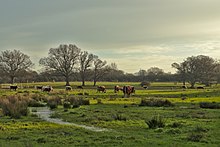
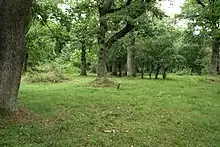
Although Vera largely focused his research on the European situation, his findings could also be applied to other temperate ecological regions worldwide, especially the broadleaved ones. More so in his book Vera also discusses the decline of ancient oak-hickory-forest communities in Eastern North America, arguing against the widely accepted assumption that those are a product of frequent fires,[6] instead suggesting that herds of American bison that roamed the East coast in the pre-settlement period kept the forests open, thus supporting light-demanding plant communities consisting of oak, hickory and hawthorn species among others.[2]
Definitions

Important for the hypothesis is the fact, that during the Pleistocene warm periods alternated periodically with colder glacial periods, globally. In Europe this had the effect that two very different faunal and floral assemblages took turns in central Europe. On the one hand the warm-temperate Paleoloxodon-faunal assemblage, consisting of the straight-tusked elephant, Merck's rhinoceros, the narrow-nosed rhinoceros, European water buffalo, aurochs and several species of deer among others had its core area in the Mediterranean and periodically expanded from there into the rest of Europe during warm interglacials, and receded during glacial periods back into refugia in the Mediterranean. On the other hand the cold-temperate faunal assemblage of the mammoth steppe, consisting of the woolly mammoth, woolly rhinoceros, reindeer, saiga, muskox, steppe bison, arctic fox and lemming among others was spread across vast areas of northern Eurasia as well as North America and during cold glacials periodically advanced deep into Europe. Other animals like horses, steppe lions, the scimitar cat, the Ice Age spotted hyena, wolves, wild boar, red deer among others were part of both faunal assemblages.[7]
At the end of the Pleistocene however, at the end of the last glaciation, the mammoth steppe faunal-assemblage receded with the warmer temperatures, but was not replaced by the Paleoloxodon-faunal assemblage whose most prominent members, straight-tusked elephants and the two species of rhinoceros, had already gone extinct. Similarly, the mammoth steppe faunal assemblage also collapsed not long after as part of the Quaternary extinction event, although regionally small woolly mammoth populations held out well into the Holocene, and the Irish elk was present in the southern Ural region into historical times.[8][9] Both has been attributed to either climate change or human impact, or a combination of the two.[10]
Theory
_(28524158712).jpg.webp)
The hypothesis states, that although the warming climate of the onsetting Holocene in Europe provided conditions that would allow for the formation of a closed canopy forest, this process was interrupted and altered by herbivores such as aurochs, European bison, red deer and tarpan, historically, with the addition of many other megafaunal mammals prehistorically, who shaped more open landscapes instead by grazing and browsing and likewise also did so in previous warm interglacial periods. It further states, that lowland forest did not emerge on a large scale before the onset of the Neolithic period and subsequent local extinctions of herbivores, which in turn allowed forests to thrive more unhindered. Indeed, investigations point to at least locally open circumstances, for example in floodplains, on infertile soils, chalklands and in submediterranean and continental areas, but maintain that forest largely dominated.[11]
However, the wood-pasture hypotheses is to some degree based on the Quaternary extinction event, around the Pleistocene-Holocene boundary, which started around 130,000 years ago but reached a maximum extinction rate from 13,000 to 8000 years ago, when a large amount of the world's megafauna and almost all megafaunal animals above 1000 kg on the northern hemisphere, in Latin America, Australasia and the Pacific islands as well as in Madagascar and the Caribbean died out in a relatively short period of time, with the most popular example probably being the woolly mammoth.
As it stands, the wood-pasture hypothesis builds in part on the overkill-hypothesis, which holds that human predation was the dominant factor for the Quaternary extinction event and was coined by Paul S. Martin in 1966, and the second-order-predation hypothesis, respectively, which states that the pressure of climate change on the Pleistocene ecosystems was exaggerated by human actions, as opposed to the climate change hypothesis which attributes the extinctions solely or mostly to the changes in climate. Thus, the theory says, human predation led to the extinction of the northern megafauna, leaving ecological niches previously occupied by megafaunal animals vacant and leading to forest vegetation ultimately.
Paleoecological evidence drawn from Coleoptera deposits has also shown that, albeit rare, beetle species associated with grasslands and other open landscapes were present throughout the Holocene in central Europe, which points to open habitats being present, but restricted. However, insect assemblages from previous interglacials when the larger megafauna was still present indicate widespread warm temperate savannah, pointing to the possibility that elephants and rhinos were more effective creators of open landscapes than the herbivores left after the Quaternary extinction event.[12] On the other hand, traditional animal husbandry might have mitigated the effects of possibly human-induced megafaunal die-off, and thus enabled the survival of an array of species associated or dependent on landscapes created and maintained by megafauna.[13]
Origin of the issue: the Quaternary extinction event

Whereas today megafaunal Proboscideans, Rhinocerotidae and Hippopotamidae significantly above 1000 kg exclusively exist in the global south, notably Sub-Saharan Africa and South Asia, land mammals of comparable or greater size used to roam the northern hemisphere and South America until relatively recently, dying out around 10,000 BC or being geographically restricted nowadays, respectively. Notable examples include the taxa Palaeoloxodon, mammoth, mastodon, Stegodon, Cuvieronius, Notiomastodon, Stephanorhinus, woolly rhinoceros, Elasmotherium, Toxodon, Mixotoxodon, Eremotherium, Megatherium, Glyptodon and all Diprotodontids.
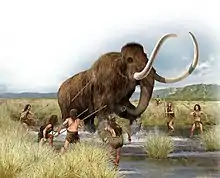
Furthermore, other megafauna above 45 kg, including various species of Cervids, Bovids, Antilocaprids, Meridiungulata, Marsupials, Camelids, Tayassuids, Equids, Felids and Ursids that were spread across all continents except for Antarctica prior to the Quaternary extinction event, have since declined across their range, or become extinct, respectively. More so, many big mammal species have since become locally extinct and survive only in fractures of their once greater distribution, examples for which include the Eurasian saiga, wapiti-deer, the Asian black bear, the yak, bison, the dhole, lions, the leopard, the jaguar and the giant anteater. While the exact cause of these events remains debated among scientists, it seems clear that this has left ecological niches in Europe, the Middle East, big parts of Asia and the Americas unoccupied, since these species were not replaced by other species with similar characteristics, as it was the case in previous extinction occasions.
Similar to how big herds of herbivores like wildebeest, zebra and buffalo as well as elephants manage to drive vegetation patterns in the African savanna, and not vice versa the vegetation dictating the activities of these herbivores,[14] it is argued that herds of similar-sized animals with similar ecological niches could have employed these ecosysteme functions in the temperate regions as well, until they largely vanished as part of the Quartenary extinction at the Pleistocene-Holocene boundary.
An illustration of this almost global phenomenon is the situation in Europe, were the only remaining large wild herbivores and omnivores widely distributed across the continent are red deer, fallow deer, roe deer, elk, reindeer, wild boar, beaver and the brown bear, and the largest remaining wild animal is the wisent. On the other hand, the Aurochs, the straight-tusked elephant, two species of Stephanorhinus as well as several native hippopotamuses, the irish elk, wild horse and Haploidoceros mediterraneus among many others were lost. Other continents like south America and Australia have witnessed even more drastic changes, and lost almost all of their native megafauna. Thus it is argued, that the remaining herbivores do not manage to adequately replace the extinct ones, and, since their extinction is often attributed to human activity, that these extinctions were not natural, i. e. that the modern ecosystems of Europe miss the megafauna's services as ecosystem engineers.[15][16][17]
Oak and hazel
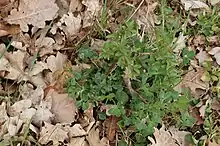
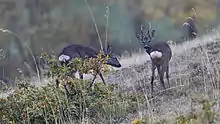
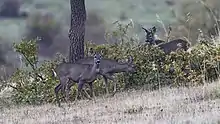
One of the most elementary arguments often put forward to substantiate the hypothesis is the widespread lack of successful regeneration of light-demanding tree species in modern forests, especially the lack of regeneration of pedunculate oak, sessile oak and common hazel in Europe.[2] This reality is starkly contrasted by European pollen deposits from previous ages, with oak and hazel often forming a dominant amount of pollen, making a dominance of these species in previous ages conceivable. Especially in regard to hazel, sufficient flowering is only achieved when enough sunlight is available i. e. the plant grows outside of a closed canopy. Thus it is argued, that the high abundance of pollen of the two taxa Quercus and Corylus in previous ages can only be explained with the primeval landscape having been of more open nature, and this contrast forms the principal theorem of Vera's hypothesis.[2] Further It has been suggested that oak requires disturbances for successful establishment.[18]
However, pollen records from islands that lacked many of the large grazers and browsers that, according to Vera, were essential for the maintenance of landscapes with an open character in temperate Europe show almost no differences in comparison to mainland Europe. More specifically pollen records from Holocene Ireland, which during the early Holocene was apparently, owing to a lack of fossils, devoid of any big herbivores except for abundant wild boar and rare red deer, show almost equally high percentages of pollen of the two taxa. Thus, one could conclude, that large herbivores were not a required factor for the degree of openness in a landscape, and the abundance of pollen from species unable to reproduce and regenerate sufficiently under a closed canopy, e. g. hazel and oak, could only be explained by other factors like windthrow and natural fires.[19]
Furthermore, new species of oak mildew (Erysiphe alphitoides) observed on European oaks for the first time in the beginning of the 20th century have been cited as a possible reason for these differences, since they affect the shade tolerance particularly of young pedunculate and sessile oaks.[20] Although the origin of these new oak pathogens remains obscure, studies point to it being an insvasive species from the tropics, possibly being conspecific with a pathogen found on mangos[21]
Associational resistance and cyclic succession
Associational resistance
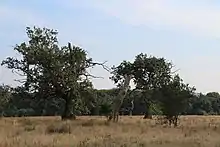
The term associational resistance was proposed to describe a phenomenon occurring in grazed ecosystems, where trees and other palatable woody species establish within thorny shrubs and subsequently benefit from their thorn protection, ultimately replacing the light-demanding mother bush or living alongside it, respectively.[22] According to Vera, associational resistance is a key process in grazed environments, ensuring natural succession and the establishment of trees under such conditions.
In temperate Europe, shrubs providing thorn protection include blackthorn, Caninae-roses, hawthorn, juniper, bramble and barberry, which presumably can establish themselves under moderate grazing pressure, where they grow bigger over time and subsequently allow other, less resilient species to establish in their thorn protection. Species such as yew, buckthorn, alder buckthorn, wayfarer, guelderrose, wild privet, dogwood, cornel, checker tree, rowan and whitebeam, which are distributed by fruit-eating birds through their faeces, would frequently be placed within these shrubs, through resting birds leaving their droppings.
On the other hand, nut-bearing species such as hazel, beech, chestnut and especially pedunculate and sessile oak would become "planted" somewhat deliberately in the vicinity of those shrubs by rodents such as red squirrel and wood mouse and corvids such as crows, magpies, ravens and especially jays, which store them for winter supply. In Europe, the Eurasian jay represents the most important seed disperser of oak, burying acorns individually or in small groups. It does not only bury acorns in depths favored by oak saplings, but seemingly also prefers spots with sufficient light availability, i. e. open grassland and transitions between grassland and shrubland, seeking for vertical structures such as shrubs in the near surroundings.[23] Since oak is relatively light-demanding while not having the ability to regenerate on its own under high browsing pressure, these habits of the jay presumably benefit oak, since they provide the conditions oak requires for optimal growth and health.[2]
In addition, species such as wild pear, crab apple and sorb tree, which bear relatively large fruit, would find propagators in herbivores such as roe deer, red deer and cattle, or in omnivores such as the wild boar, red fox, the European badger and the raccoon, while wind-dispersed species such as maple, elm, lime or ash would only land within these shrubs by chance.
Since many of these species are analogously replaced by either closely related or ecologically similar species across the temperate northern hemisphere, a comparable scheme could probably apply to these regions as well.
Cyclic succession
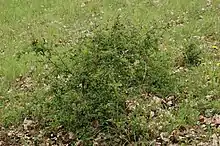
Starting from an extensively grazed pasture, one could thus figure the natural development of succession, according to the hypothesis, as follows: First unpalatable species would gradually establish, either perennial plants like nettles, thistles, teasels and restharrows, or woody plants like junipers, brooms, roses and sloes. Second, these would start to form thickets avoided by herbivores, thus enabling larger, palatable shrubs and trees respectively to grow in their protection. Over time these would then outshadow the unpalatable but light-demanding thickets and emerge as big solitary trees or groups of trees. Because of the browsing pressure, even shade tolerant tree saplings would not be able to grow under the established trees, which means that there would virtually be no vegetation beneath them. Finally, the established trees would start to decay, either due to old age or other factors like pathogens, illness, lightning strike or windbreak, eventually leaving open, bare land for grasses and unpalatable species to colonise, thus closing the cycle.[24] On a large scale different successional stages would thus contribute an ecosystem where open grassland, scrubland, emerging tree growth, groves of trees and solitary trees exist next to each other, and the alternation between these various successional stages would create dynamic shifting mosaics of vegetation.[25] This in turn stimulates high biodiversity.[26][27]
Ecology
Grazed woodlands, wood-pastures and pastures in many regions of the world harbour high biodiversity and are important for many species. Rare perennial plant species commonly or exclusively associated with these ecosystems in Europe include hellebores, peonies, asphodels, dittany, black false hellebore and Melittis melissophyllum. The tree layer is often dominated by a number of oak species and many rare, local and threatened species such as Malus florentina, Malus (Eriolobus) trilobata, medlar, sorb tree, Macedonian oak, Lusitanian oak, pears and wild plums are more often found in European silvopastoral systems than in commercial forest.[28] Rare or declining bird species such as the European roller, hoopoe, several species of shrike, owls (scops owl, little owl) as well as wrynecks, middle spotted woodpeckers and the Spanish imperial eagle are attracted by wood-pastures in particular, for various reasons, while Iberian lynx depend on dehesas.[28]
Rewilding and practical implementation of the hypothesis

Although the validity of Vera's hypothesis remains debated among ecologists and conservationists, it is often considered a fruitful approach for environment protection and conservation, and thus has been widely implemented in daily practise.
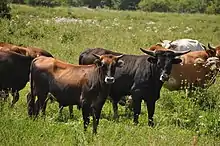
Examples for such projects include the Dutch conservation area Oostvaardersplassen, which was initiated by Vera, as well as the Knepp estate in Sussex. Isabella Tree, co-owner of the latter, has named Vera and his ideas as important reasons for her and her husband to consider rewilding their private estate with fallow deer, red deer, English longhorn cattle (as ecological proxies for the extinct aurochs) and tamworth pigs (as proxies for the wild boar).[29]
Furthermore, in the shape of Rewilding Europe, a pan-european organization that aims for creating wild spaces in Europe by re-establishing food chains and reintroducing formally missing species, has identified Vera's proposals as key to complex ecosystems and, taking them into account, works to establish big herds of European bison, aurochs-proxies (e. g. taurus-cattle), proxies for the wild tarpan (e. g. konik, Exmoor pony) as well as water buffalo and kulan, which were present in Europe until the early Holocene, to create dynamic ecosystems maintained by the grazing and browsing activity of these herbivores.[30]
Implications for environment protection and conservation practise
Historically, environment protection in Europe and around the northern hemisphere, in the temperate, broadleaved regions was often focused on the protection of old forests, since it was perceived that these old-growth forests represent the closest modern analogy to the original European vegetation prior to the likewise assumed clearing of these forests on the advent of agriculture, by humans.[2] More so it was mostly believed, that open and semi-open landscapes like heathland, wood pastures, pastures and in general any kind of landscape apart from more or less dense forest can be solely seen as a substitutional habitat for the original woodland, and that open habitats, if there in fact were any, would have been restricted to places uninhabitable for trees. Only in areas too dry, wet, rocky or sandy for trees to colonise, or were vegetation periods were too short to support trees, would these forests be replaced by other vegetation types, most notably steppe ecosystems. The dominating natural virgin vegetation of the broadleaved regions was assumed to be a climax community that over time develops into steady state dominated by a few shade-tolerant, competitive species such as beech and maple.[2] Although this theory is mostly abandoned in favour of theories that account for dynamic processes in ecosystems, e. g. temporal collapses of forest cover and disturbances through fire, storm or browsing, the prevelant imagination of a European virgin vegetation remains to be forest. Examples for this include Białowiża on the Polish-Belarusian border as well as the Hainich in central Germany.
Since the megaherbivore theory implies that these closed forests are largely man-made, either through active support of forests or the passive enablement through the suppression of herbivore numbers, i. e. browsing pressure, this would also mean that a large part of modern conservation practise is misguided and fails to create truly natural ecosystems.[19]
See also
References
- "Palaeoecological evidence for the Vera hypothesis?".
- "Grazing Ecology and Forest History". ResearchGate. Retrieved 2021-02-21.
- "We need to bring back the wildwoods of Britain to fight climate change | Isabella Tree". the Guardian. 2018-11-26. Retrieved 2021-09-14.
- Green, Ted (2002), Redecker, Bernd; Härdtle, Werner; Finck, Peter; Riecken, Uwe (eds.), "The role of invisible biodiversity in pasture landscapes", Pasture Landscapes and Nature Conservation, Berlin, Heidelberg: Springer, pp. 137–145, doi:10.1007/978-3-642-55953-2_9, ISBN 978-3-642-55953-2, retrieved 2021-12-04
- Hodder, Kathryn H.; Buckland, Paul C.; Kirby, Keith K.; Bullock, J. M. (2009). "Can the mid-Holocene provide suitable models for rewilding the landscape in Britain?". British Wildlife. 20 (5): 4–15. ISSN 0958-0956.
- Abrams, Marc D. (1992). "Fire and the Development of Oak Forests". BioScience. 42 (5): 346–353. doi:10.2307/1311781. ISSN 0006-3568. JSTOR 1311781.
- Pleistocene Mammals of Europe. Tayler and Francis. 1968. p. 6. ISBN 0202309533.
- Vartanyan, S. L.; Garutt, V. E.; Sher, A. V. (March 1993). "Holocene dwarf mammoths from Wrangel Island in the Siberian Arctic". Nature. 362 (6418): 337–340. Bibcode:1993Natur.362..337V. doi:10.1038/362337a0. ISSN 1476-4687. PMID 29633990. S2CID 4249191.
- Van der Pflicht, J. (2015). "New Holocene refugia of giant deer (Megaloceros giganteus Blum.) in Siberia: updated extinction patterns". Quaternary Science Reviews. 114: 182–188. Bibcode:2015QSRv..114..182V. doi:10.1016/j.quascirev.2015.02.013.
- Stuart, A. J.; Kosintsev, P. A.; Higham, T. F. G.; Lister, A. M. (October 2004). "Pleistocene to Holocene extinction dynamics in giant deer and woolly mammoth". Nature. 431 (7009): 684–689. Bibcode:2004Natur.431..684S. doi:10.1038/nature02890. ISSN 1476-4687. PMID 15470427. S2CID 4415073.
- Svenning, Jens-Christian (2002-04-01). "A review of natural vegetation openness in north-western Europe". Biological Conservation. 104 (2): 133–148. doi:10.1016/S0006-3207(01)00162-8. ISSN 0006-3207.
- Buckland, Paul. "Palaeoecological evidence for the Vera hypothesis?" (PDF).
- Pykälä, Juha (2000). "Mitigating Human Effects on European Biodiversity through Traditional Animal Husbandry". Conservation Biology. 14 (3): 705–712. doi:10.1046/j.1523-1739.2000.99119.x. ISSN 1523-1739.
- Carrol, Sean (2016). The Serengeti Rules. Princeton, New Jersey: Princeton University Press. p. 143. ISBN 978-0-691-17568-3.
- Rowan, John; Faith, J. T. (2019), Gordon, Iain J.; Prins, Herbert H. T. (eds.), "The Paleoecological Impact of Grazing and Browsing: Consequences of the Late Quaternary Large Herbivore Extinctions", The Ecology of Browsing and Grazing II, Ecological Studies, Cham: Springer International Publishing, pp. 61–79, doi:10.1007/978-3-030-25865-8_3, ISBN 978-3-030-25865-8, S2CID 210622244, retrieved 2021-09-11
- "The Extinctions". The Extinctions. Retrieved 2021-09-11.
- Johnson, C.N. (2009-07-22). "Ecological consequences of Late Quaternary extinctions of megafauna". Proceedings of the Royal Society B: Biological Sciences. 276 (1667): 2509–2519. doi:10.1098/rspb.2008.1921. ISSN 0962-8452. PMC 2684593. PMID 19324773.
- Bobiec, Andrzej; Jaszcz, Ewelina; Wojtunik, Karolina (2011-09-01). "Oak (Quercus robur L.) regeneration as a response to natural dynamics of stands in European hemiboreal zone". European Journal of Forest Research. 130 (5): 785–797. doi:10.1007/s10342-010-0471-3. ISSN 1612-4677. S2CID 20878128.
- Mitchell, Fraser (2005). "How open were European primeval forests? Hypothesis testing using palaeoecological data". Journal of Ecology. 93: 168–177. doi:10.1111/j.1365-2745.2004.00964.x.
- Demeter, László; Molnár, Ábel Péter; Öllerer, Kinga; Csóka, György; Kiš, Alen; Vadász, Csaba; Horváth, Ferenc; Molnár, Zsolt (2021-01-01). "Rethinking the natural regeneration failure of pedunculate oak: The pathogen mildew hypothesis". Biological Conservation. 253: 108928. doi:10.1016/j.biocon.2020.108928. ISSN 0006-3207. S2CID 232343559.
- Mougou, A.; Dutech, C.; Desprez-Loustau, M.-L. (2008). "New insights into the identity and origin of the causal agent of oak powdery mildew in Europe". Forest Pathology. 38 (4): 275–287. doi:10.1111/j.1439-0329.2008.00544.x. ISSN 1439-0329.
- Bakker, E. S.; Olff, H.; Vandenberghe, C.; Maeyer, K. De; Smit, R.; Gleichman, J. M.; Vera, F. W. M. (2004). "Ecological anachronisms in the recruitment of temperate light-demanding tree species in wooded pastures". Journal of Applied Ecology. 41 (3): 571–582. doi:10.1111/j.0021-8901.2004.00908.x. ISSN 1365-2664.
- Lambert, J. E.; Hulme, P. E.; Wall, S. B. Vander (2004-12-20). Seed Fate: Predation, Dispersal, and Seedling Establishment. CABI. ISBN 978-0-85199-072-9.
- Olff, H.; Vera, F. W. M.; Bokdam, J.; Bakker, E. S.; Gleichman, J. M.; Maeyer, K. de; Smit, R. (1999). "Shifting Mosaics in Grazed Woodlands Driven by the Alternation of Plant Facilitation and Competition". Plant Biology. 1 (2): 127–137. doi:10.1111/j.1438-8677.1999.tb00236.x. ISSN 1438-8677.
- Olff, H.; Vera, F. W. M.; Bokdam, J.; Bakker, E. S.; Gleichman, J. M.; Maeyer, K. de; Smit, R. (1999). "Shifting Mosaics in Grazed Woodlands Driven by the Alternation of Plant Facilitation and Competition". Plant Biology. 1 (2): 127–137. doi:10.1111/j.1438-8677.1999.tb00236.x. ISSN 1438-8677.
- Moreno, Gerardo; Gonzalez-Bornay, Guillermo; Pulido, Fernando; Lopez-Diaz, María Lourdes; Bertomeu, Manuel; Juárez, Enrique; Diaz, Mario (2016-02-01). "Exploring the causes of high biodiversity of Iberian dehesas: the importance of wood pastures and marginal habitats". Agroforestry Systems. 90 (1): 87–105. doi:10.1007/s10457-015-9817-7. ISSN 1572-9680. S2CID 18441263.
- Oksuz, Duygu P.; Aguiar, Carlos A. S.; Tápia, Susana; Llop, Esteve; Lopes, Paula; Serrano, Artur R. M.; Leal, Ana I.; Branquinho, Cristina; Correia, Otilia; Rainho, Ana; Correia, Ricardo A. (2020-05-15). "Increasing biodiversity in wood-pastures by protecting small shrubby patches". Forest Ecology and Management. 464: 118041. doi:10.1016/j.foreco.2020.118041. ISSN 0378-1127. S2CID 216294452.
- Hartel, Plieninger, Tibor, Tobias (2014). European Wood-pastures in Transition. Routledge. p. 27. ISBN 978-0-8153-9531-7.
- Tree, Isabella (2018). Wilding. Picador. ISBN 978-1509805105.
- "Rewilding Europe | Making Europe a Wilder Place". Rewilding Europe. Retrieved 2021-12-03.