Worcestershire sauce
Worcestershire sauce (/ˈwʊstərʃər/ WUUS-tər-shər) is a fermented liquid condiment created in the city of Worcester in Worcestershire, England, during the first half of the 19th century. The creators were the pharmacists (chemists in British English) John Wheeley Lea and William Henry Perrins, who went on to form the company Lea & Perrins. Worcestershire sauce has been considered a generic term since 1876, when the English High Court of Justice ruled that Lea & Perrins did not own a trademark for the name Worcestershire.[1]

Worcestershire sauce is frequently used to augment food and drink recipes, such as Welsh rarebit, Caesar salad, Oysters Kirkpatrick, and deviled eggs. As both a background flavour and a source of umami (the savoury fifth flavour), it is now also added to dishes that historically did not contain it, such as chili con carne and beef stew. It is also used directly as a condiment on steaks, hamburgers, and other finished dishes, and to flavour cocktails such as the Bloody Mary and Caesar.[2]
History
A fermented fish sauce called garum was a staple of Greco-Roman cuisine and of the Mediterranean economy of the Roman Empire, as the first-century encyclopaedist Pliny the Elder writes in his Historia Naturalis and the fourth–fifth-century Roman culinary text Apicius includes garum in its recipes. The use of similar fermented anchovy sauces in Europe can be traced back to the 17th century.[3]
The Lea & Perrins brand was commercialised in 1837 and was the first type of sauce to bear the Worcestershire name.[4] The origin of the Lea & Perrins recipe is unclear. The packaging originally stated that the sauce came "from the recipe of a nobleman in the county". The company has also claimed that "Lord Marcus Sandys, ex-Governor of Bengal" encountered it while in India with the East India Company in the 1830s, and commissioned the local apothecaries to recreate it (the partnership of John Wheely Lea and William Perrins of 63 Broad Street, Worcester).
According to company tradition, when the recipe was first mixed there the resulting product was so strong that it was considered inedible and the barrel was abandoned in the basement. Looking to make space in the storage area a few years later, the chemists decided to try it again, and discovered that the long fermented sauce had mellowed and was now palatable. In 1838, the first bottles of Lea & Perrins Worcestershire sauce were released to the general public.[1][5]
Ingredients
The original ingredients in a bottle of Worcestershire sauce were:
- Barley malt vinegar
- Spirit vinegar
- Molasses
- Sugar
- Salt
- Anchovies
- Tamarind extract
- Shallots (later replaced by onions)
- Garlic
- Spice
- Flavourings
Since many Worcestershire sauces include anchovies, it is avoided by those who are allergic to fish,[6] and others who avoid eating fish, such as vegetarians. The Codex Alimentarius recommends that prepared food containing Worcestershire sauce with anchovies include a label warning of fish content, although this is not required in most jurisdictions. The US Department of Agriculture has required the recall of some products with undeclared Worcestershire sauce.[7][8] Several brands sell anchovy-free varieties of Worcestershire sauce, often labelled as vegetarian or vegan.[9] Generally, Orthodox Jews refrain from eating fish and meat in the same dish, so they do not use traditional Worcestershire sauce to season meat.[10] However, certain brands are certified to contain less than 1/60 of the fish product and can be used with meat.[11][12]
Specific sauces
Lea & Perrins
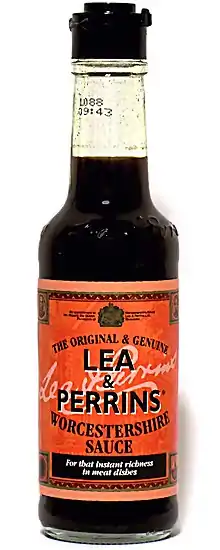
The Lea & Perrins brand was commercialised in 1837 and continues to be the leading global brand of Worcestershire sauce.[4]
On 16 October 1897, Lea & Perrins relocated manufacturing of the sauce from their pharmacy in Broad Street to a factory in the city of Worcester on Midland Road, where it is still made. The factory produces ready-mixed bottles for domestic distribution and a concentrate for bottling abroad.[13]
In 1930, the Lea & Perrins operation was purchased by HP Foods, which was in turn acquired by the Imperial Tobacco Company in 1967. HP was sold to Danone in 1988 and then to Heinz in 2005.
US packaging
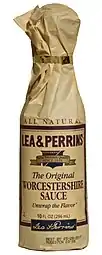
The US version is packaged differently from the British version, coming in a dark bottle with a beige label and wrapped in paper. Lea & Perrins USA claims this practice is a vestige of shipping practices from the 19th century, when the product was imported from England, as a measure of protection for the bottles.[14] The producer also claims that its Worcestershire sauce is the oldest commercially bottled condiment in the US.[15]
Brazil and Portugal
In Brazil and Portugal it is known as molho inglês ('English sauce').
Costa Rica
In Costa Rica, a local variation of the sauce is Salsa Lizano, created in 1920 and a staple condiment at homes and restaurants.
Denmark
In Denmark, Worcestershire sauce is commonly known as Engelsk sauce, meaning 'English sauce'.[16]
El Salvador
Worcestershire sauce, known colloquially as salsa inglesa ('English sauce') or salsa Perrins ('Perrins sauce'), is extremely popular in El Salvador, where many restaurants provide a bottle on each table. Over 120,000 gallons, or 2.5 ounces (71 g) per person, is consumed annually, the highest per-capita consumption in the world as of 1996.[17]
Germany
A sweeter, less salty version of the sauce called Worcestersauce Dresdener Art was developed in the beginning of the 20th century in Dresden, Germany, where it is still being produced. It is mostly consumed in the eastern part of the country.[18]
Japan
In Japan, Worcestershire sauce is labelled "Worcester" (rather than "Worcestershire"), rendered as Usutā sōsu (ウスターソース). Many sauces are more of a vegetarian variety, with the base being water, syrup, vinegar, puree of apple and tomato puree, and the flavour less spicy and sweeter.[19] Japanese Agricultural Standard defines types of the sauces by viscosity, with Worcester sauce proper having a viscosity of less than 0.2 Poiseuille. Thick (> 2 Poiseuille) sauces are more common; they are manufactured under brand names such as Otafuku and Bulldog, but these are brown sauces more similar to HP Sauce rather than Worcestershire sauce.
Tonkatsu sauce is a variation of Worcestershire sauce associated with the dish tonkatsu. It is a vegetarian sauce made from vegetables and fruits.[20][21]
Mexico
In Mexico it is known as "salsa inglesa" (English sauce).
United Kingdom, Australia, New Zealand
Holbrook's[22] Worcestershire was produced in Birmingham, England, from 1875 but only the Australian subsidiary survives.[23]
United States
Lea & Perrins Worcestershire Sauce is sold in the United States by Kraft Heinz following the Kraft & Heinz merger in 2015.
See also
 Food portal
- A.1. Steak Sauce
- Anglo-Indian cuisine
- Fish sauce
- French's
- Henderson's Relish – Similar sauce without fish
- List of sauces
- Sarson's
References
- Shurtleff, William; Aoyagi, Akiko (2012). History of Worcestershire Sauce (1837-2012) (PDF). Soyinfo Center. ISBN 9781928914433.
- "It's 2009, the 40th Anniversary of 'Canada's Drink': The Caesar". That's the Spirit. Archived from the original on 20 January 2013.
- "Fish Sauce: An Ancient Roman Condiment Rises Again". NPR.org.
- "Heinz Acquires Leading Sauce Brands, Including Lea & Perrins(R), From Groupe Danone for US$820 Million; Transaction Accelerates Growth in Global Condiments and Sauces". Retrieved 24 February 2018.
- Keogh, Brian (1997) The Secret Sauce: a History of Lea & Perrins ISBN 978-0-9532169-1-8
- Steinman, HA (August 1996). "'Hidden' allergens in foods". Journal of Allergy and Clinical Immunology. 98 (2): 241–250. doi:10.1016/s0091-6749(96)70146-x. PMID 8757199. Retrieved 14 January 2014.
- "Alabama Firm Recalls Beef Jerky Products Due to Misbranding and Undeclared Allergen" (Press release). USDA. 12 June 2013.
- Taylor, SL; Kabourek, JL; Hefle, SL (October 2004). "Fish Allergy: Fish and Products Thereof" (PDF). Journal of Food Science. Institute of Food Technologists. 69 (8): R175–R180. doi:10.1111/j.1750-3841.2004.tb18022.x. Retrieved 14 January 2014.
- Simpson, Alicia C. (2009). Quick and Easy Vegan Comfort Food: Over 150 Great-Tasting, Down-Home Recipes and 65 Everyday Meal Ideas—for Breakfast, Lunch, and Dinner. The Experiment. p. 13. ISBN 978-1-61519-109-3.
- "Ask the Expert: Meat and Fish—My Jewish Learning".
- Cohen, Dovid. "Fish and Meat". Chicago Rabbinical Council. Retrieved 14 January 2014.
- "Kosher certification". Star-K. Retrieved 4 July 2009.
- "Spicy delight as our world-famous sauce is bottled in city again". Worcester News. Retrieved 23 July 2021.
- About, Lea & Perrins
- History, Lea & Perrins
- "engelsk sauce". Saucer, krydderier og garniture (in Danish). Den store danske.
- "Salvadorans Relish a Bottle of Worcestershire Sauce". Wall Street Journal. 22 July 1996.
- "Strehlener erfand Dresdner Worcester-Sauce". www.saechsische.de (in German). Retrieved 18 November 2021.
- 彩流社『ニッポン定番メニュー事始め』澁川祐子 198頁
- "About Tonkatsu". Bull-Dog Sauce Company. Retrieved 22 April 2018.
- "Western Roots, Japanese Taste: Tonkatsu". Food Forum. Kikkoman. Archived from the original on 4 April 2011.
- Shurtleff & Aoyagi 2012, p. 57.
- "Let's Look Again". Let's Look Again. 12 October 2015.
- Angélica (28 December 2017). "Asado negro al estilo venezolano". Bizcochos y Sancochos (in Spanish).
External links
 |
Wikimedia Commons has media related to Worcestershire sauce. |
- Atkinson, Chef Greg (28 January 2001), "Sauce of Legend", The Seattle Times, NW source, archived from the original on 8 June 2002, abetted by Lea & Perrins, reports and debunks the myth, without unveiling Lady Sandys.
- A very different history of Worcester Sauce, Foods of England.
- Song "Worcestershire Sauce" written for a "Ballad Documentary" put on by the Somers Folk Club (Malvern) in 1984
Fish sauces and pastes | ||
|---|---|---|
| Sauce |  | |
| Paste | ||
| List articles | ||
| Main dishes |
|
|---|---|
| Side dishes | |
| Beverages | |
| Snacks / desserts | |
| Ingredients / condiments | |
| Utensils | |
| Lists | |
| Related | |
| |
