Wormwood: A Drama of Paris
Wormwood: A Drama of Paris is an 1890 novel written by Marie Corelli. It tells the sensational story of a Frenchman, Gaston Beauvais, driven to murder and ruin by the potent alcoholic drink absinthe.
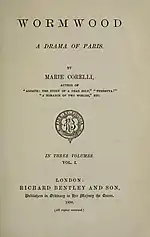
Like Corelli's previous four novels, Wormwood was a popular success but received mixed reviews from critics. Corelli presented the story as a cautionary tale about the dangers of absinthe, and it has been implicated in bans of the spirit which later occurred in Europe and the United States. The book has also been interpreted as a condemnation of the aesthetic and decadent movements.
Summary
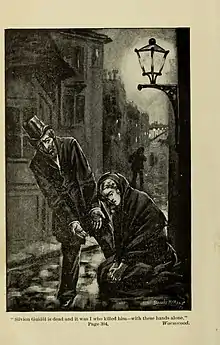
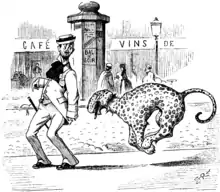
Wormwood is set in Paris and is written in the first person, from the perspective of protagonist Gaston Beauvais, a writer. Beauvais is engaged to be married to Pauline de Charmilles, but shortly before their marriage, she confesses that she has fallen in love with another man, Silvion Guidel, a priest in training. Beauvais turns to alcohol as a result and shows up to their wedding day drunk on absinthe, causing a scene. He turns to drugs and further debauchery with a friend, Gessonex. When he learns that Pauline has run away, he searches for her in the slums of Paris. He comes upon Guidel, and strangles him to death, throwing his body into the Seine river. He finds Pauline and confesses that he has killed Guidel, causing her to also throw herself into the river, from the Pont Neuf bridge. Beauvais slips into unconsciousness, and when he awakens the next day, he finds himself stalked by a hallucinatory leopard. The story ends with Beauvais in the morgue with Pauline's dead body.
Moral themes
Like many of Corelli's novels, Wormwood was intended to shine light on the moral deficits of modern society—in this case, the vices of Paris, particularly in association with the aesthetic and decadent movements.[1] Corelli included an 'Introductory note', observing that "the open atheism, heartlessness, flippancy, and flagrant immorality of the whole modern French school of thought is unquestioned." She ascribed this in part to "the reckless Absinthe-mania, which pervades all classes, rich and poor alike", and warned that this habit might come to infect Britain. An epigraph dedicated the book "à messieurs les absintheurs de Paris, ces fanfarons du vice qui sont la honte et le désespoir de leur patrie" ("to the absinthe-drinkers of Paris, those boasters of vice who are the shame and despair of their homeland").[2]
The novel was said to have contributed to legislation in France and Switzerland relating to alcohol, and Absinthe in particular (see Absinthe § bans).[3] It was also said to be indirectly responsible for a ban on absinthe in the United States—in response to this, Corelli said it was "a great thing to have accomplished, to have saved a noble nation from one of the most malignant curses of modern times".[4]
Scholars have generally interpreted the book as being in opposition to the decadent movement, though it has simultaneously been seen as co-opting decadent tropes to appeal to readers. While the book's protagonist, Gaston Beauvais, has the markings of a decadent writer, Corelli takes pains in her introductory note to distance herself from him. Despite its apparent anti-decadent viewpoint, the book quotes "Lendemain", a poem about absinthe by Charles Cros, a recently deceased decadent poet and absinthe addict, and includes a footnote in which Corelli, in her own voice, praises Cros.[5][6]
Publication
Corelli sent the manuscript for Wormwood to her long-time publisher George Bentley on 12 July 1890. She intended the novel to have a more realist style than her previous works, describing it to Bentley as "a study à la Balzac". Bentley requested that she excise some of the novel's more lurid scenes, such as one of two scenes set in the morgue; privately, he referred to Wormwood in his diary as "this repulsive book of hers". Corelli signed a contract with Bentley on 1 September, receiving £100 as an advance, £300 on publication, and 6 shillings per copy after sales passed 1,500. The book was published in November 1890 in three volumes.[3]
The first edition was, at the direction of Corelli, bound in a pale green binding similar to the colour of absinthe, and featured a serpent on the cover, and red ribbon crisscrossed on the spine, such as was found on absinthe bottles.[6]
It was published in France under the title Absinthe.[1]
A modern edition was published in 2004 by Broadview Press.[7]
Reception
Wormwood was an immediate commercial success, with the first edition selling out in ten days. Though, according to George Bentley, some readers were so scandalised by the book that they were returning it to booksellers.[3]
The novel received mixed reviews from critics. Middlebrow periodicals such as The Graphic, The Literary World, and Kensington Society praised it, finding it simultaneously entertaining and morally salubrious. It received somewhat positive reviews from the more highbrow literary journals The Academy and The Athenaeum, with both praising the story's realism.
Among publications which negatively reviewed the book was the Pall Mall Gazette and The Times.[6] The Times described it as "a succession of tedious and exaggerated soliloquies, relieved by tolerably dramatic, but repulsive incidents", and criticized Corelli's writing as having a "feminine redundancy of adjectives".[3] The Standard described the book as "repulsive". While noting that Corelli attempts to distance herself from being identified with Gaston Beauvais, the book's protagonist, the reviewer questioned the moral and artistic acceptability of an author, particularly a female author, writing from the perspective of a "vicious maniac" such as Beauvais.[8]
Wormwood was parodied in an 1891 issue of Punch, as part of the magazine's "Mr. Punch's Prize Novels" series.[1] The parody, titled "Germfood" and attributed to "Mary Morally", is an account of a Parisian man addicted to marrons glacés (a candied chestnut confection). The piece mocks Corelli's writing style, including her use of archaisms like thou and her solecistic French (for example, it quotes her narrator saying "Nous blaguons le chose."—since chose is feminine, this is grammatically incorrect, and should instead be "Nous blaguons la chose."[lower-alpha 1]). It furthermore sends up Wormwood's melodramatic and lurid plot, with Mary Morally warning "I'll give you fits, paralytic fits, epileptic fits, and fits of hysteria, all at the same time.", and the story ending with the revelation that the narrator has inexplicably died:
The world is very evil. My father died choked by a marron. I, too, am dead—I who have written this rubbish—I am dead, and sometimes, as I walk, my loved one glides before me in aërial phantom shape, as on page 4, Vol. II. But I am dead—dead and buried—and over my grave an avenue of gigantic chestnuts reminds the passer-by of my fate: and on my tombstone it is written, "Here lies one who danced a cancan and ate marrons glacés all day. Be warned!" THE END.[9]
Adaptations
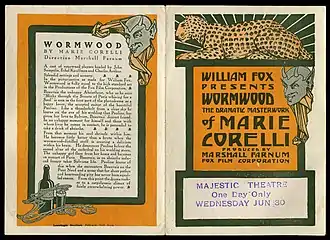
A theatrical adaptation, Wormwood, or the Absinthe Drinkers of Paris, by Charles W. Chase was staged across the United States around 1902–1903 as a temperance play. Chase's adaptation makes a number of modifications to the original story, including changing Silvion Guidel from a priest to a writer, adding the character of Mephisto, and a new scene set in hell.[10] Moreover, unlike the novel, Chase gives his play a happy ending, recasting the story's most dramatic events as a dream sequence.[11]
Wormwood was adapted into a silent film of the same name in 1915 produced by Fox Film.[12]
Notes
- This error occurs on pages 124–125 of the third volume of the first edition. It is corrected in later editions, such as the American edition published by A. L. Burt.
References
- Waller, Philip (2006). Writers, Readers, and Reputations: Literary Life in Britain 1870-1918. Oxford University Press. ISBN 9780198206774.
- Corelli, Marie (1890). Wormwood: A Drama of Paris. Richard Bentley and Son.
- Masters, Brian (1978). Now Barabbas Was a Rotter: the Extraordinary Life of Marie Corelli. London: H. Hamilton.
- "At the Antlers". The Independent-Record. 21 July 1915. p. 5.
- DeCoux, Jessica (2011). "Marie Corelli, Wormwood, and the Diversity of Decadence". Female Aestheticism.
- MacLeod, Kirsten (2006). Fictions of British Decadence: High Art, Popular Writing and the Fin De Siècle. Palgrave Macmillan. ISBN 1403999082.
- Mitchell, Sally (2007). "The Woman Who Did by Grant Allen, and Wormwood: A Drama of Paris by Marie Corelli, and The Story of a Modern Woman by Ella Hepworth Dixon, and The Girl Behind the Keys by Tom Gallon (review)". Victorian Review. 33 (1). doi:10.1353/vcr.2007.0004.
- "Some New Novels". The Standard. 25 November 1890. p. 2.
- Morally (pseudonym), Mary (11 April 1891). "Mr. Punch's Prize Novels—No. XVI.—Germfood". Punch.
- "Marie Corelli's Wormwood". Asheville Citizen-Times. 4 November 1902. p. 3.
- "The Devil in a New Play". The Leaf-Chronicle. 24 January 1903. p. 7.
- "Marie Corelli's Story, "Wormwood" - Tomorrow". The Leavenworth Times. 25 July 1915.
External links
- Marie Corelli's Wormwood – At The Virtual Absinthe Museum: Photographs of the scarce 1890 London first edition, and extensive extracts from the book downloadable in PDF format.
- Wormwood (Authorized American Edition) at the Internet Archive