Xiapei
Xiapei (Chinese: 霞帔; lit. 'Rosy cloud scarf') is a type of Chinese clothing accessory in either the form of a long scarf, a neckband, or in the shape of waistcoat depending on the time period.[1][2] It appeared as early as the Qin dynasty and continues to be worn until now (although the shape of the xiapei evolved with time).[1] In the Ming and Qing dynastyies, the xiapei, along with the fengguan, became the daily clothing of queens and the formal clothing of the wives of senior officials.[1] The xiapei eventually became part of the traditional Chinese wedding attire for commoners.[1]
History
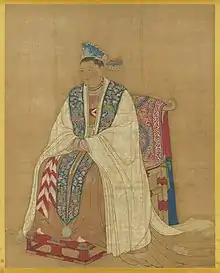
Qin and Han dynasty
The xiapei appears as early as the Qin and Han dynasty and was in the shape of the long, thin-silk scarf.[1]
Wei, Jin, Northern and Southern dynasties.
During the Wei, Jin, Northern and Southern dynasties, the xiapei was known as embroidered collar.[1]
Sui and Tang dynasty
In the Sui and Tang dynasty, the xiapei gained its name due to its beauty like rosy clouds (霞; xia).[1]
Ming dynasty
In the Ming dynasty, the xiapei was a form of long embroidered neckband which was trimmed with gold and lace.[2] It was worn by queens as daily attires and by the wives of senior official as a formal attire.[3][1]
During the Hongwu Period (1368 –1398 AD) of the Ming Dynasty, there were specific regulations on what kind of clothing a woman had to wear based on her social rank:[3]
- Women who were given rank of 1st and rank of 2nd by the Ming emperor had to wear a xiapei which was decorated with golden cloud and pheasant patterns embroidery.[3][1]
- Women who were given the rank of 3rd and 4th had to wear a xiapei which was embroidered with golden cloud and peacock pattern,[1]
- Women who were given the rank of 5th had to wear a xiapei which was embroidered with cloud and mandarin duck pattern,[1]
- Women who were given the rank of 6th and 7th had to wear a xiapei which was embroidered with cloud and magpie pattern,[1]
- Women who were given the rank of 8th and 9th had to wear a xiapei which was embroidered with branch pattern.[1]
The xiapei eventually became part of the wedding attire for commoners.[1]
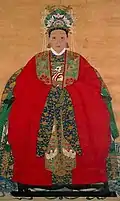 Ming dynasty noblewomen wearing a green embroidered xiapei over her red robe.
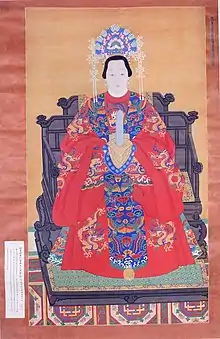 Ming dynasty noblewomen wearing a blue embroidered xiapei over her red robe.
Qing dynasty

In the Qing dynasty, the Ming dynasty xiapei (long scarf) evolved into the Qing dynasty xiapei which was in the form of a sleeveless waistcoat. This waistcoat was made up of 3 pieces:[1]
- The front and back parts which was decorated with the rank badges accordingly to the women's husband ranking, and
- Coloured tassels were decorated the bottom part of the waistcoat.[1]
- The waistcoat-shaped xiapei was tied at the sides, reached below the knee and had a fringed pointed bottom hem.[2]
Similarly to the Ming dynasty, the waistcoat xiapei was worn by the queens as a daily form of attire while the wives of senior official as a formal attire.[1] Throughout the Qing dynasty, Han Chinese women, following the Ming dynasty customs, would wear the xiapei on their wedding day.[4] The xiapei was actually first worn as part of the Wedding attire and after the wedding, it would be worn for special events.[2]
See also
 China portal
 Fashion portal
References
- Yang, Shaorong (2004). Traditional Chinese clothing : costumes, adornments & culture (1st ed.). San Francisco: Long River Press. pp. 32–33. ISBN 1-59265-019-8. OCLC 52775158.
- Lewandowski, Elizabeth J. (2011). The complete costume dictionary. Dan Lewandowski. Lanham, Maryland. p. 319. ISBN 978-0-8108-4004-1. OCLC 694238143.
- Tibberts, Jennifer (2021-01-01). "Investigating How Qipao and Hanfu Dresses are Representative of China". Senior Honors Theses: 1–52.
- Vollmer, John E. (2007). Dressed to rule : 18th century court attire in the Mactaggart Art Collection. Mactaggart Art Collection. Edmonton: University of Alberta Press. p. 46. ISBN 978-1-55195-214-7. OCLC 166687933.
