Muslim Romani people
Muslimansko Roma or Muslimanenge Roma in Balkan Romani language, are Muslims, who adopted Sunni Islam of Hanafi madhab and Culture of the Ottoman Empire, some of them are Derviş of Sufism belief, and the biggest Tariqa of Jerrahi is located at the largest Muslim Roma settlement in Europe in Šuto Orizari. Muslim Roma men are circumcised, the boys are circumcised at the age of 5, because the number 5 (panč) is a sacred symbol among the romani people. Islam among Roma is historically associated with life of Roma within the Ottoman Empire, because Muslim Roma were preferred in the Ottoman Empire and Roma converted to Islam under Ottoman rule. Muslim Roma was settled in Rumelia (Ottoman Balkans) from Anatolia and Ottoman Cyprus. Evliya Çelebi mentioned in his Seyahatnâme book, that Mehmed the Conqueror, after 1453, brought the Muslim Romani from Balat, Didim and Gümülcine to Istanbul, and that they worked as Musicians there.[1] Correspondingly, significant cultural minorities of Muslim Roma are found in Turkey (majority live in East Thrace), Bosnia and Herzegovina, Albania, Montenegro, Kosovo, Republic of North Macedonia, Bulgaria, (by mid-1990s estimates, Muslim Roma in Northern Thrace constituted about 40% of Roma in Bulgaria.[2]), (a very small group of Muslim Roma exists in the Dobruja region of Romania, comprising 1% of the country's Christian Romani population[3]), Croatia (45% of the country's Romani population[4]), Southern Russia, Greece (a small part of Muslim Roma concentrated in Western Thrace), Northern Cyprus, Serbia and Crimea. The majority speak Balkan Romani or Kurbetcha, while many speak only the language from the host country's like Albanian and South Slavic languages, and deny there Romani Background. The majority of Turkish speaking Muslim Roma in Bulgaria and some in Turkey declare themselves to be Turks instead of Roma people. Muslim Roma have a big Genetic influence of intermingling with Turks and Crimean Tatars Y-DNA, because Muslim Roma Woman got children from Turkish and Crimean Tatars Men.[5]
| Part of a series on |
| Romani people |
|---|
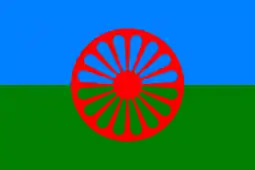 |
|
Romani diaspora by country
|
|
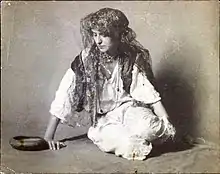
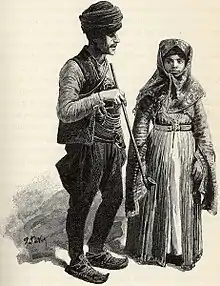
Because of the relative ease of migration in modern times, Muslim Roma may be found in other parts of the world as well. The Muslim Roma also used the word Gypsy for themselves because they didn't perceive it as a derogatory term. Muslim Roma culture is based of the Turkish culture. Under Ottoman Rule, the Christian and Muslim Roma were separated, by the order of Suleiman the Magnificent. Muslim Roma were forbidden to marry Christian Roma.[6] Significant differences between the Muslim and Christian Roma emerged through the centuries. Christian Roma in the Balkans do not consider Muslim Roma to be part of the romani society. The Muslim Roma, however, see themselves as the real original Roma, and see the Christian Roma as foreign, and call them Dasikane (servants, slaves).[7]. There is a huge gap between the two religious groups
After the collapse of the Ottoman Empire, the Muslim Roma have found themselves under double discrimination in regions where Islam was a minority religion, experiencing both Antiziganism and anti-Muslim sentiment.[8]
Horahane Term
Muslim Roma also called Religionym and confessionym as Horahane Roma (also spelled as Khorakhane, Xoraxane, Kharokane, Xoraxai, etc.) and are colloquially referred to as Turkish Roma in the host countries. They are severeal Groups of Horahane Roma, named after their old traditional professional activities, also divived in sedentary and nomadic groups.[9]
Dress
Muslim Roma women wear beautiful silk Dimije also known as Turkish salvar, at weddings, circumcision ceremonies and other festivals. Even on weekdays, quite a few older women, but also some younger women, wear the şalvar.
Dance and Music
Belly dance and Romano Hora (dance), Roman Havaları 8/9 tact, Zurna, Davul, Clarinet are performed, .
References
- "THE GYPSIES OF ISTANBUL | History of Istanbul".
- Gerd Nonneman, Tim Niblock, Bogdan Szajkowski (Eds.) (1996) "Muslim Communities in the New Europe", ISBN 0-86372-192-3
- Ana Oprişan, George Grigore, "The Muslim Gypsies in Romania" Archived 2009-03-05 at the Wayback Machine, in International Institute for the Study of Islam in the Modern World (ISIM) Newsletter 8, September 2001, p.32; retrieved June 2, 2007
- "Archived copy" (PDF). Archived from the original (PDF) on 2007-07-27. Retrieved 2009-02-06.CS1 maint: archived copy as title (link)
- Bánfai, Zsolt; Melegh, Béla I.; Sümegi, Katalin; Hadzsiev, Kinga; Miseta, Attila; Kásler, Miklós; Melegh, Béla (13 June 2019). "Revealing the Genetic Impact of the Ottoman Occupation on Ethnic Groups of East-Central Europe and on the Roma Population of the Area". Frontiers in Genetics. 10: 558. doi:10.3389/fgene.2019.00558. PMC 6585392. PMID 31263480.
- https://rm.coe.int/ottoman-empire-factsheets-on-romani-history/16808b193d
- https://amalipe.bg/en/roma-groups/ |titel=ROMA GROUPS | Център за междуетнически диалог и толерантност АМАЛИПЕ
- Peter G. Danchin, Elizabeth A. Cole (Eds.) (2002) "Protecting the Human Rights of Religious Minorities in Eastern Europe", ISBN 0-231-12475-9
- "Roma – Sub Ethnic Groups [Rombase]".
Further reading
- Roma Muslims in the Balkans by Elena Marushiakova and Vesselin Popov
- Dialect of Xoraxané Roma (in Italian)
- Romá by Leonardo Piasere