Yiddish symbols
A number of Yiddish symbols have emerged to represent the language and the Yiddishist movement over history.[1] Lacking a central authority, however, they have not had the prominence of those of the Hebrew revival and the Zionist symbols of Israel. Several of the Yiddish symbols are drawn from Yiddish songs in the klezmer tradition.
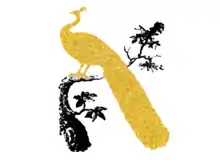
"Di Goldene Pave" popularized the symbol of the golden peacock,[2] and "Raisins and Almonds" that of a goat, echoing that in Chad Gadya.[3] The golden peacock has been a subject of Yiddish poetry, including a collection under that title from Moyshe-Leyb Halpern. The Forward uses gold in its masthead (also recalling Di Goldene Medine),[4] and the Yiddish Book Center uses a golden goat.[5]

"Oyfn Pripetshik" highlights komets-alef as a distinctive letter in Yiddish orthography, in a play on a Yiddish alphabet song. This particular letter (אָ) is also used to represent Yiddish on Duolingo,[1] replacing a "Yiddish flag" on the pattern of the flag of Israel but in black with a menorah, promoted by a user from Wikimedia Commons which was used for a time in the Duolingo Incubator.[6]
See also
References
- Cherney, Mike (2021-04-08). "Designing a Flag for Yiddish Takes Chutzpah". Wall Street Journal. ISSN 0099-9660. Retrieved 2021-04-19.
- Fonda, Batya. "The Golden Peacock". Jewish Folk Songs. Retrieved 2021-04-19.
- Fonda, Batya. "One Only Kid". Jewish Folk Songs. Retrieved 2021-04-19.
- Stern, Phil (2015-04-19). "A Forward for the Inquisitive Reader". The Forward. Retrieved 2021-04-19.
- "Why a Goat?". Yiddish Book Center. Retrieved 2021-04-19.
- Schulman, Sebastian (2015-06-15). "What Flag Should Yiddish Fly?". The Forward. Retrieved 2021-04-19.