Yuri Shvets
Yuri Borysovych Shvets (Russian: Юрий Борисович Швец, Ukrainian: Юрій Борисович Швець, born 16 May 1952) was a Major in the KGB between 1980 and 1990. From April 1985 to 1987, he worked in the Washington, D.C. Rezidentura of the First Chief Directorate.[1] While there, he held a cover job as a correspondent for TASS, a Soviet state-owned news agency.[2]
Yuri Shvets | |
|---|---|
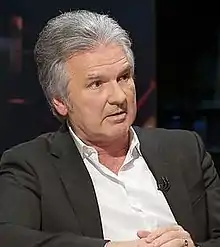 | |
| Born | Yuri Borysovych Shvets 16 May 1952 |
| Citizenship | American |
| Alma mater | Patrice Lumumba Peoples' Friendship University Academy of Foreign Intelligence |
| Espionage activity | |
| Allegiance |  Soviet Union Soviet Union |
| Agency | KGB |
| Service years | 1980–1990 |
| Rank | Major |
| Other work | His YouTube channel |
Biography
Shvets graduated in International Law from the Patrice Lumumba Peoples' Friendship University (now the Peoples' Friendship University of Russia). He also graduated from the Academy of Foreign Intelligence,[3] where he studied alongside Vladimir Putin.
Shvets reportedly recruited two key sources of political intelligence whom he referred to as "Sputnitsa", a journalist working in Washington, and "Socrates", a former aide to President Jimmy Carter with strong ties to Greece. In his 2005 book Spy Handler: Memoir of a KGB Officer, Victor Cherkashin alleges that "Socrates" was John Helmer[4] and Sputnitsa the late New Statesman journalist Claudia Wright.[5]
Move to America
After publishing a book describing his exploits and ultimate falling out with the KGB, Shvets was banned from foreign travel. In 1993, he moved permanently to the United States, where he later gained citizenship.[2]
Shvets was a key source for the book American Kompromat by Craig Unger.[2][6]
Involvement with Alexander Litvinenko
In 2006, Shvets emerged as a potentially key witness in the poisoning of ex-Federal Security Service officer Alexander Litvinenko. In an interview with the BBC, broadcast on 16 December 2006, Shvets said that he and Litvinenko had compiled a report investigating the activities of senior Kremlin officials on behalf of a British company looking to invest "dozens of millions of dollars" in a project in Russia. Shvets said the dossier about Sergei Ivanov was so incriminating, it was likely that Litvinenko was murdered because of it.[7] He said that Litvinenko had shown the dossier to another business associate, Andrei Lugovoi, who had worked for the FSB and had passed the dossier to his superiors in Moscow. Shvets was interviewed about it by Scotland Yard detectives investigating Litvinenko's murder.[8]
References
- "Book Discussion on Washington Station: My Life as a KGB Spy". C-SPAN. 14 April 1995. Retrieved 16 November 2015.
- Smith, David (29 January 2021). "'The perfect target': Russia cultivated Trump as asset for 40 years – ex-KGB spy". The Guardian. Guardian Media Group. Retrieved 29 January 2021.
- Dvali, Natalia (28 April 2015). "Сокурсник Путина, экс-разведчик КГБ: Вы серьезно думаете, что Путин, делающий подтяжку лица, развяжет ядерную войну? У него от страха ботокс потечет" [Putin's classmate, ex-KGB spy: Do you seriously think that Putin doing a facelift will unleash a nuclear war? He will have botox flow from fear]. Gordon (in Russian). Retrieved 2 June 2015.
- Wick, Daniel L. (12 March 1995). "Another Ex-KGB Spy Spills the Beans / Yuri B. Shvets claims he recruited a former Carter adviser". SFGate. Retrieved 16 November 2015.
- Feifer, Gregory; Evans, Michael (3 January 2005). "MI6 double agent was 'betrayed by a journalist'". The Times. News UK. Retrieved 28 January 2007.
- How to stop Russia from recruiting the next Trump, by Frank Figliuzzi, MSNBC
- Видео №5. Встреча в Женеве и ответы на вопросы., Jun 15, 2021
- "Litvinenko 'killed over dossier'". BBC News. 16 December 2006.
External links
- His YouTube channel
- Booknotes interview with Shvets on Washington Station: My Life as a KGB Spy in America, 18 June 1995.
Authority control  | |
|---|---|
| General | |
| National libraries | |
| Other | |