ZZT
ZZT is a 1991 action-adventure puzzle video game and game creation system developed and published by Potomac Computer Systems for MS-DOS. The game was later released as freeware in 1997. It represents an early example of a game that allowed players to edit using object-oriented programming. Players control a smiley face to battle various creatures and solve puzzles in different grid-based boards within a chosen world. It includes an in-game editor, allowing players to develop their own worlds while using the game's scripting language, ZZT-OOP.
| ZZT | |
|---|---|
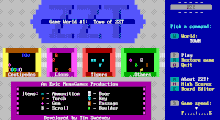 Title screen of "Town of ZZT" | |
| Developer(s) | Potomac Computer Systems |
| Publisher(s) | Potomac Computer Systems |
| Designer(s) | Tim Sweeney |
| Platform(s) | MS-DOS |
| Release | |
| Genre(s) | Action-adventure, game creation system, puzzle |
| Mode(s) | Single-player |
The game was designed by Tim Sweeney and took roughly nine months to develop. The game was built from a text editor, that he experimented with to add creatures and bullets. After positive reception from his friends and neighbours, he went on to release the game publicly as shareware.
ZZT was considered a commercial success, leading Sweeney to change his company's name to Epic MegaGames. ZZT was followed by a sequel, Super ZZT, in 1992. Other ZZT worlds were published later as Best of ZZT and ZZT's Revenge. Epic MegaGames later developed other successful games including Jill of the Jungle (1992) and Unreal (1998). An active modding community has grown around the game through making new worlds and editing tools.
Gameplay
ZZT is a top-down action-adventure puzzle video game and game creation system. Players control a white smiley face on a navy-blue rectangle that can move around in four directions.[2] Players can interact with objects by touching or shooting at them. Touching ammo containers, gems, torches, and keys adds them to your status bar. Boxes of ammo allow players to fire bullets at objects, gems increase health and are used as currency, torches light up a small area around the player in dark boards, and colored keys allow players to open same-colored doors. Other objects in the game includes bombs, doors, and scrolls. One type of object called "Object" interacts based on written scripts using the game's scripting language, ZZT-OOP. As an example, the object could be programmed to give the player health, or fire bullets at the player. At any time, players can save their progress, and return to the game's exact state.
Game worlds are made up of objects within grid boards that connect to each other. Players can move across different boards by either reaching the edge of the board or entering teleporters. Four game worlds were made for the game's release, and each starts in a unique way.[3] Town of ZZT starts in a hub world with four buildings mixed with six exits, Caves of ZZT opens with a sparse area of torches and a scroll, Dungeons of ZZT starts with a linear opening sequence with gates that lock you inside, and City of ZZT opens with a city street as a hub with a few structures. The goal of these worlds is to reach the end board, progressing either by collecting purple keys, or objects throughout the world.[4] Boards can contain action and/or puzzles. Action boards have the player face off against enemies. Enemies include lions, tigers, and bears. When enemies, bullets, or stars touch the player, they lose health. Once the player runs out of health, the game ends. Puzzles consist of untangling combinations of boulders, sliders, and pushers, or mazes sometimes including invisible walls and teleporters. Some puzzles can trap the player, leading players to require a return to a previous save. ZZT also includes an in-game editor, allowing players to make their own worlds.
Development

Video game programmer Tim Sweeney, at the time attending the University of Maryland, first developed ZZT as a text editor that ran in Pascal.[5] During this time, Tim did not know how to program graphics and only had a 286 computer and a Model M keyboard.[6][7][8] The text editor idea came from disliking the included editors for the programming languages he tried on his PC. Instead he wanted to recreate his previously made Pascal-like programming environment for the Apple II.[9] Over time, he experimented with adding collision to text characters, and making the cursor the character, and found it more fun to make it into a game. From there, he designed his first levels from text files that served as different boards, and continually offering additions to the game and editor over time. Given the graphics were dated for its time, he could came up with ideas such as talking trees or interesting characters, without concerns about breaking immersion. Most of these additions were his own, but occasionally took ideas from Kroz, such as the bomb. The game took around nine months to develop, taking under 1,000 hours of time spent developing, and around 20,000 lines of Pascal code to make.
He then shared it with friends and neighbourhood kids, observing and taking notes of how thy responded to the game. From seeing the joy and excitement from others plying his game, he found making games as a way to share something with the world, and as a way to make more income instead of his former business of mowing lawns for neighbours or wage labour. The game's episodic model took inspiration from Apogee's shareware model, where Sweeney encouraged the spread of the game across shareware vendors, user groups, and bulletin board systems.[2] During development, he also wrote to Scott Miller for advice and to learn more about the industry. Miller responded while also offering him encouragement.[10] Tim chose the name so it would be listed last alphabetically in shareware catalogs and on bulletin board systems, though a fan later suggested the backronym of "Zoo of Zero Tolerance", which Sweeney endorsed.[11] ZZT was released in January 15, 1991.[1] Town of ZZT alongside the in-game editor would be distributed freely, while the other official worlds would normally be sold by mail order to receive a single floppy disk including the purchased worlds, and drawn maps of each of the worlds.[12] At one point, City of ZZT was also distributed as ZZT's City, through Softdisk's On Disk Monthly service.[13] The along with other ZZT games were later released as freeware on October 10, 1997.[14]
Reception
Sales
Following ZZT's release, the game sold about three to four copies daily, selling around 800 copies of ZZT by November 1991,[1] and around 4,000 to 5,000 copies in total by 2009.[5] This gave Sweeney around $100 a day by November 1991, and made around $30,000 from ZZT by May 1999, of which most of the profit came from its first year.[1][15][16] After Sweeney moved out of his parents' house to establish proper corporate headquarters for Potomac Computer Systems, then renamed Epic MegaGames, his father, Paul Sweeney, continued fulfilling mail orders to the original address under the "Epic Classics" label, allowing for purchase of physical copies of ZZT.[12] The final copy of ZZT was shipped to game designer Zack Hiwiller in November 2013.[12]
Around 1992, after the custom world design contest, copies of the ZZT's Revenge collection was on sale with Best of ZZT shipped with it for free.[17]
Computer Gaming World billed ZZT as the first major video game to use object-oriented programming.[18]
Legacy
Upon getting $100 a day from ZZT, Sweeney was convinced he could earn enough from the shareware industry, and moved towards the gaming industry.[5] He renamed the company to Epic MegaGames on October 1991.[16] Around this time he began hiring some of thte winners of the world design contest.[1] Sweeney collaborated with programmer Allen Pilgrim on creating a sequel to ZZT called Super ZZT, which added more features and levels to ZZT's core gameplay. The game plays similarly to ZZT, and incorporates floor textures, a different gameplay menu, prefabricated enemies and objects, and scrolling map screens, allowing for much larger worlds than in ZZT. Although Super ZZT incorporated multiple additions to ZZT, it never caught on with the ZZT community like the original ZZT did, and very few games were ever created for Super ZZT.[9] Shortly after the release of ZZT, Sweeney started a level designer contest for registered users to make their own worlds and submit them to him.[19] Over 200 users submitted their custom worlds. The best collaboration games that won the contest were included in The Best of ZZT and ZZT's Revenge. The winners of the contest received prizes of gift certificates. The six winning custom worlds that made up ZZT's Revenge earned the designers employment in Epic MegaGames. Other contestants got honorable mentions for good entries.[17] Around 1992, Sweeney started a contest titled "ZZTaholics Challenge" for players to play any of the ten volumes from ZZT, ZZT's Revenge and Super ZZT, then submit their high scores. The winners received discount coupons to get the next two releases from Epic MegaGames for free.[20]
Upon publishing Best of ZZT and ZZT's Revenge, Sweeney realized the community began creating worlds that reached or exceeded the quality of his work.[15] He also believed that games with cutting edge graphics and sound similar in commercial quality to Super Nintendo or Sega Genesis games would sell more in the shareware model, taking influence from Commander Keen and Duke Nukem.[16] As such, he moved away from ZZT indefinitely to work on other projects like Jill of the Jungle. Sweeney and Mark Rein later credited that much of the core idea of Unreal came from what Sweeney learned from the success of ZZT, with a focus on building games with clean code and editing tools, so that others can build their own games.[6][15]
Many fan-made worlds and editing tools were created following the game's release, with a fan website, Museum of ZZT, devoted to archiving and curating game worlds and utilities made by users. As of 2021, more than 3,000 worlds have been created and archived, whether made using the built in editor, or third party editors such as KevEdit.[21] Tim Sweeney has claimed that tens of thousands of workers in the game industry have previously made worlds in ZZT.[22] A source port called "Zeta" allowed for playing ZZT games on Microsoft Windows or a web browser, while another source port, "DreamZZT", attempted ports to consoles, specifically the Sega Dreamcast and Nintendo DS.[23] Worlds continue to be developed that have expanded beyond its intended genre, creating shoot 'em ups, falling block puzzle games, and complex role-playing games.[24] While the source code of ZZT was lost in a crash,[5][10] a community developer, Adrian Siekierka, reconstructed and released the source code in 2020, creating a binary accurate executable of ZZT with permission of Sweeney.[25][26] Other games have been inspired by ZZT, such as MegaZeux, and Frog Fractions 2, and has encouraged authors of ZZT worlds to become video game developers.[2][27]
Further reading
- Anthropy, Anna (2014). ZZT. Boss Fight Books. ISBN 978-1-940535-02-9.
References
- Dr. Dos (January 15, 2021). "ZZT and Epic Newsletter Scans". Museum of ZZT. Retrieved January 15, 2021.
- Anthropy, Anna (2014). ZZT. Los Angeles, CA: Boss Fight Books. ISBN 978-1-940535-02-9. OCLC 887992348.
- Dr. Dos (July 22, 2018). "Closer Look: Caves of ZZT". Museum of ZZT. Retrieved December 3, 2021.
- Dr. Dos (June 19, 2017). "Closer Look: City of ZZT - Museum of ZZT". Museum of ZZT. Retrieved December 3, 2021.
- Edwards, Benj (May 25, 2009). "From The Past To The Future: Tim Sweeney Talks". Gamasutra. Retrieved March 27, 2018.
- Conditt, Jess (March 20, 2019). "Epic Games has 250 million 'Fortnite' players and a lot of plans". Engadget. Retrieved December 13, 2021.
- Totilo, Stephen (July 12, 2011). "The Quiet Tinkerer Who Makes Games Beautiful Finally Gets His Due". Kotaku. Retrieved December 3, 2021.
- Boudreau, Ian (April 5, 2020). "When it comes to keyboards, Tim Sweeney sticks with the classics". PCGamesN. Retrieved December 14, 2021.
- Hercules (November 17, 2000). "Hercules meets Tim Sweeney". DigitalMZX. Retrieved March 28, 2018.
- Sweeney, Tim. "The Official ZZT Home Page". Epic Games. Archived from the original on October 10, 1999.
- Sweeney, Tim (1992). "Epic MegaGames Newsletter - Spring 1992". Museum of ZZT. Epic MegaGames. p. 2. Retrieved March 28, 2018.
- Pitcher, Jenna (November 21, 2013). "Epic Classics ships last copy of ZZT". Polygon. Retrieved March 28, 2018.
- Dr. Dos (October 15, 2019). "Closer Look: ZZT's City + Interview With Stuart Hardwick". Museum of ZZT. Retrieved December 15, 2021.
- "News Update". Epic MegaGames. October 10, 1997. Archived from the original on February 14, 1998. Retrieved December 15, 2021.
- Bovelander, Wouter (May 25, 1999). "Tim Sweeney -- interview". Planet ZZT++. Archived from the original on October 11, 2000. Retrieved December 3, 2021.
- Dr. Dos (February 15, 2021). "The Epic Mega Haul". Museum of ZZT. Retrieved December 13, 2021.
- Sweeney, Tim (1992). "Epic MegaGames Newsletter - Spring 1992". Museum of ZZT. Epic MegaGames. p. 3. Retrieved March 28, 2018.
- Circle Reader Service #12 (July 1991). "Taking a Peek" (PDF). Computer Gaming World. No. 84. p. 78.
- Sweeney, Tim (1992). "Epic MegaGames Newsletter - Spring 1992". Museum of ZZT. Epic MegaGames. p. 1. Retrieved March 28, 2018.
- Sweeney, Tim (1992). "Epic MegaGames Newsletter - Spring 1992". Museum of ZZT. Epic MegaGames. p. 2. Retrieved March 28, 2018.
- Dos, Dr. "Closer Look: Modern ZZT Editing With KevEdit - Museum of ZZT". museumofzzt.com. Retrieved April 17, 2018.
- Takahashi, Dean (January 20, 2012). "Epic's 3D graphics wizard Tim Sweeney says business and technology are "intricately linked" (interview)". VentureBeat. Retrieved December 17, 2021.
- Carless, Simon (2004). Gaming Hacks (1st ed.). Sebastopol, CA: O'Reilly. p. 67. ISBN 9780596007140. OCLC 326649266.
- Kohler, Chris (October 12, 2005). "Chapter 8, Playing at Game Design". In Jepson, Brian (ed.). Retro Gaming Hacks: Tips & Tools for Playing the Classics. Sebastopol, CA: O'Reilly Media, Inc. p. 441. ISBN 978-1-4493-0390-7.
- Gipp, Stuart (March 17, 2020). "ZZT's source code has been reconstructed - Reconstruction of ZZT is a game-changer for the ZZT community". retronauts.com.
- Siekierka, Adrian (August 4, 2020). "ZZT Stories: The Reconstruction". blog.asie.pl.
- Graft, Kris (February 20, 2018). "Frog Fractions 2 ARG co-creator reflects on what makes a good alternate reality game". Game Developer. Retrieved December 14, 2021.
External links
- Official website at the Wayback Machine (archived January 26, 2002)
- ZZT at MobyGames
| Games |
| ||||||||||||
|---|---|---|---|---|---|---|---|---|---|---|---|---|---|
| Subsidiaries |
| ||||||||||||
| People |
| ||||||||||||
| Technology | |||||||||||||
| Related | |||||||||||||
 Category Category | |||||||||||||
Authority control: National libraries  |
|---|