Zheng Ji (biochemist)
Zheng Ji (Chinese: 郑集) (6 May 1900 – 29 July 2010) also known as Libin T. Cheng (his last name was spelled as Cheng in the Wade-Giles system before Pinyin was used to spell the names of Chinese people and places),[1] was a Chinese nutritionist and a pioneering biochemist. He was reputed to be the world's oldest professor and the founder of modern nutrition science in China, having lived to the age of 110.
Zheng Ji | |
|---|---|
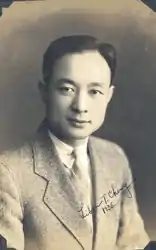 Zheng Ji in 1935 | |
| Born | 6 May 1900 |
| Died | 29 July 2010 (aged 110 years, 84 days) |
| Education | National Southeastern University, National Central University, Nanjing University, Ohio State University, Yale, Indiana University |
| Occupation | Nutritionist and professor of biochemistry, institute founder, tutor |
| Known for | Scientific Research Institute of China, Biology Professor and department head at Central Medical School, Eastern China Military School, Professor of Biology and head of biochemistry Nanjing Medical University |
Early life and education
Libin T. Cheng was born in Nanxi County, Sichuan Province, China. In 1924 Zheng Ji passed the entrance exam for the National Southeastern University (originally known as the Nanjing Advanced Normal School and renamed the National Central University in 1928, and then the Nanjing University)and studied at the biology department. In 1930 he went to America to study, majoring in biochemistry at Ohio State University and earned his M.S. in 1931.[2] He also attended Yale and Indiana University, and obtained his PhD from Indiana University in 1934.[3] In the same year, he was elected to membership of the Sigma Xi Society based on his research achievement and potential.
Career and Achievements
As early as 1931, Cheng became a member of the American Branch of The Science Society of China [4] and had his co-authored research paper “Motor Localization on the Cerebral Cortex of the Guinea-pig (Cavia Cobaya)” published in The Journal of Comparative Neurology.[5] Returning to China in 1934, Cheng “took charge of establishing the Department of Physiological Chemistry in the Biological Laboratory of the Science Society of China” [6] He successively served both as a professor and the director of the Department of Biochemistry in the Medical School of National Central University. Simultaneously, he taught at the Eastern China Military Medical School and at the Number 4 Military Medical College. Since 1950, Cheng had worked both as a biology professor and the head of the Department of Biochemistry department at the Nanjing Medical University.
In 1945, at the Medical School of National Central University, he established a biochemistry research institute to train graduate students. This was the first formal organization in China to teach biochemistry to graduate students, training a large number of students who went on to work in a variety of fields. After turning 70 he began to study the biochemistry of old age, proposing a theory of metabolic imbalance, forming the basis of geriatric biochemistry in China.
He participated in the establishment of the Chinese Nutrition Society and, later on, the Biochemistry Society. He was a past chairman of the Central University Professors Association and the first council chair of the Chinese Nutrition Society. He had written many teaching materials and writing textbooks. Some of his textbooks are still in use, such as 《普通生物化學》( General Biochemistry).
After the age of 100, he still taught and wrote books. He received many honorable certificates and awards in China and abroad. In 2010, Dr. E. Gordon Gee, president of The Ohio State University visited Zheng(Cheng) in Nanjing.[7] Zheng turned 110 in May 2010 and at the time was claimed to be the oldest professor living in the world.[8] He spent the greater part of his life teaching at the medical school and biology department of Nanjing University. He died on 29 July 2010.[9] He was list as one of the great minds in China’s biophysics in the older generation of biophysicists in China.[10]
Personal life
In 1935, Cheng married Rongfang Zhu (1914-2002), a librarian. They have two daughters, one in New York and the other in Canberra, and a son who lives in Beijing.
Awards and honors
- 《普通生物化学》(General Biochemistry), 2007,获全国优秀教材二等奖[11]
- 21st-Century Award for Achievement, International Biographical Centre of Cambridge, England, 2003 [12]
- International Man of the Year of 1992-1933 from the International Biographical Centre of Cambridge, England, 1993
- 《中国早期生物化学发展史》(The History of Early Development of Biochemistry in China)The second prize for the excellent books by university presses in East China, 1990
- 《健康长寿之路》(The Road to Health and Longevity), 1987, 第二届全国优秀科普作品一等奖[13]
- 《衰老与抗衰老》(Aging and Anti-Aging)1987,第二届全国优秀科普作品二等奖][14]
- A golden key fob from Sigma Xi, 1934
Selected Publications
Books
- 《最好的醫生是養生》(The Best Doctor is Health Preserving), 2010, 江苏教育出版社[15]
- 《不老的智慧》(The Wisdom of Immortality), 2010, 四川辭書出版社[16]
- 《不老的技術:百歲教授養生經》(Immortal Technology: the 100-year-old Professor Talking about Health Maintenance), 2008, 高寶國際出版社[17]
- 《普通生物化學》(General Biochemistry) '’),2007, 高等教育出版社出版的圖書[18]
- 《健康长寿之路》(The Road to Health and Longevity),1987[19]
- 《衰老与抗衰老》(Aging and Anti-aging), 2001,香港三聯書店[20]
- 《實用營養學》 (Practical Nutrition) 1964, 正中書局 [21]
- A Laboratory Manual of Biochemistry, 1939, Nat'l Central Univ. Med. Coll. Dep't of Biochemistry[22]
- Are the So-called Poisonous Food-combinations Really Poisonous?,1936, Nanking, Science Society of China[23]
- A Preliminary Note on the Epithelium and Its Adjacent Structures of the Fish's Stomach in Spring and Winter,1931, Nanking, Science Society of China[24]
Articles
- “Biochemical Education In China: Past and Present” 1986 [25]
- “A Simple Dark Adaptometer” (1946), Chinese Medical Journal, 63A, pp188–190, American Psychological Association[26]
- “A Note on the Vitamin C Content of Some Dried, Sugared and Salted Chinese Vegetables and Fruits" (1939), The Biological Laboratory of the Science Society of China, Zoological Series, v. 13, no. 7, Science Society of China[27]
- “Are the So-called Poisonous Food-combinations Really Poisonous?” (1936), Issue 3 of Biochemical publication, Science Society of China Biological Laboratory, Volume 11. Science Society of China Biological Laboratory
- “Lipoid Content" P. 241 (1931)[28]
References
- [file:///C:/Users/Zoe/Downloads/ARV-BOT-MIN-1930-1931.pdf]
- IU•CHEMISTRY Association of Indiana University Chemists Alumni Journal
- [File 3-1: Correspondence, meeting manual, lists of members, Charter(221 pages), 1930 - 1934 | HOLLIS for (harvard.edu)]
- Wiley Online Library
- A 110-year-old wise man: Professor Libin T. Cheng, one of the founders of biochemistry and nutrition in China
- President Gee Travels to China to Promote OSU's Global Diversity
- "World's oldest professor turns 109". China Central Television. 7 May 2009.
- "Nanjing: World's oldest professor, who kept working after 100, passes away". news.cn (in Chinese). 30 July 2010. Archived from the original on 13 February 2017. Retrieved 15 August 2010.
- Great minds in China’s Biophysics
- 获全国优秀教材二等奖
- http://tech.sina.com.cn/other/2004-03-19/0817335948.shtml[ 百岁老教授郑集获21世纪世界最有成就奖
- 当年的56位大师级人物中还有一位至今仍然健在,他就是已经活了111岁的郑集教授。
- 香港出版品: 醫藥保健 > 日常保健
- University of Wisconsin-Madison Libraries
- [iPac2.0 (library.sh.cn)]
- Center for Research Libraries-GLOBAL RESOURCE NETWORK\
- for Research Libraries-GLOBAL RESOURCE NETWORK\
- Biochemical Education In China: Past and Present| LIBIN T CHENG
- APA PsycNet
- Center for Research Libraries-GLOBAL RESOURCE NETWORK
- Quarterly Cumulative Index Medicus July-December 1931: Vol 10 Index