National Anthem of Zimbabwe
The National Anthem of Zimbabwe, also known by its incipit "Simudzai Mureza wedu WeZimbabwe" (English: "O lift high, high, our flag of Zimbabwe"; Northern Ndebele: "Kalibusiswe Ilizwe leZimbabwe"), is the national anthem of Zimbabwe.
| English: "O lift high, high, our flag of Zimbabwe" | |
|---|---|
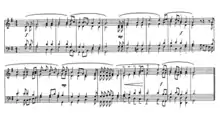 Official sheet music, as printed in the Constitution of Zimbabwe | |
National anthem of  Zimbabwe Zimbabwe | |
| Also known as | Shona: "Simudzai mureza we Zimbabwe" Northern Ndebele: "Kalibusiswe Ilizwe leZimbabwe" |
| Lyrics | Solomon Mutswairo, 1993 |
| Music | Fred Changundega, 1993 |
| Adopted | March 1994 |
| Preceded by | "Ishe Komborera Africa" |
| Audio sample | |
"Simudzai Mureza wedu WeZimbabwe" (instrumental)
| |
History
| National anthems of Zimbabwe | ||||||||||||||||||||
|---|---|---|---|---|---|---|---|---|---|---|---|---|---|---|---|---|---|---|---|---|
|
||||||||||||||||||||

.svg.png.webp)
.svg.png.webp)
.svg.png.webp)
.svg.png.webp)
It was introduced in March 1994 after a nationwide competition to replace the South African-derived "Ishe Komborera Africa" with a distinctly Zimbabwean song. The winning entry was a Shona song written by Professor Solomon Mutswairo and composed by Fred Changundega.
It has been translated into English and Ndebele, the two other main languages of Zimbabwe.
The Ndebele version is mainly sung in the Matebeleland regions of Zimbabwe, while the English version is not commonly sung. Some schools in Matabeleland South have introduced the Sotho/Tswana version.
Lyrics
Because Zimbabwe has 16 national languages, the lyrics of the original Shona song were translated into the other fifteen national languages as part of the 2013 Constitutional Reforms. The official texts were laid out in the 2013 Constitution, however the final English text in the Constitution varied from the more poetic and metrical version which had been in common usage up to that point, and remains so today. Both the new official text and the more common variant are listed below.
In spite of all the translations being official and of equal standing according to the Constitution, the Shona and Ndebele versions remain the two most prevalent variants in regular usage.
| English (official)[1] | English (unofficial, poetic) | Shona[2] | Ndebele[3] |
|---|---|---|---|
I |
I |
I |
I |
| Chewa[4] | Chibarwe[5] | Kalanga[6] | Koisan[7] |
|---|---|---|---|
I |
I |
I |
I |
| Nambya[8] | Ndau[9] | Shangani[10] | Sotho[11] |
|---|---|---|---|
I |
I |
I |
I |
| Tonga[12] | Tswana[13] | Venda[14] | Xhosa[15] |
|---|---|---|---|
I |
I |
I |
I |
See also
References
- Constitution of Zimbabwe (English), WIPO Lex
- Constitution of Zimbabwe (Shona), kubatana.net
- Constitution of Zimbabwe (Nedebele), kubatana.net
- Constitution of Zimbabwe (Chewa), kubatana.net
- Constitution of Zimbabwe (Chibarwe), kubatana.net
- Constitution of Zimbabwe (Kalanga), kubatana.net
- Constitution of Zimbabwe (Koisan), kubatana.net
- Constitution of Zimbabwe (Nambya), kubatana.net
- Constitution of Zimbabwe (Ndau), kubatana.net
- Constitution of Zimbabwe (Shangani), kubatana.net
- Constitution of Zimbabwe (Sotho), kubatana.net
- Constitution of Zimbabwe (Tonga), kubatana.net
- Constitution of Zimbabwe (Tswana), kubatana.net
- Constitution of Zimbabwe (Venda), kubatana.net
- Constitution of Zimbabwe (Xhosa), kubatana.net
- The Zimbabwe National Anthem: Shona, Ndebele and English, © Government of the Republic of Zimbabwe, 1993
- National Anthem of Zimbabwe Act, 1995 (Chapter 10:15)
External links
- Zimbabwe: Blessed be the Land of Zimbabwe - Audio of the national anthem of Zimbabwe, with information and lyrics
- Kalibusiswe Ilizwe leZimbabwe/Simudzai Mureza wedu WeZimbabwe/Blessed be the Land of Zimbabwe MIDI file
Authority control  |
|---|