Zone for Employment and Economic Development (Honduras)
Zone for Employment and Economic Development (Spanish: Zonas de empleo y desarrollo económico, or ZEDE) is the name of a new type of administrative division in Honduras (colloquially called a model city) that is subject under the national government and provides a high level of autonomy with its own political system, at a judicial, economic and administrative level.[1][2]
Cities will be created with the intention of attracting investment and generating employment in currently uninhabited parts of the country, or in municipalities that agree to be converted into ZEDE zones. Every zone will de facto be governed by a technical secretary,[3] elected by a committee that will oversee the adoption of best practices.[4] The committee is in its turn appointed by the president of Honduras, in accord with the organic laws[5] that regulate these zones. The inhabitants will be able to interact with each other voluntarily.
The ZEDE is not unique. Other successful free trade zones can be found in China (Hong Kong, Shenzhen, Shanghai, Macao), in South Korea (Songdo), and in Singapore.
Objectives
ZEDE has the following objectives for economic development:[6]
- International logistics centres that permit the processing of goods at a grand scale (such as the Colón Free Trade Zone in Panamá).
- International business courts that resolve disputes between both national and foreign business entities (such as the Isle of Man, United Kingdom).
- Special investment districts that permit the creation of centres for the service sector (such as the Cayman Enterprise City, Cayman Islands).
- Districts for renewable energy that permit investment in renewable energy (such as the solar parks in Arizona, United States).
- Special economic zones in which the laws that govern the economy will be different from the rest of the country. National laws might be suspended in favor of solutions based on a free market. Compare Shenzhen, China.
- Zones subject to a special judicial system that function under a judicial tradition different from the usual (such as the courts in the financial districts of Dubai that are subject to Common Law).
- Special agro-industrial zones that permit incentives for exporting high-quality agricultural products (such as the cultivation of asparagus in Peru).
- Special tourist zones that permit special conditions for creating centres for tourism in undeveloped parts of the country.
Projected impact
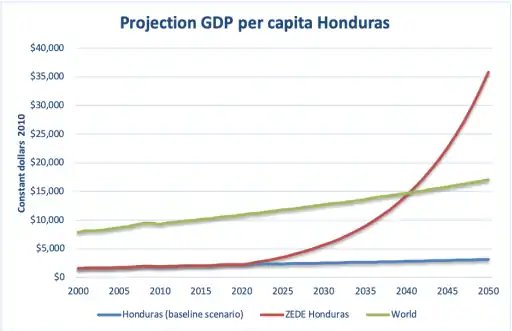
Recently, economists at the Universidad Francisco Marroquín conducted an economic impact analysis examining how ZEDEs might impact the Honduran economy. They found that a ZEDE which resembles the growth rates of China's Special Economic Zones would reach $36,000 GDP per capita by 2050.[7]
Current ZEDEs
List may be incomplete or out of date.
- Próspera - Technology and Services ZEDE. Located next to the village of Crawfish Rock on the Island of Roatan.[9] Prospera's Laws allow for expansion along coastal Honduras. On March 18, 2021 they confirmed the addition of an area near the Satuye area of La Ceiba, labeled as "Port Satuye".[10]
- Ciudad Morazán - Low Income Manufacturing (Maquila) Employee Community and Industrial Zone. Located near the city of Choloma in the Department of Cortes.[11] Phase 1 of the development will entail in a gated low-income housing project. Phase 2 will create manufacturing areas within the gated community.
- ZEDE Orquídea,[12] in Choluteca - For the agricultural industry with the parent company Agroalpha. Located at Las Tapias in the municipality of San Marcos de Colon. Agroalpha will construct a large greenhouse for cultivation of produce for foreign exports. ZEDE Orquídea has adopted the common law of the State of Delaware as its applicable private law.[13]
Potential candidates and failed ZEDEs
- Unnamed Peña Blanca ZEDE - Originally proposed as the first ZEDE with a focus in the agricultural sector.[14] Peña Blanca was selected for its location near the agricultural and manufacturing region of Valle de Sula. The project ultimately failed to receive local support.
- Unnamed Suyapa ZEDE - Religious tourism ZEDE surrounding Districto Central's Basilica de Suyapa.[14] It failed to receive local support.
- Unnamed Valle ZEDE - Distributed among the three municipalities of Nacaome, Amapala and Alianza. The Valle ZEDE was intended to function as an agricultural and logistics ZEDE, with the department's capital, Nacaome, serving as a agricultural research center, Alianza, on the border with El Salvador, as a logistics free trade zone, and the island city of Amapala as a megaport on the Pacific's Gulf of Fonseca.[15]
See also
- Dubai - economic centre of the United Arab Emirates
- Free Economic Zone of Manaus in the Brazilian Amazon
- Shenzhen - Special Economic Zone (SEZ) in China
References
- Article "Zona de empleo y desarrollo económico" on Wikipedia in the Spanish language
- Official Page for ZEDE
- "Organic Law of the ZEDE, Article 12". Dreams of Cities. Retrieved 17 May 2015.
- "Organic Law of the ZEDE, Article 11". Dreams of Cities. Retrieved 17 May 2015.
- "Unofficial translation, Organic Law of the ZEDE". Dreams of Cities. Retrieved 17 May 2015.
- ¿Que es un ZEDE? (2013-03-03)
- "Economic Impact of a Honduran ZEDE". UFM Market Trends. Retrieved 2019-05-14.
- "Economic Impact of a Honduran ZEDE". UFM Market Trends. Retrieved 2019-05-16.
- https://prospera.hn/
- https://pzgps.hn/resolution-approving-and-authorizing-the-incorporation-of-the-port-of-satuye-into-prospera-zede-resolucion-por-la-que-se-aprueba-y-autoriza-la-incorporacion-del-puerto-de-satuye-a-la-prospera/
- https://www.morazan.city/
- http://ojs.instituteforcompgov.org/index.php/jsj/issue/view/4
- https://zedeorquidea.com/
- https://www.laprensa.hn/honduras/apertura/328509-98/pe%C3%B1a-blanca-y-suyapa-ser%C3%ADan-las-primeras-ciudades-modelos
- https://www.estrategiaynegocios.net/centroamericaymundo/mundo/europa/752477-407/nacaome-alianza-y-amapala-sue%C3%B1an-con-ser-primera-ciudad-modelo