1896 FA Cup Final
The 1896 FA Cup Final was won by The Wednesday at the Crystal Palace, in a victory over Wolverhampton Wanderers.[1]
| Event | 1895–96 FA Cup | ||||||
|---|---|---|---|---|---|---|---|
| |||||||
| Date | 18 April 1896 | ||||||
| Venue | Crystal Palace, London | ||||||
| Referee | William Simpson | ||||||
| Attendance | 48,836 | ||||||
Tournament format
Clubs competed for a new trophy, which remains the oldest surviving FA Cup trophy, although it was retired from use in 1910.[2]
Route to the Final
The WednesdayRound 1: Southampton St. Mary's 2–3 The Wednesday Round 2: The Wednesday 2–1 Sunderland Quarter-final: The Wednesday 4–0 Everton Semi-final: The Wednesday 1–1 Bolton Wanderers
|
Wolverhampton WanderersRound 1: Wolverhampton Wanderers 2–2 Notts County
Round 2: Wolverhampton Wanderers 2–0 Liverpool Quarter-final: Wolverhampton Wanderers 3–0 Stoke City Semi-final: Wolverhampton Wanderers 2–1 Derby County
|
The Final
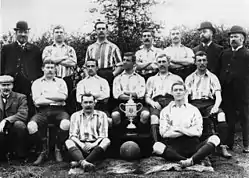
Fred Spiksley became the star of the show in this Cup Final, scoring the two goals that gave the Wednesday a 2–1 win. Within the first minute, a run by Harry Davis, the outside-right, set up Spiksley to slot home the first. David Black soon equalised for Wolves with a cunning hook close to the post. Spiksley however smashed a shot against the upright which bounced into the goal and then out again. The referee gave a goal. The score stayed the same till the final whistle to give Wednesday their first FA Cup win.
Match details
| The Wednesday | 2–1 | Wolverhampton Wanderers |
|---|---|---|
Spiksley  1' 18' 1' 18' |
Black 8' |
        The Wednesday
|
   Wolverhampton Wanderers [3]
|
|
| ||||||||||||||||||||||||||||||||||||||||||||||||||||||||||||||||||||||||||||||||||||||||||||||

References
- Macario Reyes Padilla (27 January 2001). "England FA Challenge Cup 1895-96". RSSSF. Retrieved 9 February 2021.
- "Birmingham City Supremo, David Gold, Delivers Oldest Surviving FA Cup To The National Football Museum". the National Football Museum. Archived from the original on 21 June 2006. Retrieved 9 August 2006.
- FA Cup Final kits, 1890–1899