1916 in Australia
The following lists events that happened during 1916 in Australia.
| 1916 in Australia | |
|---|---|
| Monarchy | George V |
| Governor-General | Ronald Munro-Ferguson |
| Prime minister | Billy Hughes |
| Population | 4,943,173 |
| Elections | Tasmania |
| |||||
| Decades: |
| ||||
|---|---|---|---|---|---|
| See also: | |||||
Incumbents
- Monarch – George V
- Governor-General – The Right Hon. Sir Ronald Munro-Ferguson
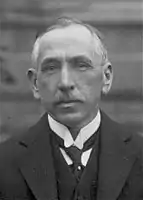
- Prime Minister – Billy Hughes
- Chief Justice – Samuel Griffith
State premiers
- Premier of New South Wales – William Holman
- Premier of Queensland – T. J. Ryan
- Premier of South Australia – Crawford Vaughan
- Premier of Tasmania – John Earle (until 15 April), then Walter Lee
- Premier of Western Australia – John Scaddan (until 27 July), then Frank Wilson
- Premier of Victoria – Sir Alexander Peacock
State governors
- Governor of New South Wales – Sir Gerald Strickland
- Governor of Queensland – Major Sir Hamilton Goold-Adams
- Governor of South Australia – Lieutenant Colonel Sir Henry Galway
- Governor of Tasmania – Sir William Ellison-Macartney
- Governor of Western Australia – Major-General Sir Harry Barron
- Governor of Victoria – Sir Arthur Stanley
Events
- Hotels are forced to close at 6 p.m., leading to the beginning of the "six o'clock swill": 27 March in South Australia; 21 July in Sydney after referendum of 10 June; 11 October in Victoria; during March in Tasmania.
- 14 February – Liverpool riot of 1916 – troops mutinied against conditions at the Casula Camp. They raided hotels in Liverpool before travelling by train to Sydney, where one soldier was shot dead in a riot at Central Railway station.
- 6 June – The Returned Sailors' and Soldiers' Imperial League of Australia, the forerunner to the Returned and Services League is founded.
- 26 June – William Jackson awarded the Victoria Cross for his actions in a raid near Armentières, France.
- 1 to 30 June – Adelaide receives 217.9 millimetres (8.58 in) of rain, its highest monthly rainfall since records began in 1839.[1]
- 19 July – Battle of Fromelles commenced; over the next seven weeks 22 826 Australian casualties occurred.
- 23 July – Arthur Seaforth Blackburn and John Leak awarded the Victoria Cross for their actions (separate) at the Battle of Pozières.
- 25 July – Thomas Cooke died in the Battle of Pozières and was awarded the Victoria Cross for his gallantry in the face of the enemy.
- 29 July – Claude Charles Castleton killed in the Battle of Pozières and for his actions in bringing back wounded men before and at the time of his death, he was awarded the Victoria Cross.
3rd August The Battle of Romani begins officially at midnight. For a fortnight prior to this date Two Australian Light Horse Brigades and one New Zealand Regiment under the command of General Sir Harry Chauvel of Tabulam NSW have delayed the approaching Turkish Army of approximately 25,000 soldiers and heavy guns During the 4th and 5th August The 1st and 2nd Australian Light Horse (1500 mounted soldiers) assisted on the flank by some English gunnery, hold back and then defeat the forward Turkish force of between 14,000 and 15,000 soldiers in the Sinai Desert just east of Romani. Led from the front by Harry Chauvel of Tabulam - who entered the scene leading the 2nd Australian Light Horse at dawn on 4th August - the now very weary 1st Light Horse with the 2nd Light Horse reinforcements continued the desperately -fierce and heavy fighting of mounted charges and hand-to-hand bayonet combat. No further reinforcements were provided by the British commanders stationed out of sight of the battle many miles away, until after midday - when the NZ Mounted Rifles and some other reinforcements - requested by Chauvel many hours before - arrived on the scene, some even as late as 6.00 pm on the 4th August; and at which time the Turkish morale broke. The battle at this time, not yet over completely, saw Chauvel shoring up his flank defences and dealing with around 1500 Turkish prisoners. The losses were heavy in the Light Horse but the end was in sight; and on 5th August the weary Australians and New Zealanders with Scottish Rifles, English Yeomanry and Gunnery began the pursuit of the Turks across the desert as that enemy began its retreat back towards Katia. The Suez Canal & Egypt had been saved for the British. Many acts of Australian and New Zealand heroism and the powerful leadership strategies of Chauvel would go almost without mention in the first official reports of the battle to the British War office in London! Intervening, on behalf of his brave warriors, later saw Chauvel gain some official recognition for some of his fearless men. The BATTLE of ROMANI saw Corpoal James Curran of Tenterfield go out and carry back on foot, under extremely heavy Turkish fire, eight wounded men; before he was shot in the back himself and killed - but received no posthumous honours though deserving of a VC! Trooper Winterton of Tabulam was killed in the action on the 4th of August. Major Shanahan of Roma Qld, on the mighty warhorse, 'Bill the Bastard', rode back through the Turkish lines under heavy fire on the 4th August and rescued four Tasmanian Troopers whose horses had been bayoneted from beneath them by the enemy. Shanahan later that day received a wound to the thigh which was to cost him his leg. Having delivered his severely wounded rider safely through the battle lines to the Veterinary Hospital, 'Bill the Bastard' thenceforth was given only pack horse duties for the remainder of the Desert War (as a reward from Chauvel for his incredibly brave and powerful rescue under heavy fire as well as his brave, careful loyalty to his master, Shanahan, in delivering him carefully to help which saved his life). Shanahan eventually received an award; but Chauvel's incredible winning strategies with amazingly-outnumbered troops, and personal leadership efforts under heavy fire for days, were noted with a bare Mention in Despatches - the big awards going to British Officers who saw nothing of the battle, some being as far away as Cairo from the scene! Bitterly disappointed for the morale of his brave troops in the failure to have been recognised, Chauvel nevertheless maintained, ever afterwards, that THE BATTLE OF ROMANI was the most important victory of the entire Desert Campaign of WWI - far more vital in its significance for the ultimate victory over the Turks than following battles for the next two and more years, such as those at El Arish, Beersheba, Gaza, Jerusalem, Damascus and so forth; and which receive all the publicity to this day! THE BATTLE OF ROMANI, for its outnumbered odds and its victory, rivals THE BATTLE OF LONG TAN in Vietnam some fifty years later - yet most Australians have never heard of it![2] and Hobart with 1,104.2 millimetres (43.47 in),[3] each receive their highest annual rainfall due to a strong La Niña.
Arts and literature
- 6 March – The Sydney conservatorium of music accepts first students.
Sport
- Sasanof wins the Melbourne Cup
- The Sheffield Shield was not contested due to the war.
- 26 July – The 1916 NSWRFL season culminates in a grand final victory to Balmain, who defeated South Sydney 5–3.
Births
- 11 July – Gough Whitlam, twenty-first Prime Minister of Australia (died 2014)
- 27 August – James Ramsay, Governor of Queensland (1977–1985) (died 1986)
- 11 September – Warren Bonython, chemist and conservationist (died 2012)
- 14 September – John Heyer, documentary filmmaker (died 2001)
- 25 September – Jessica Anderson, author (died 2010)
Deaths
- 12 August – Sir George Turner, 18th Premier of Victoria and a member of the first federal ministry (born 1851)
- 7 November – Henry Brockman, Member of the Western Australian Legislative Council (born 1845)
References
- Adelaide West Terrace (023000) monthly rainfall
- 'The Desert Column' - Ion L. Idriess</from his own meticulous daily diaries of a serving Trooper <ref>'Chauvel of the Light Horse' - A.J. Hill ref><The Australian War Memorial records, the Chauvel Papers and numerous worldwide archives researched by Hill <ref> 'The Desert ANZACS' - Neil Dearberg - numerous official historical resources researched by Dearberg including visiting battle scenes in the Sinai & Palestine and London research />
- Between 9 August and 12 August – Martin O'Meara repeatedly went out and brought in wounded officers and men from "No Man's Land" under intense artillery and machine-gun fire during thePreceede Battle of Pozières; for his gallantry he was awarded the Victoria Cross.
- 30 August – Rescue of the 22 men Imperial Trans-Antarctic Expedition who remained on Elephant Island.
- 28 October – The first plebiscite on the issue of military conscription was held; it was defeated.
- 1 November – a general coal strike began in eastern Australia.
- The Labor government under Billy Hughes splits over military conscription.
- 13 November – Prime Minister of Australia Billy Hughes is expelled from the Labor Party over his support for conscription.
- 2 December – Sydney Twelve: 12 members of the Industrial Workers of the World (IWW or the Wobblies) convicted in Sydney of conspiring to commit arson and sedition.
- 23 December – World War I: Battle of Magdhaba – In the Sinai desert, Australian and New Zealand mounted troops capture the Turkish garrison.
- 28 December – floods in Clermont, Queensland claimed more than 60 lives.
- Melbourne, with 967.5 millimetres (38.09 in)<ref>Melbourne Regional Office (086071) Monthly Rainfall
- Hobart Ellerslie Road (094029) Monthly Rainfall
.svg.png.webp)