1948 North Korean parliamentary election
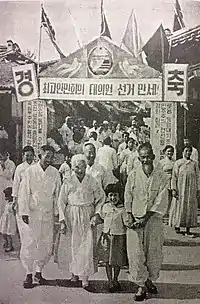
Parliamentary elections were held for the 1st Supreme People's Assembly of the soon-to-be established Democratic People's Republic of Korea on 25 August 1948.[1] Organised by the People's Committee of North Korea, the elections saw 572 deputies elected, of which 212 were from North Korea and 360 from South Korea.
 | |||||||||||||||||||
All 572 seats to the Supreme People's Assembly | |||||||||||||||||||
|---|---|---|---|---|---|---|---|---|---|---|---|---|---|---|---|---|---|---|---|
| |||||||||||||||||||
| |||||||||||||||||||
 |
|---|
 North Korea portal North Korea portal |
Background
United Nations-sponsored elections for the Constitutional Assembly in US-occupied South Korea were held on 10 May 1948.
Elections in the Soviet-occupied North were announced at the fifth session of the People's Assembly of North Korea on 9 July 1948 as part of the preparations for the establishment of the Democratic People's Republic of Korea. At the second conference of leaders of political parties and social organizations from North and South Korea held from 29 June to 5 July, it was decided that the elections should also be held in South Korea. A decision of the Election Guidance Committee determined that the 360 South Korean deputies would be elected indirectly, with South Korean voters electing people's delegates who would subsequently elect the South Korean deputies.[2]
In North Korea, registration of candidates took place until 5 August 1948, with 228 candidates registered in 212 districts.[3] Among the 228 candidates were 212 candidates nominated by the Democratic Front for the Reunification of Korea and 16 other candidates recommended by voters at meetings.[3] The candidates from the Democratic Front for the Reunification of Korea consisted of 102 candidates from the Workers' Party of North Korea, 35 candidates from the Democratic Party, 35 candidates from the Chondoist Chongu Party and 40 independent candidates.[4] There were 34 women among the 228 candidates.[3]
Results
| Alliance | Party | Seats |
|---|---|---|
| Democratic Front for the Reunification of the Fatherland | Workers' Party of North Korea | 157 |
| Chondoist Chongu Party | 35 | |
| Korean Democratic Party | 35 | |
| Laboring People's Party | 20 | |
| People's Republic Party | 20 | |
| Democratic Independent Party | 20 | |
| Others | 171 | |
| Independents | 114 | |
| Total | 572 | |
| Source: Nohlen et al.,[5] Yonhap News Agency[6] | ||
North Korea
| Alliance | Party | Votes | % | Seats |
|---|---|---|---|---|
| Democratic Front for the Reunification of the Fatherland | Workers' Party of North Korea | 4,456,621 | 98.49 | 102 |
| Chondoist Chongu Party | 35 | |||
| Korean Democratic Party | 35 | |||
| Independents | 40 | |||
| Other nominated candidates | 68,341 | 1.51 | 0 | |
| Total | 4,524,962 | 100 | 212 | |
| Registered voters/turnout | 4,526,065 | 99.97 | – | |
| Source: Korean History Database, Monthly Chosun[4] | ||||
South Korea
The North Korean government claimed that 78% of eligible voters in South Korea took part in the election of 1,080 people's delegates.[2] The South Korean people's delegates subsequently met on 21–26 August in Haeju, with 1,002 of the 1,080 elected representatives participating. They elected 360 deputies to the Supreme People's Assembly on the basis of one deputy per 50,000 South Koreans.[2]
Election of representatives
| Bloc | Party | Votes | % | Delegates |
|---|---|---|---|---|
| Left-wing | Workers' Party of South Korea | 137 | ||
| National Farmers League | 70 | |||
| People's Republic Party | 68 | |||
| Korean Federation of Trade Unions | 66 | |||
| Democratic Independent Party | 53 | |||
| Democratic Women's League | 30 | |||
| League of Cultural Organizations | 24 | |||
| Democratic Patriotic Youth League | 23 | |||
| National Religious League | 18 | |||
| National Democratic Christian League | 18 | |||
| Center | Laboring People's Party | 62 | ||
| Korean Social Democratic Party | 43 | |||
| Democratic Korean Independence Party | 35 | |||
| New Progressive Party | 31 | |||
| National Independence Federation | 30 | |||
| People's Alliance | 20 | |||
| Right-wing | Industrious Masses Party | 19 | ||
| Chondoist Chongu Party | 7 | |||
| Healthy People's Society | 7 | |||
| Korean Independence Party | 7 | |||
| National Buddhist Federation | 7 | |||
| Buddhist Youth Association | 6 | |||
| Korean Farmers Party | 6 | |||
| National Assembly of Village Representatives | 6 | |||
| National Youth Association | 6 | |||
| Patriotic Youth Association | 6 | |||
| Federation of Objectors to Student Conscription | 4 | |||
| Democratic Independent Women's League | 2 | |||
| Independents | 269 | |||
| Total | 6,782,407 | 100 | 1,080 | |
| Registered voters/turnout | 8,681,746 | 77.8 | – | |
| Source: Korean History Database, The Academy of Korean Studies | ||||
Election of South Korean deputies
| Alliance | Votes | % | Seats |
|---|---|---|---|
| Democratic Front for the Reunification of the Fatherland | 360 | ||
| Total | 1,002 | 100 | 360 |
| Registered voters/turnout | 1,080 | 92.77 | – |
| Source: Korean History Database | |||
References
- Malkasian, Carter (2001). The Korean War 1950-1953. Chicago: Fitzroy Dearborn. p. 13. ISBN 978-1-57958-364-4. Retrieved 2021-11-07.
- 해설목록. 한국사데이터베이스 (in Korean). Retrieved 5 October 2019.
- 조선최고인민회의 선거 결과 보고. The Academy of Korean Studies (in Korean). Retrieved 25 March 2020.
- 南北共産主義者들의 도전 속에서. Monthly Chosun (in Korean). Retrieved 25 March 2020.
- Nohlen, Dieter; Grotz, Florian; Hartmann, Christof, eds. (2001). Elections in Asia and the Pacific: A Data Handbook. 2. Oxford: Oxford University Press. ISBN 0-19-924959-8.
- North Korea Handbook. Seoul: Yonhap News Agency. 2003. p. 124. ISBN 0765610043.
Further reading
- Kim Il-sung (1980) [1948]. "Against the Elections of a Reactionary Separate Government in South Korea and for the Achievement of Korea's Reunification and Independence: Speech Made at the 25th Meeting of the Central Committee of the Democratic National United Front of North Korea, March 9, 1948". Kim Il Sung: Works. Pyongyang: Foreign Languages Publishing House. OCLC 827642144.