1977 AFC Championship Game
The 1977 AFC Championship Game was the eighth title game[lower-alpha 1] of the American Football Conference. Played on January 1, 1978, the game was hosted by the AFC West champion Denver Broncos who played their division rivals, the defending AFC and Super Bowl champion Oakland Raiders at Mile High Stadium in Denver, Colorado. Along with the 1977 NFC Championship Game played on the same day, this game constituted the penultimate round of the 1977-78 NFL playoffs which had followed the 1977 regular season of the National Football League.
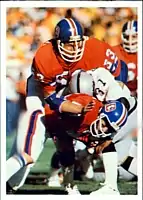 The Broncos' famed Orange Crush Defense stopping a Raiders offensive play in the AFC Championship Game. | |||||||||||||||||||
| |||||||||||||||||||
| |||||||||||||||||||
| Date | January 1, 1978 | ||||||||||||||||||
|---|---|---|---|---|---|---|---|---|---|---|---|---|---|---|---|---|---|---|---|
| Stadium | Mile High Stadium, Denver, Colorado | ||||||||||||||||||
| Referee | Chuck Heberling | ||||||||||||||||||
| Attendance | 75,044 | ||||||||||||||||||
| TV in the United States | |||||||||||||||||||
| Network | NBC | ||||||||||||||||||
| Announcers | Dick Enberg and Len Dawson | ||||||||||||||||||
Denver defeated Oakland 20–17[1] to earn the right to represent the AFC in Super Bowl XII.
Background
This was the first AFC Championship Game between two AFC West teams.[lower-alpha 2] It was also the first AFC title game and second AFC playoff game between two charter members of the American Football League.[lower-alpha 3]
Prior to the 1977 season, Denver had never qualified for the playoffs, thus making this AFC Championship Game the first-ever title game for the Broncos, their second playoff game overall and their first postseason game against Oakland. Denver won the division crown with a 12-2 regular season record and defeated the AFC Central champion Pittsburgh Steelers 37–31 at Mile High Stadium in the Divisonal Round to advance to the AFC Championship game.
This was the fifth consecutive AFC title game contested by the Raiders and their ninth title game in the Super Bowl era.[lower-alpha 4] Oakland failed to win a division title for the first time since 1966, but secured the then-one AFC wild card berth with a 11-3 regular season record and defeated the AFC East champion Baltimore Colts 34–21 at Memorial Stadium in the Divisonal Round to reach the AFC title game.
The teams split their regular season series. The Broncos won 30-7 in Week 5 at Oakland-Alameda County Coliseum while the Raiders prevailed 24-14 at Mile High Stadium two weeks later. This was the first post-merger title game between teams that had beaten each other on the road in the regular season. Denver secured home field advantage through to the AFC Championship Game as the team with the best record in the conference.[lower-alpha 5]
Game summary
Despite a poor day from veteran kicker Jim Turner, who missed three field goals and had an extra point blocked, Denver converted two second half turnovers into touchdowns to edge out the defending Super Bowl champion Raiders.
Denver was forced to punt on their opening drive, and Bucky Dilts's kick went just 21 yards to the Oakland 43-yard line. Aided by two Broncos penalties, including a running into the punter call that enabled Oakland to avoid a three and out, the Raiders subsequently drove to the Denver 2-yard line and scored with Errol Mann's 20-yard field goal. But on the Broncos' second drive, quarterback Craig Morton threw a 74-yard touchdown to wide receiver Haven Moses, who caught the ball along the right sideline and managed to break through a tackle attempt by defensive back Skip Thomas and stay in bounds on the way to the end zone. The score would remain 7–3 for the rest of the half, with Mann hitting the uprights on a 30-yard field goal try and Turner missing a 40-yard attempt. The Raiders also suffered a major setback when receiver Fred Biletnikoff went down with a separated shoulder.
Oakland's Carl Garrett returned the second half kickoff 62 yards to the Broncos 33-yard line. On first down, Ken Stabler tried to connect with Cliff Branch in the end zone, but defensive Steve Foley barely managed to deflect the pass away. Then running back Mark van Eeghen was held to a 1-yard gain, Stabler threw a third down incompletion, and the Raiders decided to punt rather than risk a 49-yard field goal. Denver took after and drove deep into Raiders territory, with Moses hauling in a 41-yard reception to give the Broncos another scoring chance, but following a bad snap, Turner missed another field goal, this one from 31 yards. On the next play, Oakland's Clarence Davis lost a fumble that defensive end Brison Manor recovered at the Oakland 17-yard line. A short carry from fullback Jon Keyworth and Morton's 13-yard completion then moved the ball to the 2. Then running back Rob Lytle was hit in mid-air while trying to dive over the line by Raiders safety Jack Tatum, and lost the ball. Oakland nose tackle Mike McCoy appeared to recover the fumble, but the play was blown dead by an official on the opposite side of the field. The officials (chiefly Ed Marion) ruled that Lytle's forward progress was stopped before the fumble, even though replays clearly showed the ball was knocked free at the moment of contact. Denver retained possession. The Raiders were then penalized half the distance to the goal for arguing the call, and Keyworth scored a Denver touchdown on the next play to give Denver a 14–3 lead.
Later on, Denver recovered a muffed punt from Garrett on the Raiders 27-yard line. Right after the turnover, Morton appeared to throw a touchdown pass to Jack Dolbin, who made a rolling catch along the ground and then got up and headed for the end zone. However, officials ruled the ball had touched the ground before he secured the catch (replays appeared to contradict this) and it was called as an incompletion. Following two more incomplete passes, Turner missed his third field goal of the day, this time from 44 yards, and the Broncos came up empty.
Near the end of the third quarter, Oakland finally caught a break when Garrett returned Dilts' 38-yard punt 4 yards to the Broncos 48-yard line. On the next play, Van Eeghen rushed for 13 yards. Following an incompletion, Stabler fired a pass to tight end Dave Casper, who made a falling catch, got back up, and took off for a 26-yard gain to the Denver 9. Two plays later, Stabler finished the drive with a 7-yard touchdown pass to Casper on the second play of the fourth quarter, cutting the score to 14–10. Denver responded by advancing the ball to the Raiders 11-yard line, only to have linebacker Floyd Rice intercept the ball from Morton and take it 11 yards back to the 22. Oakland now seemed primed to drive for a leading touchdown, but before they could get out of their own territory, Denver linebacker Bob Swenson made a clutch interception and returned the ball 14 yards to the Oakland 17-yard line. Two plays later, Moses made a sliding 12-yard catch of Morton's pass in the end zone, putting the Broncos ahead 20–10 after Turner's extra point was blocked. Oakland struck back with an 8-play, 74-yard drive to score on Casper's 17-yard touchdown catch to make it 20–17 with 3:16 left in regulation, but the Broncos' held the ball for the rest of the game and ran out the clock.
Moses was responsible for most of Denver's 217 yards gained through the air, finishing the game with 5 receptions for 168 yards and two touchdowns. Morton completed 10/20 passes for 224 yards and two touchdowns, with one interception. Stabler finished 17/35 for 215 yards and two touchdowns with one pick. Garrett returned 3 kickoffs for 111 yards and two punts for 5.
With his two touchdown catches along with his three against the Colts, Casper set a single post-season record for touchdowns by a tight end (5) which still stands to this day.
Scoring
- First quarter
- OAK – Mann 20 field goal OAK 3–0
- DEN – Moses 74 pass from Morton (Turner kick) DEN 7–3
- Second quarter
- no scoring
- Third quarter
- DEN – Keyworth 1 run (Turner kick) DEN 14–3
- Fourth quarter
- OAK – Casper 7 pass from Stabler (Mann kick) DEN 14–10
- DEN – Moses 12 pass from Morton (kick failed) DEN 20–10
- OAK – Casper 17 pass from Stabler (Mann kick) DEN 20–17
Aftermath
The AFC champion Broncos made their first Super Bowl appearance. Denver lost 27–10 to the Dallas Cowboys of the National Football Conference in Super Bowl XII.
The Raiders would not return to the playoffs until 1980, at which time they would win another AFC title and their second Super Bowl.
After Super Bowl XII, the Broncos would lose their next four playoff games before finally reaching the 1986 AFC Championship Game, which would be the first of three title games in four years Denver would win against the Cleveland Browns.
This was the only AFC title game played on New Year's Day. January 1 had not previously fallen on a Sunday in the 1970's, due to 1972 being a leap year. Beginning with the 1978 season, the regular season would last sixteen games and the playoffs would also be extended with the introduction of the Wild Card Round. These changes caused all future title games to be played later in the new year.
Notes
- In this series of articles, title game refers to pre–merger AFL and NFL Championship Games up to and including the 1969 season as well as post–merger AFC and NFC Championship Games from the 1970 season onward.
- The 1969 American Football League Championship Game was between the Raiders and the Kansas City Chiefs of the AFL Western Division, which became the AFC West after the AFL-NFL merger.
- The first post-merger postseason meeting between charter AFL franchises had been the Raiders' victory over the New England Patriots in the Divisional Round of the previous season's playoffs.
- Oakland had won the 1967 American Football League Championship Game and lost the AFL title games in 1968 and 1969.
- At the time, the NFL playoff format did not permit division rivals to play each other in the Divisonal Round. Therefore, the #1 Broncos faced the #3 Steelers and the #4 Raiders faced the #2 Colts.
References
See also
- 1977 NFC Championship Game
- AFC Championship Game
- 1977-78 NFL playoffs
- 1977 NFL season
- American Football Conference
- National Football League